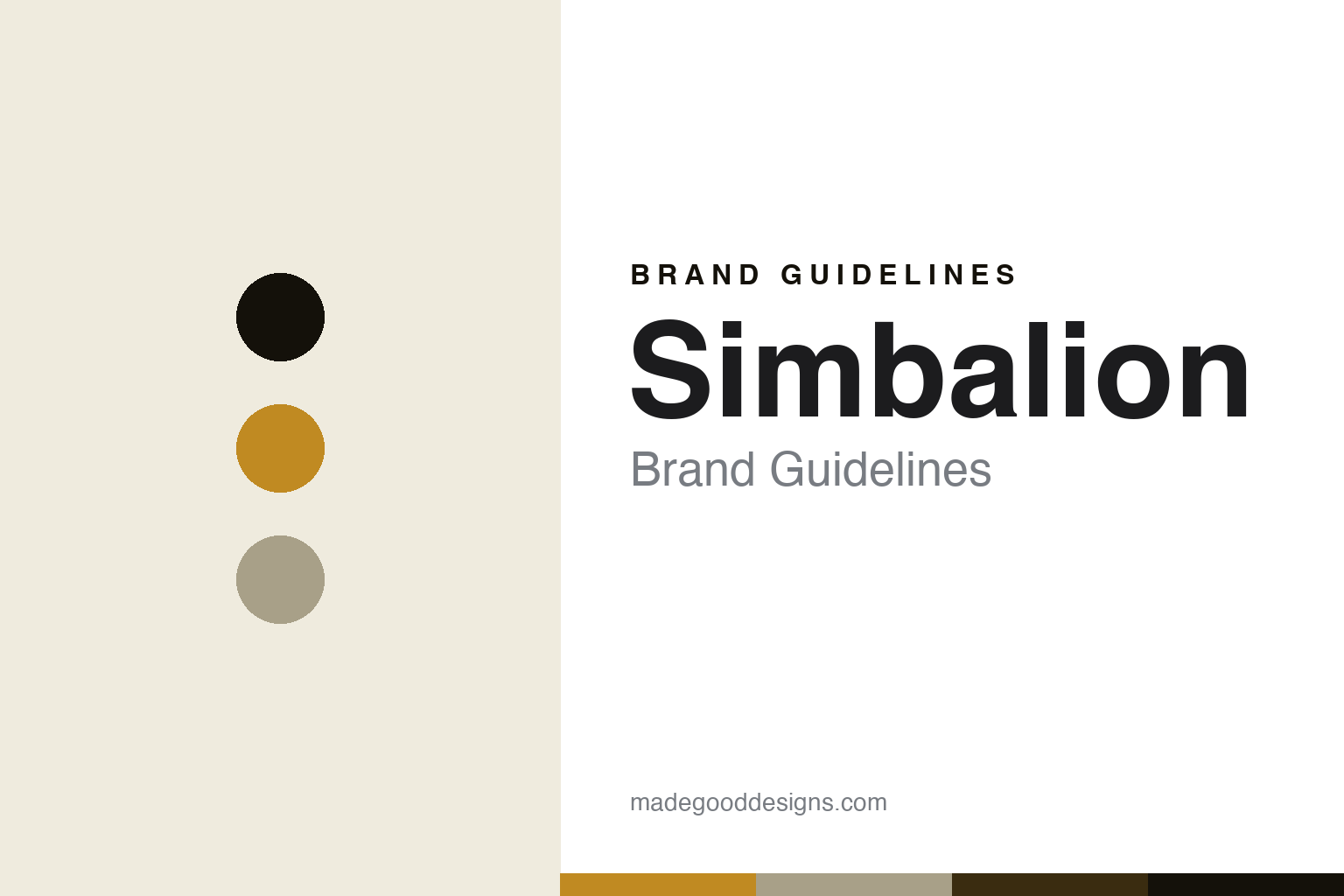
Simbalion Brand Guidelines
Taiwan’s lion pencil.
Aa
Two constants: a lion-gold palette and an art-sans register. Abstract homage — not a Simbalion colour, label, barrel or lion mark.
Taiwan’s lion pencil
Simbalion is Taiwan’s “lion” art-and-stationery house since 1956, a household name for crayons, markers and colour made in Taiwan and China.
Simbalion is a lesson in how a colour core anchors a whole art-supply house. Trading under a lion — its Chinese name means “male lion,” and its English arm is “Lion Pencil” — Simbalion is a Taiwanese household name for crayons, markers, watercolours, poster colours and coloured pencils, the art supplies generations of Taiwanese schoolchildren grew up with. Its answer to how a colour is made a business is broad: make dependable, colourful art materials for schools and hobbyists across every medium. A colour core under a lion’s mark.
Its identity is the Taiwanese art-supply house. Simbalion’s crayons, markers and coloured pencils are the work it is known for. A core, one of a wide range. A lion-branded staple of Taiwanese classrooms.
(Honest notes, so the story stays precise. Simbalion is a Taiwanese company — its legal English name is Lion Pencil Co., its Chinese name uses the character for “male lion” — with its headquarters in Banqiao, New Taipei. On manufacture, we are honest: production is split between Taiwan (a modern factory in Longtan, Taoyuan) and China (a large factory in Kunshan, Jiangsu, since 2000), so we say “made in Taiwan and China” rather than claim everything is Taiwan-made. It was founded in 1956 by Li Amu (with trading roots reaching back to 1934), and it remains a private, family-run company. It is a broad, mass-market art and stationery house — not a premium fine-art marque — and its coloured pencils and watercolour pencils are one part of a wide catalogue. Its name, the lion logo and its line names are its IP, described but never reproduced, and there is no official brand hex — these tones are an unofficial interpretation. This is design commentary and does not promote any product.)
Colour
Simbalion lives in a lion-gold palette. Click a swatch to copy the hex.
Simbalion’s identity is bright, broad and Taiwanese — a lion gold, an ink, a sand, a bronze, and a paper. The palette leans lion gold and sand: the register of a lion mark and a colourful school art box. It signals warmth and range over prestige. The honest caveat: with no published brand hex, these values are an original, unofficial interpretation, not first-party colours — an abstract nod to a lion’s gold, not a sampled pencil or the actual logo.
The lesson is a lion-gold palette signals a broad art-supply identity. Simbalion’s world is a bright, mass-market, art-and-school object. For designers, it is a reminder that a warm gold and a soft sand can carry a brand built on a whole art box — the gold of a lion mark and the neutral of school paper. Because these tones can fail as small text, keep type dark and let the colour live in the accents, palette and band. The takeaways: cover the media; keep it colourful; be honest about where it is made; and treat any single hex as unofficial.
Typography
The register is an art sans — friendly, bright, capable.
Simbalion’s identity carries a friendly, bright, capable spirit — a broad art-supply house, not a fine-art marque. An art sans captures the mood: warm, clear and versatile, the register of a colourful school brand. Set in a lion-gold palette, the art sans feels friendly and bright — exactly the personality Simbalion carries. It is capable rather than austere, mirroring a wide art range. (Simbalion’s real labels, the lion mark and line names are things we describe but do not reproduce, and the exact typeface is not ours to use.) Because it is not ours to use, the honest description is “an art-sans spirit,” shown here in a stand-in. The type behaves like the house: friendly, bright and capable.
Aa
An art-sans spirit — friendly and bright. (Specimen set in Mulish, an art-sans STAND-IN; NOT the Simbalion wordmark or lion mark.)
The national pencil
Simbalion stands for the colourful art house of a nation.
Simbalion is a lesson in how a colour core lives inside a broad art identity. A lion-gold palette, an art sans and a colourful line-up make one thing — the art supplies a country grows up with — the whole house: bright, broad and Taiwanese. The range across media is the differentiator, and the national familiarity is the meaning. The point is a lion-branded house that owns the Taiwanese art box, from crayons to coloured pencils, rather than the professional studio.
Put to work, the identity is breadth as design. An art house in this spirit would make colour across many media, own its mass-market school role, and be honest about geography — a Taiwanese company that manufactures in both Taiwan and China. A brand learning from it would see that a broad, colourful art-supply identity is durable — that being the art box of a nation’s childhood is a real bond — and that being precise, founded 1956, a lion mark, made in Taiwan and China, keeps the story honest. A brand learning from it would also let a memorable mark, the lion, carry a wide range coherently. A brand learning from it would also see the value of a single strong emblem across dozens of products: a lion on a crayon, a marker and a coloured pencil ties an otherwise sprawling catalogue into one recognisable family, so a child who trusts the crayon reaches for the pencil, and a school that stocks one Simbalion product tends to stock the rest. The lesson Simbalion teaches is that breadth can hold an identity: the range gives it reach, and the lion mark gives it a face. The colour is the personality, and the art box is the proof.
For designers and brand-builders, Simbalion holds the art-house pole in this round of the national pencil, from Taiwan: make colour across every medium, and be honest about geography. The lessons: cover the media; own the school role; disclose where you manufacture; let a mark unify the range; and never reproduce a protected logo. It is also a reminder to stay precise: Simbalion is Taiwan’s lion art-and-stationery house since 1956, made in Taiwan and China — with the palette here an unofficial interpretation. Simbalion made the lion and the whole art box the identity — proof that breadth, honestly told, can be the difference.
Explore & save
Keep Simbalion’s identity on hand — save it to a board in the Made Good inspiration library.
Simbalion identity set
Pin the lion-gold palette and the art-sans register to your own board.