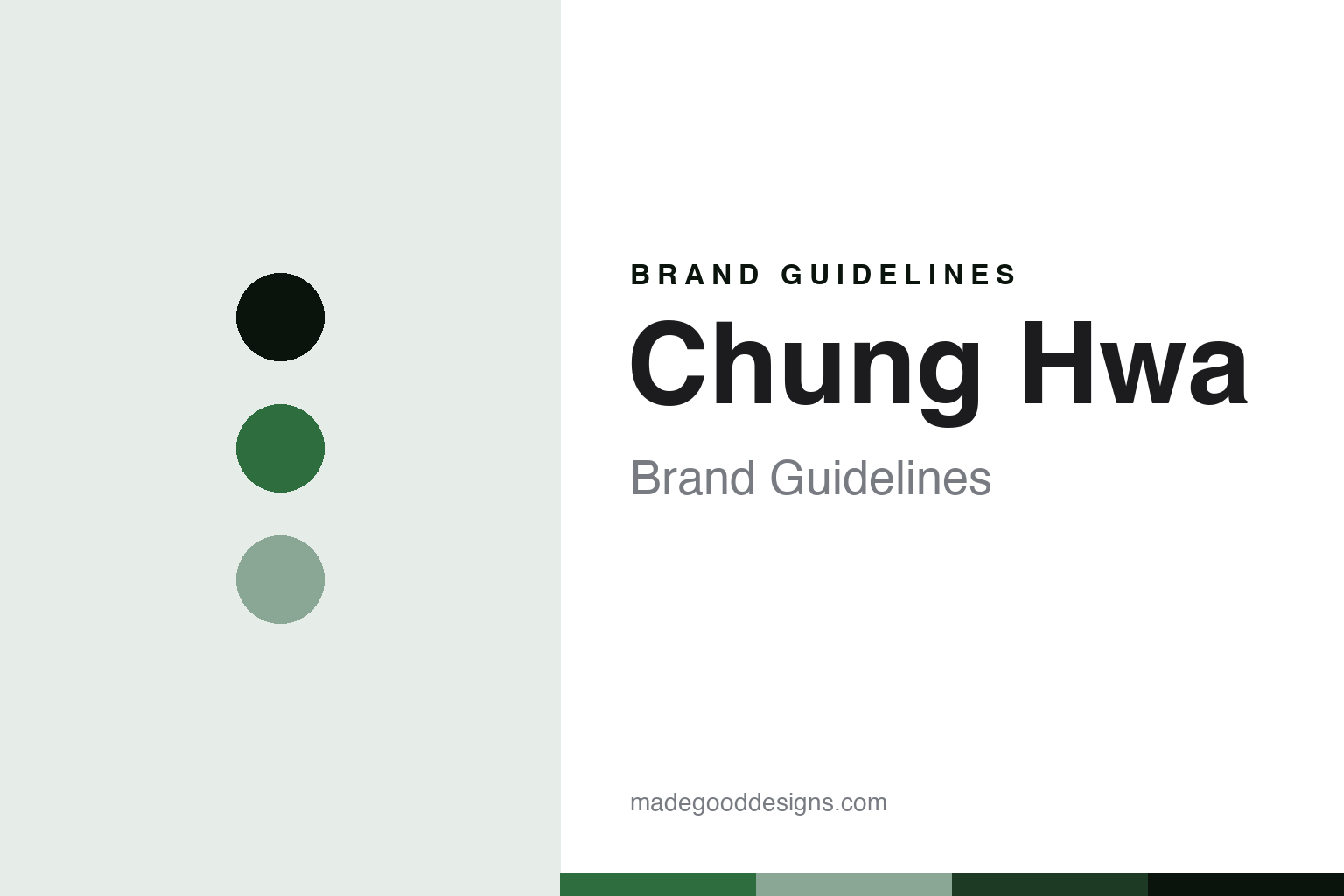
Chung Hwa Brand Guidelines
China’s exam pencil.
Aa
Two constants: a pencil-green palette and a national-sans register. Abstract homage — not a Chung Hwa colour, label, barrel or livery.
China’s exam pencil
Chung Hwa is China’s iconic everyday graphite pencil since 1935, made in Shanghai and now a subsidiary of the Lao Feng Xiang group.
Chung Hwa is a lesson in how a graphite core becomes a national object. For generations of Chinese students, workers and draughtsmen, the everyday pencil was a Chung Hwa — the red-and-black 6151 and the green drawing pencil — the graphite core a whole country wrote, sketched and sat exams with. Its answer to how a pencil is made a national tool is scale and consistency: make a dependable graphite pencil, affordable and everywhere, and become the default. A core that a nation grew up on.
Its identity is China’s everyday graphite pencil. Chung Hwa’s 6151, its green drawing pencil and its exam pencils are the work it is known for. A core, made ubiquitous. A pencil woven into how China learns and works.
(Honest notes, so the story stays precise. Chung Hwa (Zhonghua, meaning “China”) is the flagship brand of China First Pencil Co., made in Shanghai, with production bases in the Shanghai area and in Jiangsu and Jilin. It was founded in 1935 as China’s first domestically owned pencil factory. Two important corrections: its founder was Wu Gengmei, the industrial chemist nicknamed the “Pencil King” — not Wu Yun-chu, a different industrialist with whom he is often confused; and on corporate structure, the historically listed pencil company renamed itself Lao Feng Xiang, a jewellery company, in 2009, so the pencil business today operates as a subsidiary of the Lao Feng Xiang group rather than as a listed pencil company. Its most documented model is the red-and-black 6151, with a green-liveried drawing pencil for draughtsmen; it also makes coloured pencils and is heavily marketed as the exam pencil for China’s gaokao. The name Zhonghua literally means “China,” a nationally resonant term we treat respectfully. Its name, its liveries and marks are its IP, described but never reproduced, and there is no official brand hex — these tones are an unofficial interpretation. This is design commentary and does not promote any product.)
Colour
Chung Hwa lives in a pencil-green palette. Click a swatch to copy the hex.
Chung Hwa’s identity is everyday, national and enduring — a pencil green, an ink, a sage, a pine, and a paper. The palette leans pencil green and sage: the register of the classic green drawing pencil and a national everyday tool. It signals ubiquity and heritage over prestige. The honest caveat: with no published brand hex, these values are an original, unofficial interpretation, not first-party colours — an abstract nod to a famous green livery, not a sampled pencil.
The lesson is a pencil-green palette signals an everyday, made-in-Shanghai identity. Chung Hwa’s world is an accessible, ubiquitous, Chinese-made object. For designers, it is a reminder that a classic green and a soft sage can carry a brand built on being a nation’s pencil — the green of a draughtsman’s pencil and the neutral of exam paper. Because these tones can fail as small text, keep type dark and let the colour live in the accents, palette and band. The takeaways: make it dependable; make it everywhere; treat a national name with respect; and treat any single hex as unofficial.
Typography
The register is a national sans — plain, solid, ubiquitous.
Chung Hwa’s identity carries a plain, solid, ubiquitous spirit — a national everyday brand, not a boutique. A national sans captures the mood: even, dependable and familiar, the register of a pencil in every Chinese pencil case. Set in a pencil-green palette, the national sans feels plain and solid — exactly the personality Chung Hwa carries. It is ubiquitous rather than exclusive, mirroring an everyday graphite core. (Chung Hwa’s real liveries, labels and marks are things we describe but do not reproduce, and the exact typeface is not ours to use.) Because it is not ours to use, the honest description is “a national-sans spirit,” shown here in a stand-in. The type behaves like the brand: plain, solid and ubiquitous.
Aa
A national-sans spirit — plain and solid. (Specimen set in Space Grotesk, a national-sans STAND-IN; NOT the Chung Hwa wordmark or any livery.)
The national pencil
Chung Hwa stands for the graphite core of a nation.
Chung Hwa is a lesson in how a graphite core becomes a country’s default. A pencil-green palette, a national sans and a dependable core make one thing — the pencil a nation writes and sits exams with — the whole brand: everyday, national and enduring. The ubiquity is the differentiator, and the heritage as China’s first domestic pencil is the meaning. The point is a pencil made ordinary on purpose, from a factory founded in 1935 to prove China could make its own.
Put to work, the identity is national ubiquity as design. A pencil house in this spirit would compete on dependability and reach, honour its founding as a point of national pride, and be precise about its history and structure. A brand learning from it would see that being a nation’s everyday pencil is a powerful identity — that the pencil a whole country grew up with earns a familiarity no premium marque can buy — and that being precise, founded 1935 by Wu Gengmei the “Pencil King,” now a subsidiary of the Lao Feng Xiang group after the 2009 rename, keeps the story honest. A brand learning from it would also treat a nationally resonant name with respect, and take counterfeiting seriously, as the real Chung Hwa does with its anti-fake checks. The lesson Chung Hwa teaches is that national ubiquity can hold an identity: the everyday reach gives it presence, and the 1935 founding gives it pride. The familiarity is the personality, and the graphite pencil is the proof.
For designers and brand-builders, Chung Hwa holds the national-everyday pole in this round of the national pencil, from China: be the dependable default, and tell your history precisely. The lessons: compete on reach; honour the founding; get the founder and the corporate structure right; treat a national name with respect; and never reproduce a protected livery. It is also a reminder to stay precise: Chung Hwa is China’s iconic everyday graphite pencil since 1935, made in Shanghai and now a subsidiary of the Lao Feng Xiang group — with the palette here an unofficial interpretation. Chung Hwa made national ubiquity the identity — proof that being a country’s pencil, honestly told, can be the difference.
Explore & save
Keep Chung Hwa’s identity on hand — save it to a board in the Made Good inspiration library.
Chung Hwa identity set
Pin the pencil-green palette and the national-sans register to your own board.