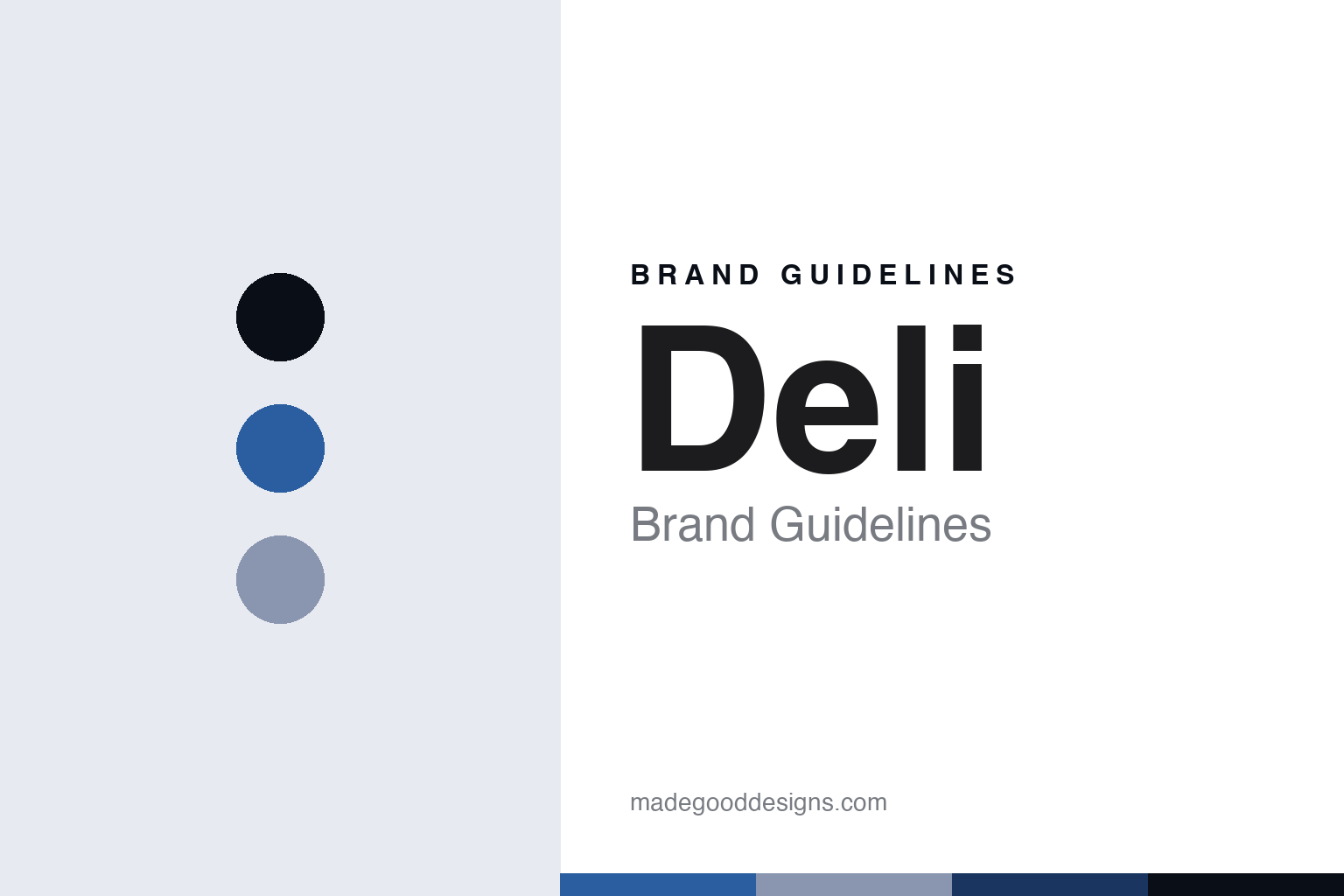
Deli Brand Guidelines
Asia’s stationery giant.
Aa
Two constants: an office-blue palette and an office-sans register. Abstract homage — not a Deli colour, label or barrel.
Asia’s stationery giant
Deli is the giant Chinese office-and-stationery house since 1981, Asia’s largest, whose coloured pencils are one line in a vast catalogue.
Deli is a lesson in how a colour core sits inside an industrial-scale stationery empire. One of the largest stationery makers in Asia, Deli makes everything a Chinese office or classroom uses — staplers, calculators, pens, whiteboards, filing — and its coloured pencils are one student line within an enormous catalogue. Its answer to how a colour is made a business is scale: manufacture thousands of products across many categories, at volume, for a domestic market of hundreds of millions. A colour core as one item in a giant’s range.
Its identity is the Chinese stationery giant. Deli’s office supplies, and its mass-market student range including coloured pencils, are the work it is known for. A core, one of thousands of products. An industrial-scale maker of everyday stationery.
(Honest notes, so the story stays precise. Deli Group is a genuinely Chinese manufacturer, headquartered in Ningbo, in Zhejiang, and it is a giant — often described as the largest stationery maker in Asia, with revenue in the billions of dollars and around sixteen thousand employees. It was founded in 1981 (not 1988) by Lou Fujun, and it is a privately held company, not listed on a stock exchange. Its identity is a mass-market office-and-stationery house; its coloured pencils are a budget student line, one item in a catalogue of thousands, not a premium fine-art range. One honest clarification: Deli’s higher-end art-materials play is a separate sub-brand, Damast, a joint venture with the French colour maker Pébéo — so the professional art line and the everyday Deli student pencils are different things, and we do not conflate them. Its name and marks are its IP, described but never reproduced, and there is no official brand hex — these tones are an unofficial interpretation. This is design commentary and does not promote any product.)
Colour
Deli lives in an office-blue palette. Click a swatch to copy the hex.
Deli’s identity is industrial, practical and vast — an office blue, an ink, a slate, a navy, and a paper. The palette leans office blue and slate: the register of a corporate stationery giant and a working desk. It signals scale and utility over prestige. The honest caveat: with no published brand hex, these values are an original, unofficial interpretation, not first-party colours.
The lesson is an office-blue palette signals a scale, made-in-China identity. Deli’s world is an industrial, mass-produced, Chinese-made object. For designers, it is a reminder that a corporate blue and a cool slate can carry a brand built on scale — the blue of an office and the grey of a filing cabinet. Because these tones can fail as small text, keep type dark and let the colour live in the accents, palette and band. The takeaways: make everything; make it at scale; keep the premium line distinct; and treat any single hex as unofficial.
Typography
The register is an office sans — plain, corporate, capable.
Deli’s identity carries a plain, corporate, capable spirit — an industrial stationery house, not a boutique. An office sans captures the mood: even, businesslike and dependable, the register of a giant maker. Set in an office-blue palette, the office sans feels plain and corporate — exactly the personality Deli carries. It is capable rather than expressive, mirroring a mass-market everyday product. (Deli’s real labels and marks are things we describe but do not reproduce, and the exact typeface is not ours to use.) Because it is not ours to use, the honest description is “an office-sans spirit,” shown here in a stand-in. The type behaves like the house: plain, corporate and capable.
Aa
An office-sans spirit — plain and corporate. (Specimen set in Rubik, an office-sans STAND-IN; NOT the Deli wordmark or any label.)
The pencil makers, old and new
Deli stands for the colour core inside a stationery giant.
Deli is a lesson in how a colour core is one product in an empire. An office-blue palette, an office sans and a student pencil make one thing — a colour line inside a vast stationery catalogue — the whole house: industrial, practical and vast. The scale is the differentiator, and the mass-market breadth is the meaning. The point is a company that makes thousands of stationery products at industrial volume, of which coloured pencils are a small, affordable part.
Put to work, the identity is scale as design. A stationery house in this spirit would make everything a market needs, compete on volume and value, and be honest about the tier of each line — its everyday coloured pencils are budget student goods, while its professional art ambitions live in a separate joint-venture brand. A brand learning from it would see that industrial scale is its own identity — that being a market’s default stationery supplier is a real position — and that being precise, founded 1981, private, Asia’s largest, keeps the story honest, neither understating the scale nor overstating the art-grade credentials of a student pencil. A brand learning from it would also keep its premium and mass lines clearly separate, as Deli does with its Pébéo joint venture, so a buyer knows exactly what tier they are getting. A brand learning from it would also see that sheer scale need not mean anonymity: even a giant that makes thousands of undifferentiated products can carry a coherent identity if it names its tiers clearly, so a teacher buying a class set and an artist buying the professional line each know exactly what they hold and what it is for. The lesson Deli teaches is that scale can hold an identity: the breadth gives it presence, and the honest tiering gives it clarity. The industry is the personality, and the everyday colour is the proof.
For designers and brand-builders, Deli holds the scale pole in this round of the pencil makers, old and new, from China: make everything, and tier it honestly. The lessons: compete on scale and value; be candid about each line’s tier; keep premium and mass lines distinct; and never reproduce a protected label. It is also a reminder to stay precise: Deli is a giant Chinese office-and-stationery house since 1981, Asia’s largest, whose coloured pencils are one student line — with the palette here an unofficial interpretation. Deli made scale the identity — proof that industrial breadth, honestly tiered, can be the difference.
Explore & save
Keep Deli’s identity on hand — save it to a board in the Made Good inspiration library.
Deli identity set
Pin the office-blue palette and the office-sans register to your own board.