Kijima Takayuki Brand Guidelines
The Tokyo milliner.
Aa
Two constants: a graphite palette and an atelier-minimal register. Abstract homage — not a Kijima Takayuki hat, label or hatband.
The Tokyo milliner
Kijima Takayuki is the contemporary Tokyo milliner whose eponymous handmade hat brand, launched in 2013, carries the lineage of master milliner Akio Hirata.
Kijima Takayuki is a lesson in how a milliner’s name can be a modern brand. From an atelier in Tokyo, Kijima Takayuki makes handmade hats for women and men — contemporary millinery, refined and design-led, sold to high-end fashion boutiques around the world. Its answer to how a hat becomes a name is craft and modernity: hand-make each hat in Tokyo, and give classic forms a contemporary sensibility. A milliner whose name is on the hat because the hand is his.
Its identity is the contemporary Tokyo milliner. Kijima Takayuki’s handmade hats, refined and modern, are the work it is known for. A hat, made by hand in Tokyo. A name that is a maker.
(Honest notes, so the story stays precise, with a correction. The eponymous brand Kijima Takayuki was launched in 2013 — renamed from his earlier label — while his Tokyo atelier, in Daikanyama, dates to 1995; so the atelier is older than the name, and the brand is not from around 2002. Kijima trained under the master milliner Akio Hirata, a foundational figure in Japanese millinery, and in his formative years made hats for fashion houses including Issey Miyake, Yohji Yamamoto and Comme des Garçons — collaborations we describe as of that period rather than as ongoing. His hats are handmade in his Tokyo atelier, which is the heart of the brand; we describe them as handmade in Tokyo rather than asserting that every item is stamped Made in Japan. On his name: in Japanese order, Kijima is the family name and Takayuki the given name, so on later mention we say Kijima. As this is a living maker, we keep to public professional facts. His name and marks are his IP, described but never reproduced, and there is no official brand hex — these tones are an unofficial interpretation. This is design commentary and does not promote any product.)
Colour
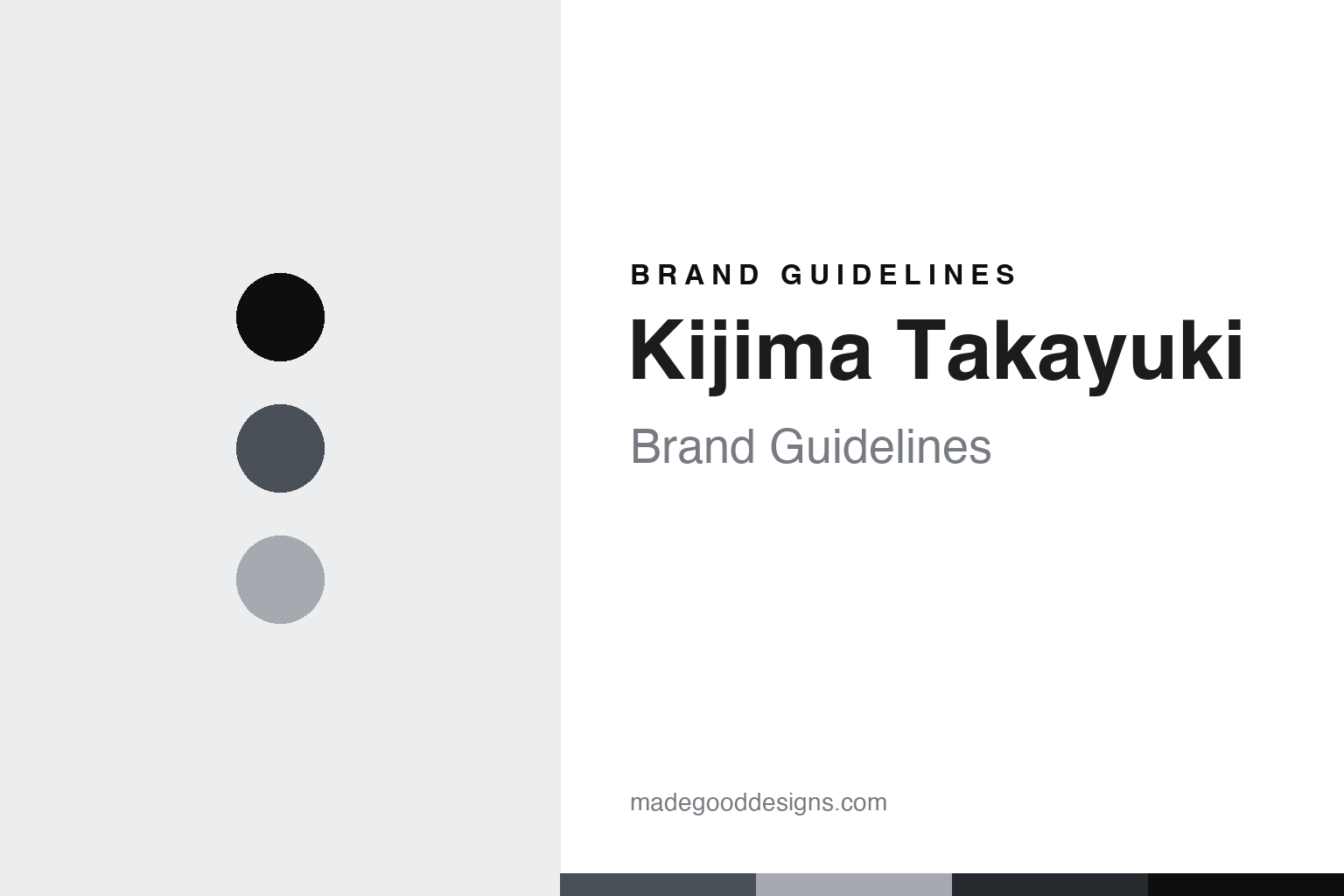
Kijima Takayuki lives in a graphite palette. Click a swatch to copy the hex.
Kijima Takayuki’s identity is refined, minimal and Japanese — a graphite, an ink, a grey, a slate, and a paper. The palette leans graphite and grey: the register of a contemporary Tokyo atelier and a design-led milliner. It signals restraint over decoration. The honest caveat: with no published brand hex, these values are an original, unofficial interpretation, not first-party colours.
The lesson is a graphite palette signals a contemporary, made-in-Tokyo identity. Kijima Takayuki’s world is a refined, minimal, Japanese object. For designers, it is a reminder that a graphite and a soft grey can carry a brand built on a hand and a modern sensibility — the near-black of an atelier and the calm of restraint. Because these tones can fail as small text, keep type dark and let the colour live in the accents, palette and band. The takeaways: make by hand; keep it minimal; date the brand honestly; and treat any single hex as unofficial.
Typography
The register is an atelier minimal — refined, quiet, modern.
Kijima Takayuki’s identity carries a refined, quiet, modern spirit — a contemporary milliner, not a heritage house. An atelier-minimal register captures the mood: even, restrained and design-led, the register of a modern Tokyo hat. Set in a graphite palette, the atelier-minimal type feels refined and quiet — exactly the personality Kijima Takayuki carries. It is minimal rather than ornate, mirroring a design-forward hat. (Kijima Takayuki’s real labels and marks are things we describe but do not reproduce, and the exact typeface is not ours to use.) Because it is not ours to use, the honest description is “an atelier-minimal spirit,” shown here in a stand-in. The type behaves like the atelier: refined, quiet and modern.
Aa
An atelier-minimal spirit — refined and quiet. (Specimen set in Mulish, an atelier-minimal STAND-IN; NOT the Kijima Takayuki wordmark or any label.)
The name on the hat
Kijima Takayuki stands for the milliner who is the name.
Kijima Takayuki is a lesson in how a milliner’s name and hand can be the identity. A graphite palette, an atelier-minimal register and a handmade hat make one thing — a contemporary Tokyo milliner — the whole brand: refined, minimal and Japanese. The hand-craft is the differentiator, and the lineage is the meaning. The point is a maker who carries the tradition of a master milliner into a modern, design-led idiom, and whose name is on the hat because the hand is his.
Put to work, the identity is the maker as the brand. A milliner in this spirit would keep the hats handmade, carry a real lineage, and be precise about its story — an atelier from 1995, an eponymous brand from 2013, formative work for great fashion houses. A brand learning from it would see that a maker’s name and a modern sensibility are a durable identity — that a hat handmade in a Tokyo atelier has a story a factory hat cannot tell — and that being precise, atelier since 1995, brand since 2013, trained under Akio Hirata, keeps the story honest. A brand learning from it would also value the lineage: carrying a master’s tradition into a contemporary idiom is exactly the kind of honest continuity that gives a modern name depth. The lesson Kijima Takayuki teaches is that a maker can be the identity: the hand gives it authenticity, and the lineage gives it depth. The maker is the personality, and the hat is the proof.
For designers and brand-builders, Kijima Takayuki holds the modern-milliner pole in this round of the name on the hat, from Japan: make by hand, and carry the lineage honestly. The lessons: make by hand; keep it modern; date the atelier and the brand separately; credit the lineage; and never reproduce a protected label. It is also a reminder to stay precise: Kijima Takayuki is the contemporary Tokyo milliner whose eponymous handmade hat brand, launched in 2013, carries the lineage of master milliner Akio Hirata — with the palette here an unofficial interpretation. Kijima Takayuki made the maker the identity — proof that a milliner’s name and hand can be the difference.
Explore & save
Keep Kijima Takayuki’s identity on hand — save it to a board in the Made Good inspiration library.
Kijima Takayuki identity set
Pin the graphite palette and the atelier-minimal register to your own board.