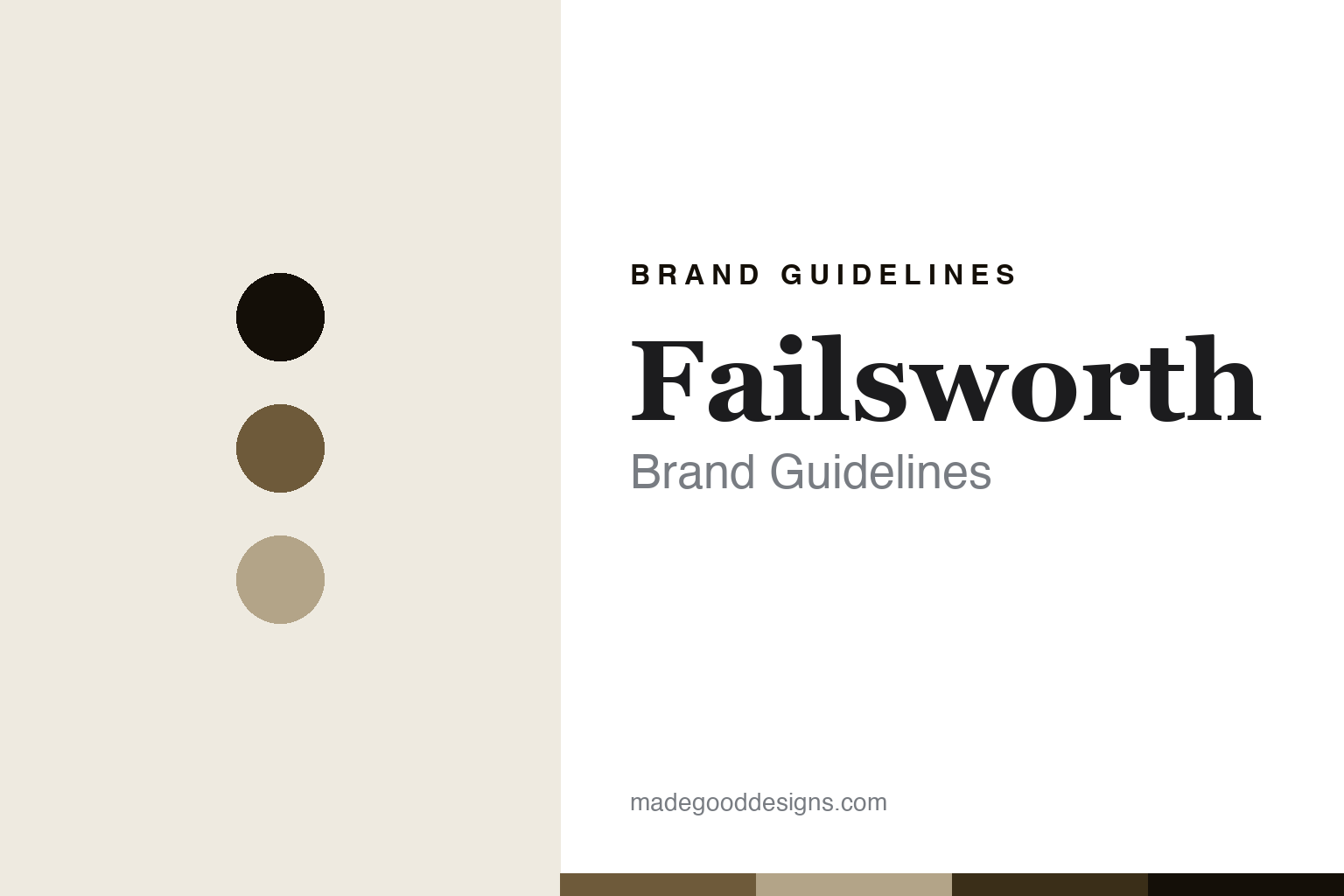
Failsworth Brand Guidelines
The English tweed cap.
Aa
Two constants: a tweed-brown palette and a Manchester-serif register. Abstract homage — not a Failsworth cap, label or tweed pattern.
The English cap maker
Failsworth is the British cap maker founded in 1903 in the Manchester hatting district, best known for the English tweed flat cap.
Failsworth is a lesson in how a town’s name becomes a cap. Founded in 1903 and named for the town of Failsworth, near Manchester, this heritage British firm is best known for the tweed flat cap — the everyday English cap in wool and tweed. Its answer to how a hat is made an everyday object is craft and cloth: cut a British tweed, and make the cap the country wears to the field and the pub. A cap named for a Manchester hat town.
Its identity is the English tweed-cap maker. Failsworth’s tweed flat caps and newsboy caps, and its Manchester hatting heritage, are the work it is known for. A cap, cut from tweed. A name from the English hat trade.
(Honest notes, so the story stays precise. Failsworth Hats was founded in 1903 — originally to make silk hats — and takes its name from the town of Failsworth, in the Manchester hatting district; the company is still active, though its registered office today is in Oldham, in Greater Manchester, rather than the town of Failsworth, so we say the Manchester–Oldham area. It is an independent firm, held through a private trust, and works largely as a trade supplier to hat retailers rather than a big direct-to-consumer brand. Two honest points. First, on where it is made: we could not verify current manufacture, so we do not claim its caps are made in England — like many British cap names it is understood to produce across a mix of locations, and British-woven cloth does not mean a British-sewn cap. Second, on cloth: it is commonly associated with Yorkshire tweeds and some Harris Tweed, which we present as reported, and we reproduce no mill’s pattern or the Harris Tweed orb mark. Its name and marks are its IP, described but never reproduced, and there is no official brand hex — these tones are an unofficial interpretation. This is design commentary and does not promote any product.)
Colour
Failsworth lives in a tweed-brown palette. Click a swatch to copy the hex.
Failsworth’s identity is heritage, British and rustic — a tweed brown, an ink, an oat, a bark, and a paper. The palette leans tweed brown and oat: the register of a wool flat cap and a Manchester hat town. It signals cloth and craft over fashion. The honest caveat: with no published brand hex, these values are an original, unofficial interpretation, not first-party colours — an abstract nod to tweed, not a reproduction of any weave.
The lesson is a tweed-brown palette signals a heritage, English-cap identity. Failsworth’s world is a heritage, tweed, British object. For designers, it is a reminder that a warm tweed brown and a soft oat can carry a brand built on a cloth and a town — the brown of tweed and the neutral of a workshop. Because these tones can fail as small text, keep type dark and let the colour live in the accents, palette and band. The takeaways: cut the tweed; carry the town; be honest about where it is made; and treat any single hex as unofficial.
Typography
The register is a Manchester serif — heritage, sturdy, British.
Failsworth’s identity carries a heritage, sturdy, British spirit — a hat-town cap maker, not a fashion label. A Manchester serif captures the mood: traditional, solid and understated, the register of a tweed flat cap. Set in a tweed-brown palette, the Manchester serif feels heritage and sturdy — exactly the personality Failsworth carries. It is British rather than glossy, mirroring a wool cap. (Failsworth’s real labels and its cloth suppliers’ marks are things we describe but do not reproduce, and the exact typeface is not ours to use.) Because it is not ours to use, the honest description is “a Manchester-serif spirit,” shown here in a stand-in. The type behaves like the house: heritage, sturdy and British.
Aa
A Manchester-serif spirit — heritage and sturdy. (Specimen set in Cormorant Garamond, a Manchester-serif STAND-IN; NOT the Failsworth wordmark or any label.)
The cap makers
Failsworth stands for the English tweed cap.
Failsworth is a lesson in how a cloth and a town can be an identity. A tweed-brown palette, a Manchester serif and a flat cap make one thing — the English tweed cap — the whole identity: heritage, British and rustic. The tweed is the differentiator, and the Manchester hat town is the meaning. The point is a firm named for a hatting town, that has cut tweed flat caps for over a century, and supplies the trade with the everyday English cap.
Put to work, the identity is cloth-and-town as design. A cap maker in this spirit would build on a real cloth and a real place, and be honest about the making — a founding in 1903, a Manchester–Oldham base, a production it does not clearly state. A brand learning from it would see that a tweed and a town are a durable identity — that a flat cap named for a hat town carries a heritage a generic cap cannot — and that being precise, founded 1903, based in the Manchester area, made where it does not fully disclose, keeps the story honest. A brand learning from it would also separate cloth from make: a Yorkshire tweed is a genuine claim, but it does not by itself make a British-sewn cap, and saying so plainly is what keeps a heritage credible. The lesson Failsworth teaches is that a cloth can hold an identity: the tweed gives it substance, and the honest framing keeps it credible. The tweed is the personality, and the flat cap is the proof.
For designers and brand-builders, Failsworth opens this round of the cap makers, from England: build on the cloth, and be honest about the make. The lessons: cut the tweed; carry the town; disclose where it is made; separate cloth from sewing; and never reproduce a mill’s mark. It is also a reminder to stay precise: Failsworth is the British cap maker founded in 1903 in the Manchester hatting district, best known for the English tweed flat cap — with the palette here an unofficial interpretation. Failsworth made the tweed cap the identity — proof that a cloth and a town can be the difference.
Explore & save
Keep Failsworth’s identity on hand — save it to a board in the Made Good inspiration library.
Failsworth identity set
Pin the tweed-brown palette and the Manchester-serif register to your own board.