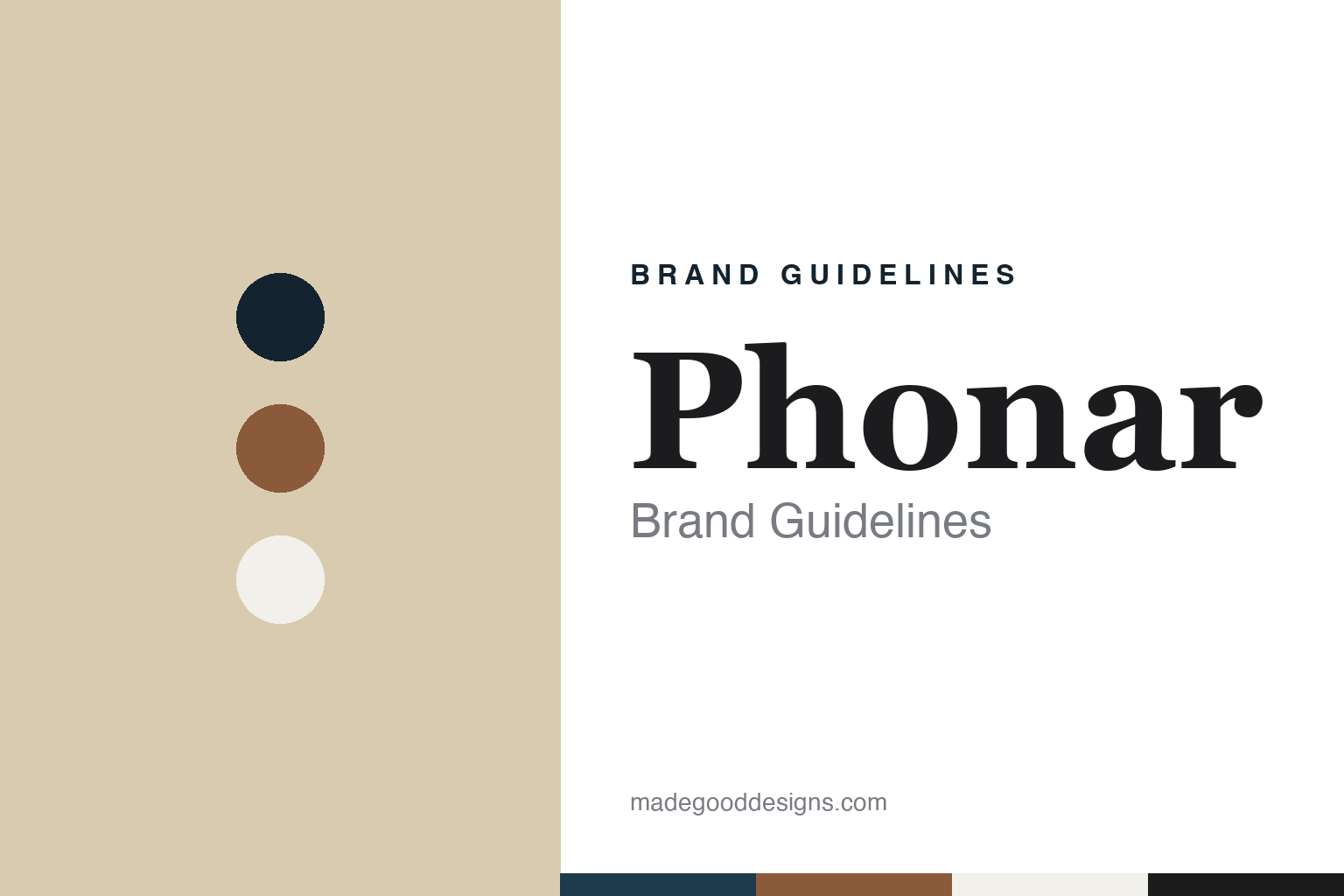
Phonar Brand Guidelines
The Tarp speaker maker near the Danish border.
Aa
Two constants: a Phonar North Sea blue and walnut palette and a Furniture serif register. Abstract homage — not a Phonar product or mark; no speaker, logo or nameplate is reproduced.
Scan Akustik
A contract factory that started its own brand.
Phonar makes loudspeakers in Tarp, a small municipality in Schleswig-Holstein south of Flensburg, close to the Danish border. It calls itself “the northernmost hi-fi manufactory in Germany” — a description the trade site fairaudio repeated in 2016 and 2019, each time marking it as the company’s own.
Its history, as the company tells it, begins as a contract maker. In its early years, the website says, the works in Tarp — then called Scan Akustik — built loudspeakers mainly for international consumer-electronics brands, “still familiar today,” with up to 1,000 speaker boxes a day leaving the factory. It does not name those customers, and we found no independent source that does. Scan Akustik should not be confused with Scan-Speak, the Danish driver maker whose tweeters Phonar later used.
The location matters to the story the company tells. Its 2001 English profile said that being so near Scandinavia had brought “some very good partnerships” with companies there, and it praised Denmark’s reputation for making wooden furniture.
To avoid depending on a few large customers, the founder, Klaus Henningsen, decided in the early 1980s to build a brand of his own. “In 1983 the idea was put into practice,” the company says, as the separate firm Phonar Akustik GmbH, whose aim was to make high-quality “Klangmöbel,” or sound furniture, faithful to the musical original.
How far back the factory goes is less precise. The current website says Phonar’s story began “almost 50 years ago,” but the same wording was already on the page in November 2018, according to the Internet Archive; in 2001 the English site spoke of speakers designed and produced in Tarp for “more than 25 years.” Both point to roots in the 1970s, by the company’s own account.
Colour
From Credo to Match Air.
Phonar’s early catalogue, archived in 2001, included the Compact, Monitor, Volume and Credo models, the P20, P30 and P40 floorstanders and the AS100 subwoofer, with a company-compiled list of reviews from German, Polish, Hungarian and Norwegian magazines. Its top line for years was the Credo: in 2011 fairaudio tested the Credo Primus compact at 4,000 euros a pair, with optional Optimus bass units that turn it into a floorstander.
The Veritas range — Latin for “truth” — became its main line. Reviewing the Veritas P4 Next in July 2012, fairaudio described a cabinet that leans back by exactly five degrees, which Phonar says corrects the drivers’ phase, a Scan-Speak fabric-dome tweeter matched in pairs, Peerless bass-midrange drivers and internal wiring from the American cable maker Wireworld; the reviewer called the veneer and finish furniture quality. The cheaper Veritas Style series followed in 2016 in white and black satin lacquer, at 900 euros a pair for the floorstander.
In November 2018, the company says, Phonar launched Match Air, a wireless active system it says took more than two years to develop. fairaudio reported in January 2019 that a hub sends music to the DSP-equipped speakers at 24 bits and 96 kHz, with five models priced from 2,900 to 8,900 euros a set. The wired Veritas Match speakers use what Phonar calls NoLoss technology and “Single Driver Amplification,” with ten selectable filters.
Phonar has also distributed other brands in Germany: Wireworld cables since 2012, by its own account, the Danish electronics maker Gato from 2017 and PowerGrip mains filters from 2020, according to fairaudio.
Typography
Design and documentation.
The seven brands here are smaller, long-running German hi-fi makers; six still trade, most run by a founder or a founder’s family.
ASR is in Herborn, Hesse; its owner, Friedrich Schäfer, says he founded it in 1980 with Michael Rompf, who left in 1994. Restek AG of Fuldabrück, near Kassel, says Adrianus Elschot and Bernd Hugo founded it in 1975; Elschot still heads it. Gauder Akustik of Renningen, near Stuttgart, says Roland Gauder and Achim Knapp founded it in 1997.
Phonar of Tarp, in Schleswig-Holstein, says it built speakers for other brands as Scan Akustik before Klaus Henningsen founded Phonar Akustik in 1983; his son Kai took over in 1998. Abacus Electronics of Nordenham began in 1983 as Audio Pro Deutschland, part of Sweden’s Audio Pro, founder Karl-Heinz Sonder told fairaudio; the current company was registered in 2022 with Hanno Sonder as managing director. Symphonic Line of Duisburg belongs to Rolf Gemein, who founded it after an earlier firm, Vernissage, HiFi Test reported.
Isophon is the exception: German Wikipedia says the Berlin company, founded in 1929, was sold to the Bosch/Blaupunkt group in the 1980s while its name stayed with the owning family. Gauder’s firm used the name until building the last Isophon on 31 December 2012.
Five of the six active makers say they build in Germany; trade-press reports place workshops in Nordenham, Duisburg and Renningen. Phonar, a self-described manufactory, said in 2001 that many of its cabinets were made in Scandinavia.
This guide sets out what can be checked about each brand — who founded it, who owns it, and what it says about where its products are made — and marks clearly what rests only on the company’s own word.
Aa
A furniture serif — speakers sold as “Klangmöbel.” (Specimen set in Lora, a serif STAND-IN; NOT the Phonar logo.)
Phonar
A family firm in Tarp.
Phonar remains a family business. In 1998, the company says, Klaus Henningsen handed the management to his son Kai Henningsen, a business-administration graduate, who is named as managing director on the website today; the company register summary published by North Data lists the firm as Phonar Akustik Kai Henningsen GmbH. The company describes itself as having 15 employees, a 5,000-square-metre site, about 100 selected specialist dealers in Germany and an export share of about 40 per cent — figures it already gave in 2018. Its website lists distributors in more than 20 countries, from France and Poland to China, India and Taiwan, and links to the 2026 Norddeutsche HiFi-Tage, a regional hi-fi show. In 2001 its English site claimed 25 employees and more than 1,500 German dealers, a sign of how the specialist trade has shrunk.
Where the speakers are made is only partly documented. Today the company calls itself a manufactory and says each Veritas speaker is “made by hand with great effort,” without spelling out where each part is produced. In 2001 its English site said that “since many years” its most sophisticated cabinets had been produced in Scandinavia. The drivers are bought in: its specification sheets name Scan-Speak tweeters and Peerless bass units. We found no published brand guidelines, and the naming — m for compact monitors, p for floorstanders, c for centres — appears to be a system, though the company does not explain it.
For a design guide, Phonar shows how a former contract factory can build a brand around furniture-grade cabinets. Compare Nubert, another family-run German speaker maker, and Canton, a larger German speaker brand. For this guide we use a North Sea blue and a walnut brown with a serif, an unofficial interpretation; no product or logo is reproduced.
Explore & save
Keep Phonar’s identity on hand — save it to a board in the Made Good inspiration library.
Phonar identity set
Pin the Phonar North Sea blue and walnut palette and the Furniture serif register to your own board.