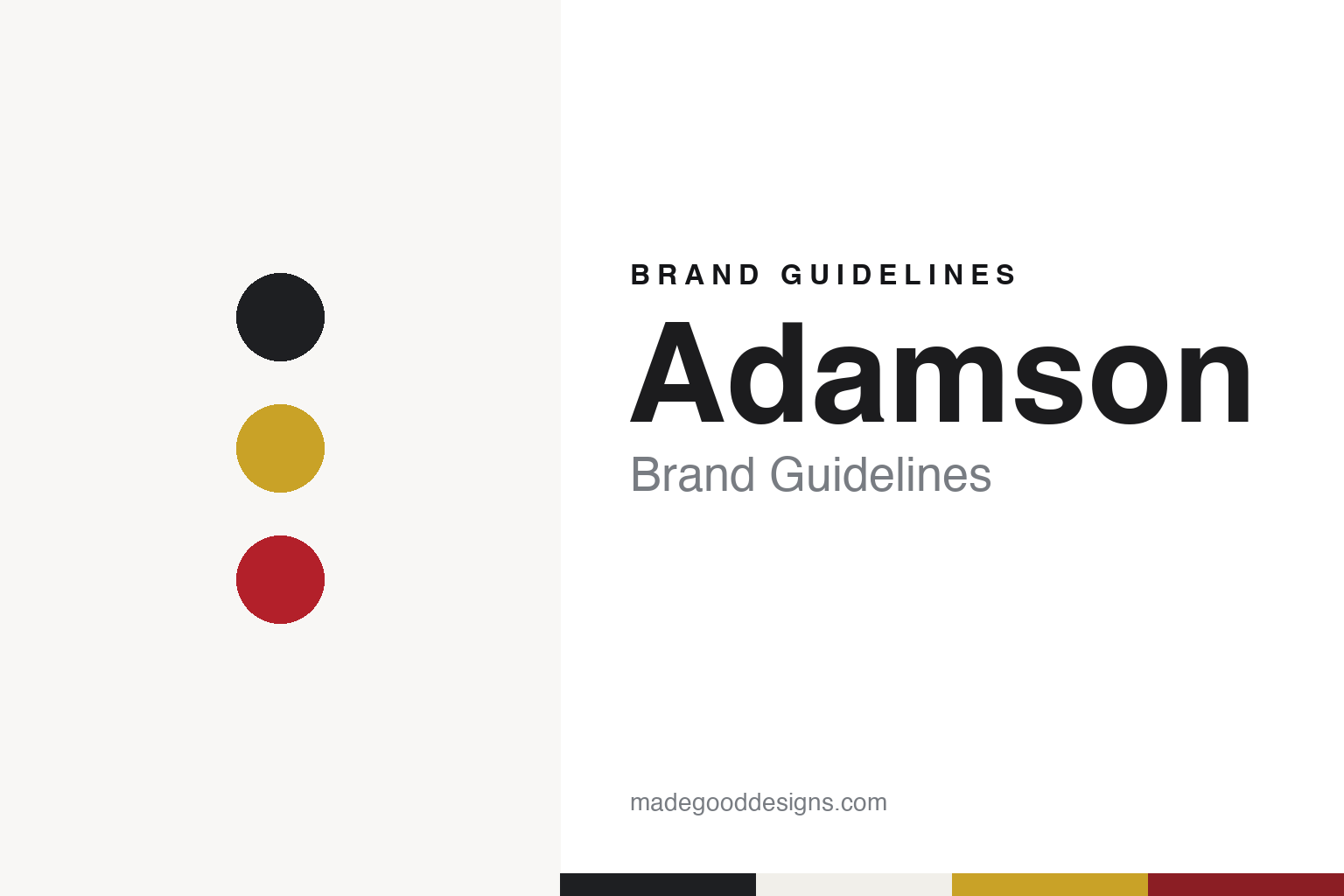
Adamson Brand Guidelines
The Canadian line-array maker that builds its own drivers.
Aa
Two constants: an Adamson graphite, Kevlar gold and maple red palette and an Engineering sans register. Abstract homage — not an Adamson product or mark; no loudspeaker, logo or nameplate is reproduced.
A warehouse in Vancouver
Brock Adamson’s company.
Adamson Systems Engineering is a Canadian loudspeaker maker named after its founder, Brock Adamson. The company dates itself to 1984: “Since 1984, Adamson has had one goal,” its website says, adding that what Brock Adamson “began in a small warehouse in Vancouver” now has a 100,000-square-foot headquarters in Port Perry, Ontario. We found no Wikipedia article on the company and no independent record of its founding date, so 1984 is the company’s own year. FRONT of HOUSE, the American live-sound magazine, put the start more loosely in a 2018 profile, saying he started his company “about the time” the TEF measurement system appeared in 1983.
That profile, written when Adamson was named the Parnelli Awards’ Audio Innovator — an honour the company dates to 2019 — gives the fullest account of his early years. Born in Vancouver, he was, he told the magazine, “around the bands and got stuck with the P.A.,” and started out building studio monitors. He designed his first midrange driver in Vancouver in 1986, and after working as an audio consultant for Expo 86, the city’s world’s fair, he moved east to Ontario, where, the magazine says, he found the machine-tool and manufacturing suppliers that Vancouver lacked.
The move shaped the company. FRONT of HOUSE reported that he bought 40 acres of industrial land at Port Perry, north-east of Toronto, and formed a construction company to build the plant to his own specification. In 2017 the company’s website described it as one of the largest employers in Scugog Township, the municipality that includes Port Perry, with more than 100 staff.
Colour
Waveguides, Kevlar and line arrays.
Adamson’s reputation rests on engineering it does itself, above all its drivers. FRONT of HOUSE credited the MH225 of the late 1980s as the first use of an acoustical waveguide in a commercial loudspeaker system, a design Brock Adamson said drew on research shared by the waveguide theorist Earl Geddes; the company’s first in-house driver, the M200 midrange, went into that cabinet. He chose Kevlar rather than paper for his cones, which he told the magazine costs more but does not fatigue in the field, and he said Britain granted him a patent on it. Dave Shadoan of the American rental company Sound Image told the magazine that Adamson was “one of the few if only audio companies that build their own transducers.”
The line arrays came next. Adamson released the Y-Axis in 1999. FRONT of HOUSE called it the second line array system, while the company’s own website in 2017 called Adamson “the first line array designed and manufactured in North America”; we give both claims as stated. The Y10 followed in 2002 and the T21 subwoofer in 2006. That year the INXS tour took out a Y18 system, which the magazine counts as Adamson’s break into American touring; Sound Image used it on John Legend’s tour in 2008. The E15, developed under the engineer Ben Cabot from 2010, became its large-format touring array, and the magazine listed it in 2018 on tour with Drake, Imagine Dragons and BTS.
Recent ranges show a shift from passive cabinets to powered, networked ones. Its CS-Series and IS-Series followed; the IS-Series is aimed at installation, and a weatherized IS line was announced in May 2021. In January 2024 Adamson launched VGt, the first product in its Vergence Group: a large-format line array with built-in class-D amplification, Milan AVB networking and signal processing. In June 2025 it announced XG integration amplifiers, and its software includes ArrayIntelligence and the FletcherMachine spatial-audio engine.
Typography
Touring and installation sound.
Concerts and festivals are amplified by a few specialist loudspeaker makers. English Wikipedia credits L-Acoustics, founded by Christian Heil in 1984 and based at Marcoussis, south of Paris, with the V-DOSC line source array of 1992, and says most makers have since adopted the line array — a column of linked cabinets — for touring.
France has a second maker. Nexo, founded in 1979 and based at Plailly, north of Paris, says Yamaha completed its acquisition in 2008 and that its cabinets are designed and made in France. Germany’s d&b audiotechnik, founded in 1981 by Jürgen Daubert and Rolf Belz, is based in Backnang, near Stuttgart; the Paris private-equity firm Ardian bought it in 2016, Providence Equity Partners announced a significant investment in 2023, and the company says its products are handmade there.
Two are British. Martin Audio, founded by Dave Martin in 1971, is based in High Wycombe and was bought by Focusrite plc in December 2019, the companies announced. Funktion-One, formed in 1992 by Tony Andrews and John Newsham after they left Turbosound, is based near Dorking, Surrey, and English Wikipedia lists Berlin’s Berghain among the clubs using its systems.
In North America, Meyer Sound was founded in 1979 by John and Helen Meyer and is based in Berkeley, California. Adamson, which dates itself to 1984 in Vancouver, says it makes its systems at its own plant in Port Perry, Ontario.
This guide sets out what can be checked about each brand — who founded it, who owns it, and what it says about where its products are made — and marks clearly what rests only on the company’s own word.
Aa
An engineering sans — a founder’s surname as the brand. (Specimen set in Archivo, a sans STAND-IN; NOT the Adamson logo.)
Adamson
Made at Port Perry, by its own account.
Ownership is less documented than engineering. We found no report of a sale or an outside investor in the sources we checked, and the company does not publish its shareholders, so we make no claim about who owns it beyond its founder’s continuing role. In January 2019 FRONT of HOUSE reported that Marc Bertrand, formerly chief executive of TC Group Americas, had been named chief executive, with Brock Adamson becoming chairman. By May 2023 Bertrand had joined Theory Professional, which described him as Adamson’s former CEO, and in January 2024 the VGt announcement quoted Brock Adamson as “President & CEO.”
Manufacturing is the centre of its identity. The company calls itself “a highly vertically integrated manufacturer” that buys raw materials locally and processes them “at our facility,” and in 2017 it said “almost every component in your cabinet is made from raw material in our Canadian factory.” In May 2024 it said it was finishing a $4 million electronics production line at Port Perry, adding that “while others outsourced overseas … Adamson stayed close to home.” We give those as the company’s statements; the independent support is FRONT of HOUSE’s account of the purpose-built plant and Shadoan’s comment on its drivers.
We found no published brand guidelines, and no documented logo typeface or colours. Its boilerplate calls it “Canada’s most recognized exporter of loudspeaker technology for the pro-audio sector,” a claim we could not test.
For a design guide, Adamson shows how a founder’s surname and one factory town can carry a brand. Compare L-Acoustics, the French line-array maker that also dates itself to 1984, and JBL, an American loudspeaker name with its own touring arrays. For this guide we use a graphite, a Kevlar gold and a maple red with a sans, an unofficial interpretation; no product or logo is reproduced.
Explore & save
Keep Adamson’s identity on hand — save it to a board in the Made Good inspiration library.
Adamson identity set
Pin the Adamson graphite, Kevlar gold and maple red palette and the Engineering sans register to your own board.