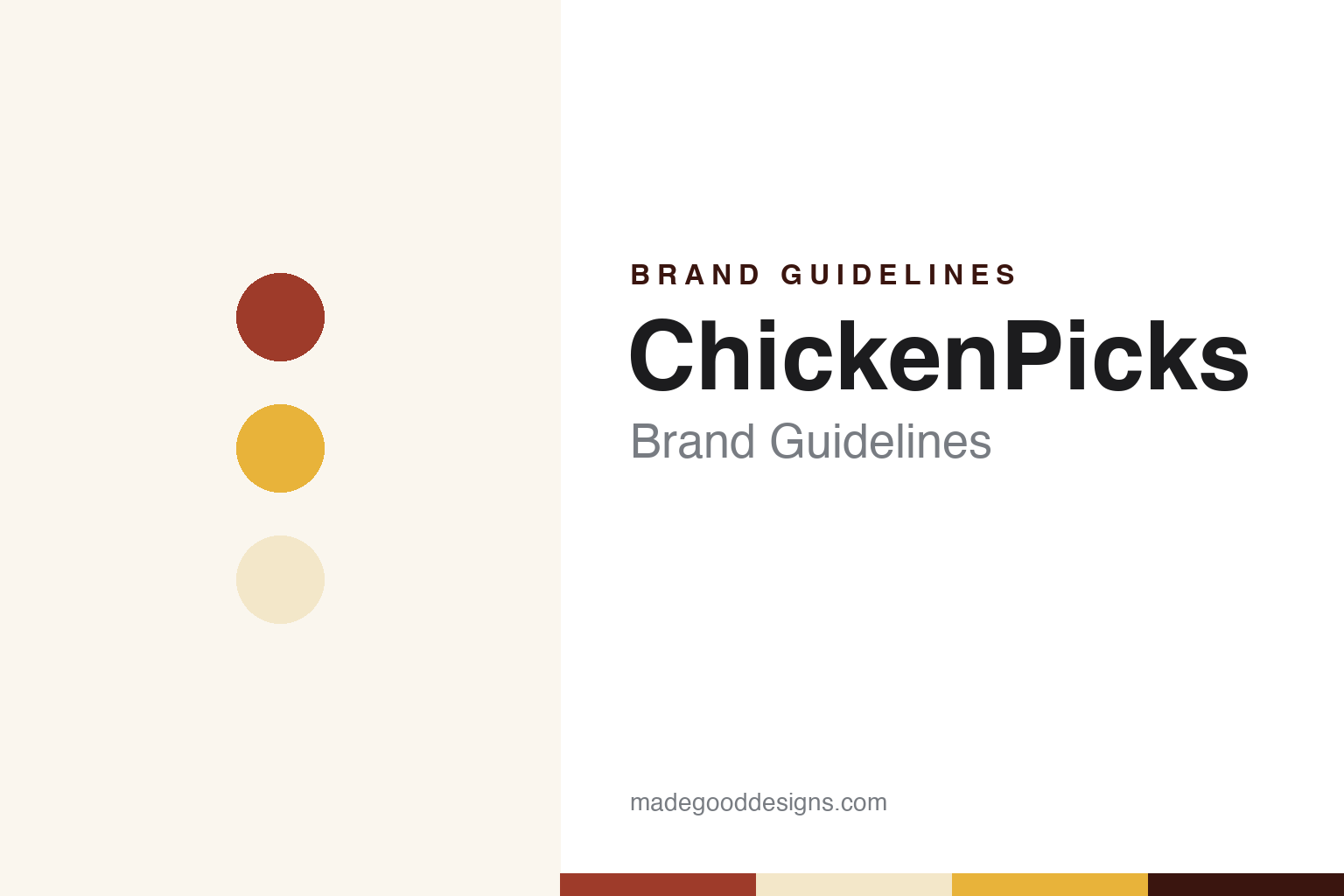
ChickenPicks Brand Guidelines
The Dutch pick maker that turned a schoolboy cartoon into a brand.
Aa
Two constants: a ChickenPicks barn red, yolk yellow and straw palette and a Hand-lettered script register. Abstract homage — not a ChickenPicks product or mark; no pick, cartoon or logo is reproduced.
A pick from the mid-1980s
A radio panel, an ashtray and a piece of thermoset.
ChickenPicks is a Dutch company, and its story is told almost entirely by its founder. Eppo Franken, a guitarist from Rotterdam who now lives in Dordrecht, says he began playing at 11 — the website dates that to 1979 — on a diet of KISS, Deep Purple and AC/DC, with Ace Frehley as the reason he picked up the instrument. In the mid-1980s he decided that the picks on sale did not feel right. In a 2014 version of the company’s About page he wrote that he was about 17 when Dunlop and Fender picks stopped doing what he wanted: he wanted a heavy pick, but the 2.0 mm picks he tried lacked comfort. He experimented with the front panel of an old radio and with ashtrays before finding a piece of thermosetting plastic, which he cut into a pick shape and sanded until the bevel felt right.
The company’s date for that first pick varies: its pages said 1984 in 2017 and 2019, and say 1985 today. That design, it says, became the Regular 2.6 mm, still one of its most popular picks. For about 25 years the picks remained a private habit. Franken studied business economics and built a career in banking, the company says, making picks for himself and for friends.
The business began in 2010. Franken says it was his wife, Jolanda, who suggested selling them; both then worked at one of the largest banks in the Netherlands, and ChickenPicks started as a side project with a simple website and a Twitter account. The Wayback Machine’s earliest copy of chickenpicks.com, from January 2012, shows a small Dutch webshop headed “ChickenPicks by Eppo Franken,” promising “the right balance and the right tone” and urging players to “stop breaking strings.” In 2014 Franken wrote that he had made about 1,200 picks by hand in 2011, at 15 to 20 minutes each, in what he called the backyard barn; the current site puts the number he made by hand, all of them sold, at about 1,400 before production moved to a specialist manufacturer.
Colour
Chicken picking, thermoset and bevels.
The name comes from country music. “Chicken picking” is the snapping, staccato style of country lead guitar, and Franken, who says he has played mostly country for more than 30 years, names Ricky Skaggs, Redd Volkaert and Brent Mason among his favourite players. His band history, as he gave it in 2014, ran from a 1980s hard-rock band called Nataraj through an all-round band, Mystery, and a country band, Heartbroke, to the Terry White Band, a Dutch country act he joined in 2009. Dutch Wikipedia names him as one of the electric guitarists who have stood in with The Amazing Stroopwafels, the Rotterdam folk-pop band known for “Oude Maasweg,” since December 2024.
The product is defined by material and thickness. ChickenPicks are made of what the company calls a “unique thermoset material” — a plastic that sets permanently when cured rather than softening again with heat. It says the material is harder and denser than the nylon, acetal, Tortex and Ultem used by other makers, and puts it at about 90 on the Shore D hardness scale. Every model is thick, from 2.0 mm to 3.5 mm, with bevelled edges meant to glide across the strings, and the company describes “Grip Ribs” for traction. In 2014 Franken wrote that, as far as he knew, he was the only maker using thermosetting plastic for picks; that is his claim, not a checked fact.
The range is built around familiar shapes. The Light 2.2 and Regular 2.6 follow the standard 351 outline, which the company pitches at players of Fender medium and Dunlop standard picks; the Shredder, in 2.4 and 3.5 mm, is about 13 per cent smaller; the Badazz III, in 2.0, 2.5 and 3.2 mm, follows the Jazz III shape; and the Bermuda III is a triangle, with a sharp-tipped Pointy version and an XL version, introduced in 2022, that the company calls “the bass pick.” A starter set and small rubber grip stickers called Gripperzz complete the shop.
Typography
Design and documentation.
These seven pick makers solve one job in very different ways. Two Dutch makers work in thick, bevelled picks. Chicken Picks was started by the guitarist Eppo Franken, who began selling his thermoset picks in 2010; the company says that since 2013 they have been machine-made in Germany and Belgium and hand-finished in the Netherlands. Wegen is the work of Michel Wegen, a professional model maker in Lochem, who says each of his picks is made by hand.
Two American makers work in hard synthetics. V-Picks is the Smith family’s business in Tennessee; Vinni Smith says he first cut acrylic picks in 1980 and revived them in 2003, and the company describes its picks as handmade in the USA. BlueChip, based in Knoxville, Tennessee, says its picks are milled on CNC machines in its own machine shop, Blue Chip Machining.
Two others draw on an older material or a longer history. Red Bear Trading, of Cedar City, Utah, says it has made picks by hand since 2003 from Galalith, a casein plastic made from milk protein. Pickboy is a brand of Nakano Co., Ltd., which says it was founded in Japan in 1967 as a guitar-accessory maker and supplies its celluloid, nylon and polyacetal picks from Japan.
The seventh, Dava, rethinks the pick’s shape rather than its material. Dave Storey says he started the company in 1996; it has been based in Albuquerque, New Mexico, since at least 2004, makes multi-gauge picks with a flexible centre section, and says its picks are made in the USA.
This guide sets out what can be checked about each brand — who founded it, who owns it, and what it says about where its products are made — and marks clearly what rests only on the company’s own word.
Aa
A hand-lettered script — the founder says the logo is his own handwriting. (Specimen set in Kalam, a handwritten STAND-IN; NOT the ChickenPicks logo.)
Made in Europe
Moulded abroad, finished by hand at home.
ChickenPicks has stayed a family business. Its contact page gives the trading name ChickenPicks guitar picks, registered with the Rotterdam Chamber of Commerce, together with the name Guitar Accessories Europe and postal addresses in the Netherlands and Germany; we found no record of an outside owner or acquisition in the sources we checked. Production has been described in slightly different ways over the years. In 2017 and 2019 the website said the picks had been made “in a special mould under high temperature” since 2012, with the finishing still done by hand, and that they were “made in Europe, free from child labour.” Today it says that since 2013 all picks have been machine made in Germany and Belgium and hand finished in the Netherlands, where each one is checked and sanded by hand at a sheltered-employment workplace for people with mental and physical disabilities. We give these as the company’s own statements.
The trade-show record follows the same arc. The company says it showed at small Dutch guitar shows, then at Summer NAMM in Nashville in 2013 and 2014, and at its first full Winter NAMM in Los Angeles in 2015 with seven models; it says it attended every NAMM Show from 2015 to 2020, and its 2015 site also listed Musikmesse in Frankfurt. It now claims more than 200,000 players in over 100 countries, a figure we could not check.
The identity is unusually personal. In 2014 Franken wrote that the logo lettering is his own handwriting, and that the cartoon figure on the pick, called “Pick,” began as a doodle he drew on his school chalkboard at 16 — originally a boxing glove with eyes — and was “born again” at the end of 2010.
For a design guide, ChickenPicks shows how a one-person origin story can carry a brand: a founder’s handwriting, a schoolboy cartoon and a name borrowed from a guitar technique. Compare Dunlop, whose Jazz III and Tortex picks set the shapes and materials ChickenPicks measures itself against, and Fender, whose 351 outline it follows. For this guide we use barn red, yolk yellow and straw with a hand-lettered script, an unofficial interpretation; no product or logo is reproduced.
Explore & save
Keep ChickenPicks’s identity on hand — save it to a board in the Made Good inspiration library.
ChickenPicks identity set
Pin the ChickenPicks barn red, yolk yellow and straw palette and the Hand-lettered script register to your own board.