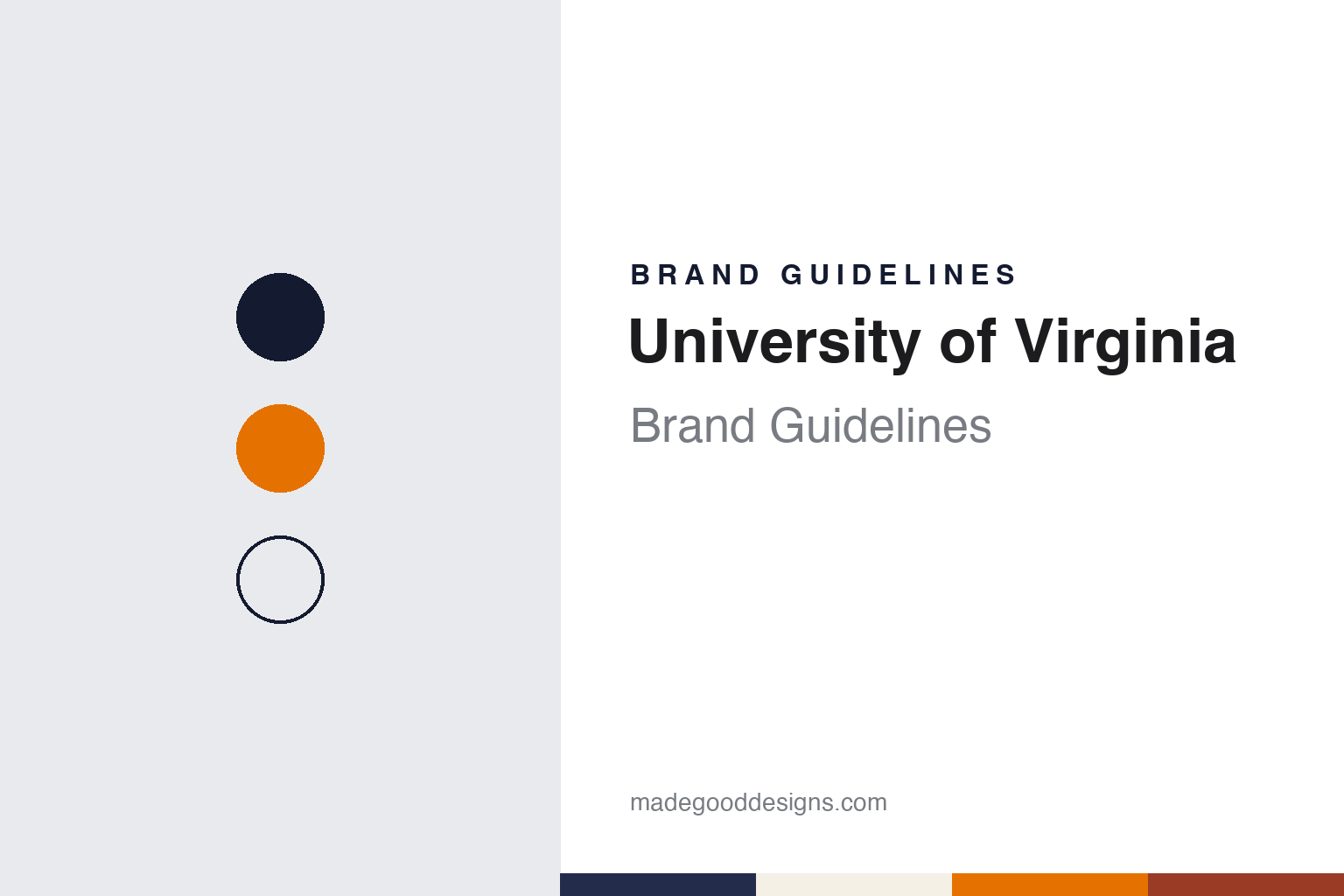
University of Virginia Brand Guidelines
A dome on the Lawn, a scarf from Oxford and two crossed sabres.
Aa
Two constants: a Jefferson blue, Cavalier orange and brick palette and a neoclassical serif register. Abstract homage — not a University of Virginia mark; no seal, V-Sabre, shield or wordmark is reproduced.
The Lawn
A university planned around a library.
The University of Virginia was drawn before it was built. Wikipedia’s history of the university records that in 1817 a meeting at the Mountain Top Tavern at Rockfish Gap — attended by Thomas Jefferson, James Madison, James Monroe and the chief justice John Marshall, among others — chose a site near Charlottesville, and that the Commonwealth of Virginia chartered the university on January 25, 1819. Jefferson designed both its original course of study and its original buildings, and classes began on March 7, 1825. The grounds Jefferson laid out, which he called the Academical Village, are part of a UNESCO World Heritage Site together with his house at Monticello.
The arrangement is the core of the visual identity. Wikipedia notes that the grounds were planned around a library, the Rotunda, rather than a church. Its article on the building records that the architect Benjamin Henry Latrobe proposed a domed building at the head of the Lawn in a letter to Jefferson dated July 17, 1817, and that Jefferson modelled it on the Pantheon in Rome, working from a drawing in the 1721 Leoni translation of Andrea Palladio, at a reduced scale. Construction began in 1822 and ended in 1826. During the Marquis de Lafayette’s tour of 1824–25, Lafayette and Madison dined with Jefferson in the unfinished Dome Room, and Lafayette toasted Jefferson as the “Father of the University of Virginia,” a phrase Jefferson later had inscribed on his grave.
The building has been rebuilt twice. In 1895 a fire that began in the Annex on the Rotunda’s north side gutted it; students carried out a marble statue of Jefferson and part of the library. The architect Stanford White of McKim, Mead, and White rebuilt it with a fireproof tile dome by the Guastavino Company in 1898–99, reducing three floors to two around a larger Dome Room. For the Bicentennial in 1976 White’s interior was gutted and rebuilt to Jefferson’s original design.
Colour
Orange and blue from a scarf.
The colours were chosen in a crowd. The Cavalier Daily, the university’s student newspaper, told the story on October 18, 2007: in 1888 the official colours were red and gray, which students felt were too bland on the football field, and a mass meeting was held to choose something more noticeable. A football player, Allen Potts, arrived wearing an Oxford University scarf in orange and blue; it was pulled from his neck and held up as the answer. Wikipedia’s article on Virginia athletics gives the earlier pair as grey and cardinal red and the adopted colours as orange and navy blue, and adds that the scarf came back with Potts from a summer of rowing at Oxford.
The colours have stayed while the details around them have moved. When Virginia Athletics introduced a new visual identity on April 24, 2020, The Cavalier Daily reported that the primary colours would remain Cavalier Orange and Jefferson Blue, with new orange and blue accent tones added and described as inspired by the Blue Ridge Mountains around Charlottesville. Crowds have used the orange in their own way: the same 2007 article dates the “Sea of Orange” at home football games to Al Groh, who became head coach in 2000.
The athletics identity draws on the same buildings as the university. According to The Cavalier Daily’s 2020 report, the redesign was an 18-month project with Nike’s Global Identity Group, which began with interviews of coaches, student-athletes and administrators, and took its cues from the Rotunda, the Lawn and the serpentine walls. The new typography was drawn on architectural grids — straight lines, perfect circles and clean angles — taken from original drawings of the Rotunda, and the numerals were given sharp edges echoing the sabres in the marks.
Typography
Design and documentation.
Technical universities tend to build their identities from a small, durable kit: a formal seal or shield for diplomas and ceremonies, a wordmark for everyday communication, a short list of official colours, and a separate family of athletic marks that carries the same colours onto uniforms, courts and stadium walls. Because engineering and science schools often grew out of trade institutes or land-grant charters, their earliest symbols tend to be practical rather than heraldic, and later identity programmes usually tidy those older marks rather than replace them.
Colour does much of the work. Two-colour schemes, frequently a metallic gold paired with a dark neutral or a saturated red, are fixed by name long before they are fixed by number, so modern guides translate a traditional colour into print, screen and thread specifications. Some campuses add a registered tartan, which turns a colour story into a woven pattern for scarves, pipe bands and graduation regalia.
Mascots extend the system into three dimensions. Costumed characters, live animals and restored vehicles, from vintage cars to locomotive replicas, appear at games and parades, and each one is usually governed by its own usage rules alongside the logo, so that a single colour pair and a consistent letterform hold the whole family together.
Aa
A neoclassical serif for a colonnade-and-dome identity. (Specimen set in Libre Baskerville, a serif STAND-IN; NOT a University of Virginia typeface or logo.)
University of Virginia
Cavaliers, Wahoos and the V-Sabre.
The university’s teams answer to two names. Wikipedia’s article on the university records that they have been called the Cavaliers since 1923, the name referring to the Royalists of the English Civil War who were said to have fled to the Colony of Virginia; the same year a university contest produced the fight song “The Cavalier Song,” with words by Lawrence Haywood Lee Jr. and music by Fulton Lewis Jr. The other name is less formal. The Cavalier Daily wrote in 2007 that Washington and Lee fans called Virginia’s baseball players Wahoos in the 1890s as an insult, and that by the 1940s the university had embraced it. The cheer “Wahoowa” has a less settled history; the paper repeated a legend tying it to a song performed at Charlottesville’s Levy Opera House in 1893.
The mascot came late. According to the same article, the university’s mascots in the 1920s and 1930s were dogs — Beta, named for the Beta Theta Pi fraternity, and then Seal. A Cavalier on horseback appeared at a football game against Harvard in 1947, and after decades of occasional appearances the costumed CavMan became the official mascot in 1984. Wikipedia describes him as a swashbuckling swordsman in an orange and navy cloak and plumed hat, and records that the crossed-sabres logo was adopted in 1994.
The V-Sabre remained the primary mark in the 2020 update. The Cavalier Daily reported that the new version added a bevel to the V and the swords to make it look bolder, and that two secondary marks joined it: a Cavalier Shield, whose top traces the Rotunda’s dome, with a plumed hat and the crossed swords, and a Virginia Cavalier, a figure in a fighting stance with its head down so that its face is hidden. CNN reported on June 17, 2020 that athletics director Carla Williams had announced that the serpentine detail on the sabre handles in both the V-Sabre and the shield would be replaced with smooth handles, after the link between the original serpentine walls and the concealment of enslaved labourers was raised.
For a design guide, the University of Virginia shows how an architectural plan can serve as a brand system, with letterforms and marks drawn from a single building and colours taken from one student’s scarf. Compare Columbia University and the University of Texas at Austin. For this guide we use Jefferson blue, Cavalier orange and brick with a serif, an unofficial interpretation; no product or logo is reproduced.
Explore & save
Keep University of Virginia’s identity on hand — save it to a board in the Made Good inspiration library.
University of Virginia identity set
Pin the Jefferson blue, Cavalier orange and brick palette and the neoclassical serif register to your own board.