Rio Tinto Brand Guidelines
A river in Andalusia, a set of initials, and a name brought back.
Aa
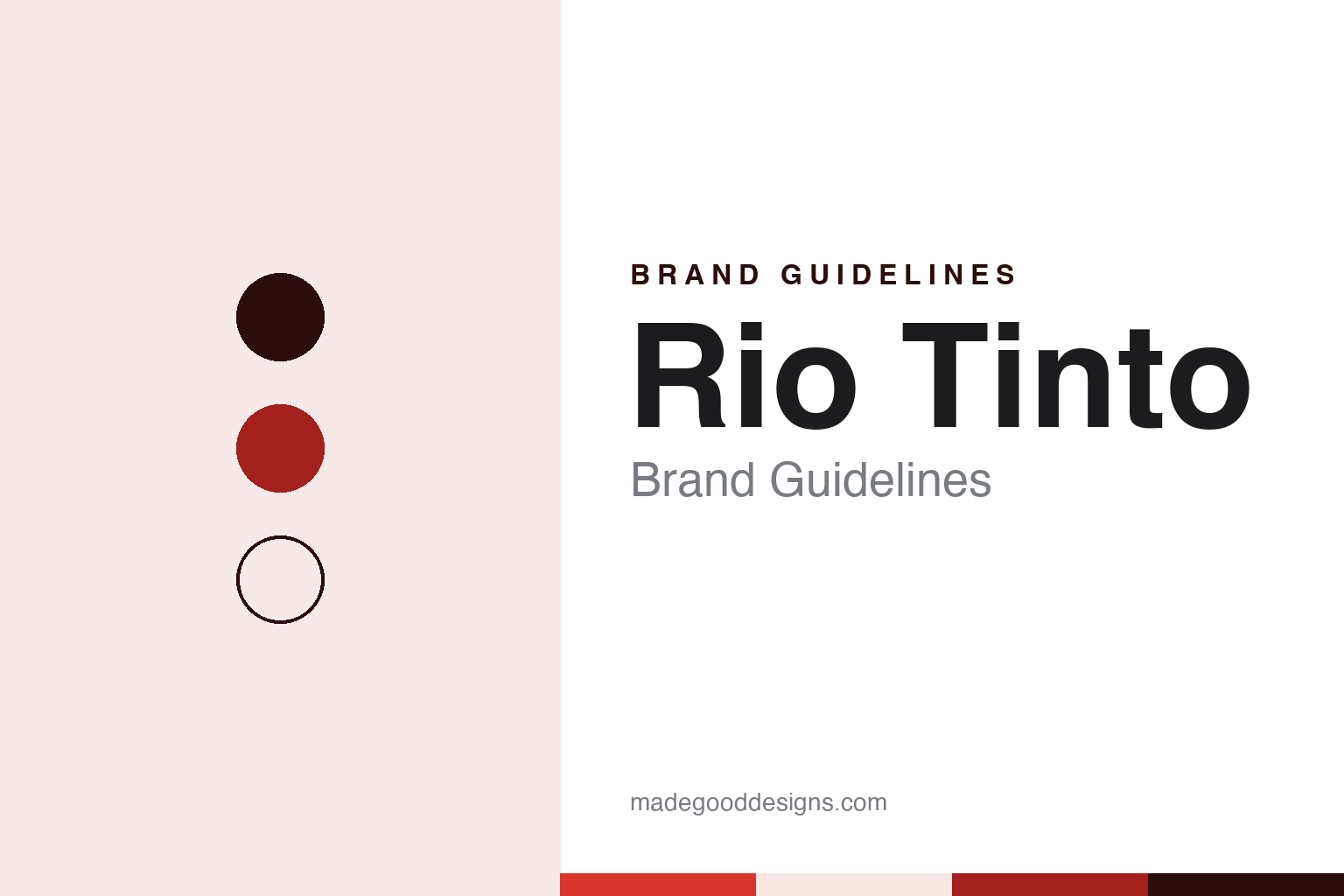
Two constants: a river red, ochre rust and pale clay palette and a plain grotesque register. Abstract homage — not a Rio Tinto asset or mark; no logo or wordmark is reproduced.
A river, a mine and a company
A Spanish auction in February 1873 and a London registration in March.
Rio Tinto takes its name from a river. The Río Tinto rises in the Sierra Morena mountains of Andalusia and runs south-southwest to the Gulf of Cádiz at Huelva. English Wikipedia explains that its water has a red and orange colour from its acidic chemistry and high levels of iron, and that “río tinto” means “coloured river” in Spanish, usually given in English as red river. The mines on its banks were worked long before any company existed; the same encyclopedia says copper, silver and gold were taken there in antiquity, and that the Spanish state reopened the workings in the eighteenth century.
The company was born when the state sold them. English Wikipedia records that the Spanish government held an auction for the mines on 14 February 1873 and that a group led by Hugh Matheson’s Matheson & Company won it, in a syndicate with Deutsche Bank and the civil engineering firm Clark, Punchard and Company. The syndicate then launched the Rio Tinto Company, registering it on 29 March 1873. ABC News summed up the origin in January 2026: Rio Tinto was founded in 1873 and is named after the river in Spain that was the site of its original copper mine.
For decades the company and the mine were almost the same thing. English Wikipedia says control passed to the Rothschild family at the end of the 1880s, and that the business stayed focused on its Spanish property until 1925, when Sir Auckland Geddes succeeded Lord Milner as chairman and brought in a new management team. Geddes pushed the company towards joint ventures and exploration outside Spain, and in 1929 it raised money to invest in copper mining in Northern Rhodesia, now Zambia, later grouping those holdings under the Rhokana Corporation.
The link to the river weakened in the 1950s. English Wikipedia says that in 1954 the Rio Tinto Company sold most of its stake in the mines from which it took its name, disposing of the rest over the following years, and used the proceeds to fund exploration elsewhere. The mines themselves continued under other owners: Mining Technology reported in July 2015 that EMED Mining, through its Spanish subsidiary EMED Tartessus, owned the historic Rio Tinto copper mine near Seville and was preparing to restart it. The company kept the name even after it had sold the place.
Colour
From a company name to a set of initials, and back again.
The name went through a long period of abbreviation. In 1962, English Wikipedia says, the Rio Tinto Company merged with the Australian firm Consolidated Zinc, which had grown out of zinc treatment at Broken Hill in New South Wales. The British parent became the Rio Tinto-Zinc Corporation, known as RTZ, and its main Australian subsidiary became Conzinc Riotinto of Australia, known as CRA. Both new names were joined from the old ones: zinc from Consolidated Zinc and Rio Tinto from the Spanish company, run together in the case of “Conzinc Riotinto”.
From 1962 until the mid-1990s those initials were the public face of the group. English Wikipedia describes RTZ and CRA as separately managed and separately traded, with CRA focused on Australasia and RTZ on the rest of the world. As the two companies’ interests began to overlap, shareholders of both agreed to combine them, and in 1995 they became a dual listed company, with one management team but shares in two separately named entities.
The interim name was simply the two sets of initials joined: RTZ-CRA. English Wikipedia says that after that period RTZ became Rio Tinto plc and CRA became Rio Tinto Limited, referred to together as Rio Tinto, a change made in 1997. The full words of the 1873 name, which had been compressed into letters in 1962, returned as the name of the whole group, on both sides of the world.
The same naming habit carried into later acquisitions. When Rio Tinto bought the Canadian aluminium company Alcan in November 2007, English Wikipedia says, the new division was called Rio Tinto Alcan, with its headquarters in Montreal, so the acquired name sat after the group name rather than replacing it. The shares still trade under the ticker RIO in London and in Sydney.
Typography
Mining company names and their marks.
Heavy-industry names tend to be built from the facts of their own formation. A merger of two firms often produces a compound name or a short string of initials, and those initials can outlive the words they once stood for, so a company is later known only by its acronym. Other names come straight from geography: a river, a hill, a harbour town or a mining district gives the company its word, and the place name travels with it to sites and offices far from the original ground.
The surfaces that carry these identities are unlike consumer packaging. A mark has to read on a gatehouse sign, on the side of a blast-furnace building or a conveyor gantry, and on stacks of coil and plate leaving a mill. It is printed on hard hats and high-visibility clothing, stencilled on ore wagons and locomotives, and painted on the hulls of ships and the bodies of haul trucks. Distance, dust, weather and heat all shape the design choices: heavy letterforms, a small number of solid colours and a symbol simple enough to survive being stencilled, embroidered or seen from a moving train.
Aa
A plain grotesque — after a short, two-word company name set without ornament. (Specimen set in Archivo, a sans STAND-IN; NOT the Rio Tinto logo or its typeface.)
Two companies, one name
Rio Tinto plc in London, Rio Tinto Limited in Melbourne.
The 1997 names describe how the group is built. English Wikipedia explains that Rio Tinto remains a dual-listed company: Rio Tinto plc is listed on the London Stock Exchange and Rio Tinto Limited on the Australian Securities Exchange, and the arrangement gives shareholders in the two companies equivalent economic interests, as if they held shares in one business. The group has head offices in London and Melbourne, so the British and Australian sides of its history are both present in its legal names.
The initials RTZ and CRA had each pointed to one side of the business, one British and one Australian; the single name Rio Tinto covers both. It also points to neither London nor Melbourne, but to a river in Andalusia from which the company sold its last mining stake decades ago.
The company has used its name on public projects as well as on reports. English Wikipedia records that Rio Tinto supplied the metal for the medals of the Salt Lake City 2002 Winter Olympics and the London 2012 Olympic and Paralympic Games, and that it held the naming rights to the Utah soccer stadium until 2022. In each case the two words appeared on their own, with no initials or subsidiary names attached.
For a design guide, Rio Tinto shows how a long corporate history can run through a single place-name, shortened into initials for decades and then restored in full as the name of a merged group. Compare Anglo American, another mining group whose name joins two places, and BHP, which also returned to an older name after a merger. For this guide we use river red, ochre rust and pale clay with a sans, an unofficial interpretation; no product or logo is reproduced.
Explore & save
Keep Rio Tinto’s identity on hand — save it to a board in the Made Good inspiration library.
Rio Tinto identity set
Pin the Rio Tinto river red, ochre rust and pale clay palette and the plain grotesque register to your own board.