Maya Brand Guidelines
A codename that stuck, a Toronto company and a year on every release.
Aa
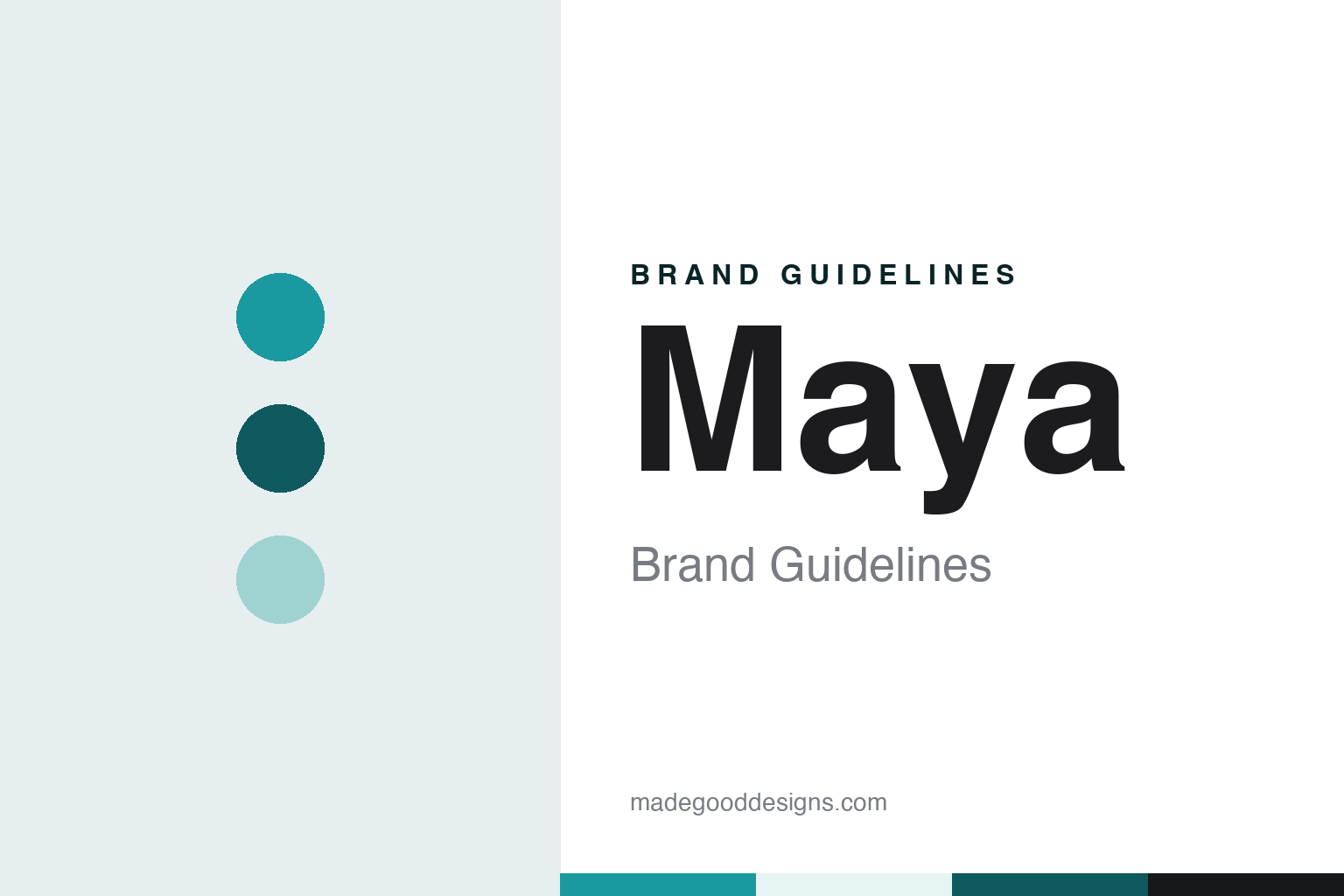
Two constants: a lagoon teal, deep teal and sea glass palette and a clean geometric sans register. Abstract homage — not a Maya or Autodesk asset or mark; no logo, icon or wordmark is reproduced.
Two companies, one codename
Alias, Wavefront and Silicon Graphics.
Maya grew out of two rival companies. The Los Angeles Times reported on 8 February 1995, in a story by Amy Harmon, that Silicon Graphics planned to buy Alias Research, based in Toronto, and Wavefront Technologies, based in Santa Barbara. The paper described the two as longtime competitors: Wavefront’s strength lay in animation, Alias’s in computer modelling, and both had found their early customers among industrial designers in the car and aircraft industries before entertainment work grew. Their tools, the paper said, had been used for effects ranging from Jim Carrey’s contortions in The Mask to the football-playing beer cans of the Bud Bowl commercials. At the news conference in Los Angeles, Wavefront co-founder Mark Sylvester said the two companies, working together, could tackle larger technical problems instead of duplicating each other’s work. The paper also reported that the move followed Microsoft’s purchase of their rival SoftImage the previous year, and that Microsoft planned to bring SoftImage’s tools to cheaper Windows NT personal computers.
The Alias half of the story has its own naming tale. English Wikipedia says Alias was founded in Toronto in 1983 by Stephen Bingham, Nigel McGrath, Susan McKenna and David Springer, and that in 1984, at a restaurant in Detroit during the SIGGRAPH conference, the founders chose the name Alias because the company’s only revenue at the time came from Springer’s work on an anti-aliasing program for Silicon Graphics. Alias 1 followed at SIGGRAPH in 1985, Wikipedia says, and later products included Studio and PowerAnimator.
After the 1995 deal the combined business became a Silicon Graphics subsidiary named Alias|Wavefront, with a vertical bar between the two names. Wikipedia says Maya was put together from several existing code bases — Wavefront’s The Advanced Visualizer, Thomson Digital Image’s Explore, Alias’s PowerAnimator and Alias Sketch! — with animation features added, and that the project’s codename was Maya. The codename became the product name. Walt Disney Animation Studios worked with the developers during its production of Dinosaur, Wikipedia says, and asked for a customisable user interface, a request that shaped the program’s open architecture.
Colour
A slash in the name, then a year.
Maya 1.0 was released in February 1998, Wikipedia says, running on SGI’s IRIX workstations and on Windows. Its early releases carried the parent’s name in front, as A|W Maya, through Maya 1.5 in October 1998 (an IRIX-only release), Maya 2.0 in June 1999, Maya 2.5 in November 1999 and Maya 3.0; Wikipedia’s release table lists Maya 3.0 in February 2000 as the version that added Linux, and Maya 3.5, in October 2001, came out as a Mac-only release. The program’s scripting also changed shape in those years. Wikipedia says development began with Tcl as the scripting language and that, after the merger with Wavefront, it was replaced with the Maya Embedded Language, or MEL, based on a language called Sophia from Wavefront’s Dynamation; Python was added later.
The company around the product changed its name and owner twice more before Autodesk arrived. Wikipedia says that in July 2003 Alias|Wavefront was renamed Alias Systems Corporation, and that in June 2004 Silicon Graphics sold the business to the Ontario Teachers’ Pension Plan and the private equity firm Accel-KKR. In September 2004 Alias acquired Kaydara, adding that company’s character animation and motion editing products to its line.
Then came Autodesk. Wikinews reported on 7 October 2005 that the California-based maker of AutoCAD had announced plans to acquire Toronto-based Alias, with completion expected within six months, and quoted Autodesk’s chief operating officer, Carl Bass. Wikipedia gives the announcement date as 4 October 2005 and the completion date as 10 January 2006. Autodesk has owned Maya since that deal completed. Under the new parent the product was renamed Autodesk Maya, though Wikipedia notes that “Maya” remains the name in everyday use.
Typography
Icons, splash screens and version names.
Design software carries its identity in places a printed product never has to. The app icon does the heaviest work: it sits in a dock or on a taskbar at a few dozen pixels, beside dozens of rivals, so it tends toward a single shape, one or two colours and a letterform or emblem that still reads when it is shrunk to the size of a fingernail.
The splash screen is the second stage: the image that fills the wait while a program loads. Some studios use it for artwork made with the software itself, changing it with each release, so the splash becomes a kind of dated record of the product’s look. Mascots appear more often in community-built and open-source projects, where a character can stand in for a volunteer team that has no corporate logo to lean on.
Version naming is part of the system too, whether it uses plain numbers, years or code names. Commercial vendors usually fold a product into a parent brand’s typeface and colour rules; open-source projects tend to keep looser, community-maintained marks. The palettes shown here are our interpretation, not official colours.
Aa
A clean geometric sans — after a short, four-letter product name. (Specimen set in Figtree, a sans STAND-IN; NOT the Maya logo, wordmark or any Autodesk typeface.)
Maya
From 8.5 to a year on the box.
The change of owner showed up quickly in the version names. Wikipedia’s release table lists Maya 8.0, in August 2006, as the earliest Autodesk-branded version and the earliest 64-bit one, followed by Maya 8.5 in January 2007, which the table credits with a Python API, support for Intel-based Macs and the Nucleus solver. With the next release, in September 2007, the product took the name Maya 2008 — internally still version 9.0 — and the numbering became year-based. Wikipedia’s entry on Alias makes the same point: all versions after 8.5 use a year-based convention, such as Maya 2008.
That calendar label has stayed. Each major release since has carried the following year’s number, so Maya 2026 arrived in March 2025 and Maya 2027 in March 2026, with Maya 2026 making OpenPBR the default material, according to Wikipedia’s release table, which cites Autodesk’s Maya 2027 release notes for the latest release date of 25 March 2026.
The identity, then, is layered. There is the bare four-letter name, kept from a development codename; the vertical-bar pairing of Alias|Wavefront that the program wore in its early years; the Toronto company named after a graphics technique; and, since January 2006, the Autodesk name placed in front, with a year attached to every release. Through all of it, the short word Maya has stayed the constant.
For a design guide, Maya shows how a codename can outlast the companies that coined it and survive three owners intact. Compare Autodesk, its owner since 2006, and ZBrush, a sculpting program that exchanges models with Maya through GoZ. For this guide we use lagoon teal, deep teal and sea glass with a sans, an unofficial interpretation; no product or logo is reproduced.
Explore & save
Keep Maya’s identity on hand — save it to a board in the Made Good inspiration library.
Maya identity set
Pin the Maya lagoon teal, deep teal and sea glass palette and the clean geometric sans register to your own board.