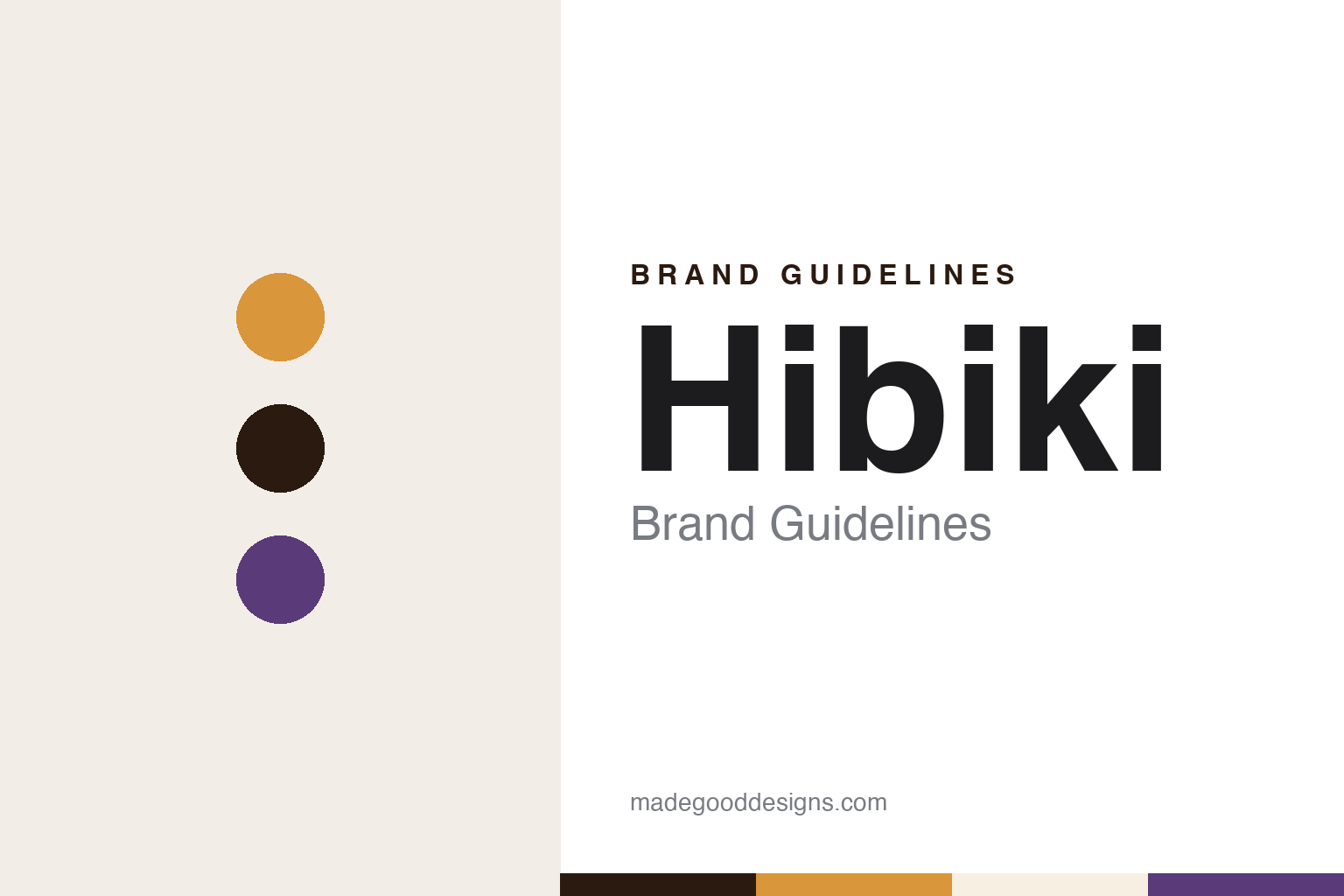
Hibiki Brand Guidelines
Suntory’s 1989 blend in a 24-faceted bottle.
Aa
Two constants: an amber, washi cream and purple palette and a Mincho serif register. Abstract homage — not a Hibiki product or mark; no bottle, label or calligraphy is reproduced.
A ninetieth-birthday blend
An anniversary whisky that became Suntory’s flagship blend.
Hibiki is a Japanese blended whisky made by Suntory, the drinks company that grew out of the wine shop Shinjiro Torii opened in Osaka in 1899. The whisky was introduced in 1989, and Japanese Wikipedia says the first release, a 17-year-old, was created to mark the company’s 90th anniversary and placed at the top of its blended range in Japan. English Wikipedia records that the brand launched with 17- and 21-year-old expressions, that a 30-year-old followed in 1997 and that a 12-year-old was added in 2009.
The name is a single word. Hibiki is Japanese for resonance or echo, and the character 響 is the centre of the label. As a blend, Hibiki draws on more than one Suntory distillery: English Wikipedia, citing reporting from 2015, names the Yamazaki and Hakushu malt distilleries and the Chita grain distillery as the sources for Japanese Harmony. An earlier report cited by English Wikipedia, from 2010, described a Hibiki blend of more than 30 whiskies, some aged over 30 years and some matured in casks that had held umeshu, the Japanese plum liqueur.
Ownership has stayed with Suntory, but the corporate structure around it has changed. Suntory bought the American company Beam Inc. in 2014, and English Wikipedia says Hibiki then sat within the new spirits business, Beam Suntory, headquartered in the United States; that business was renamed Suntory Global Spirits in 2024. In Japan the whisky is sold by Suntory’s domestic business.
Hibiki became internationally famous in part through film. English Wikipedia notes that in Sofia Coppola’s Lost in Translation (2003), Bill Murray plays Bob Harris, an American actor in Tokyo to shoot advertisements for Suntory whisky, and that Hibiki is the whisky in those scenes. Two decades later Coppola directed a short film for Suntory’s centenary in 2023, starring Keanu Reeves, English Wikipedia says.
Colour
Twenty-four facets and one brushed character.
The Hibiki bottle is the brand’s best-known design feature. Suntory’s release for a 2021 limited edition, reported by BevNET and The Whiskey Wash, says the bottle has been made with 24 facets since its introduction in 1989, and that the facets stand for the 24 hours of the day and the 24 seasons of the traditional Japanese lunar calendar. The bottle’s designer is not named in those releases.
The label carries a single hand-written character. Japanese Wikipedia says the 響 on the label was brushed by the calligrapher Ogino Tansetsu. Japanese Wikipedia also records that for the 2023 centenary edition Suntory used Echizen washi, a traditional hand-made Japanese paper, for the label.
Suntory has used the faceted bottle as a canvas for limited editions. The 2021 edition, the company said, was decorated around the theme “Ryusui-Hyakka,” or one hundred flowers and flowing water, to suggest time passing from one season to the next. English Wikipedia also describes a limited 35-year-old Hibiki presented in a ceramic decanter made with the ceramic artist Tokuda Yasokichi III, an example of the brand turning to Japanese craft for its rarest bottlings.
The range itself has narrowed and changed. Japanese Harmony, a blend without an age statement, was released in Japan on 10 March 2015, and Japanese Wikipedia says it was meant to take over from the 12-year-old as the entry point. English Wikipedia, citing reporting from 2015, says it blends at least ten malt and grain whiskies from the three distilleries, matured in five types of cask. Japanese Wikipedia says sales of the 12-year-old ended in Japan in 2015, and English Wikipedia notes that both the 12- and 30-year-old had gone from the company’s website by October 2017. Japanese Wikipedia records that shipments of the 17-year-old ended in July 2018 because demand for aged whisky had outrun stocks during Japan’s whisky boom.
Typography
Design and documentation.
The seven brands in this group are all Indian and Japanese spirits names: Old Monk, McDowell’s, Royal Stag, Officer’s Choice, Blenders Pride, Hibiki and Nikka. Spirits brands in general sit at many different points in the trade, from houses that still carry a founder’s name to labels that now belong to much larger drinks groups, and a single brand can be sold everywhere from a corner shop to a hotel bar.
A spirits brand’s identity is usually carried less by a single bottle than by a label, a name and the story it tells, because the company behind the name may have changed hands, moved its production or grown far beyond the place where it started. That makes the questions behind each name worth asking plainly: who started it, who owns it now, and where its whisky or rum is actually distilled, blended and bottled.
Each guide separates what independent sources record from what the company says about itself — its founding story, its owners over time, where its spirits are made and how its labels have changed — and marks plainly what rests only on the company’s own word.
響
A Mincho serif with a brush-like stroke for a single label character. (Specimen set in Shippori Mincho, a serif STAND-IN; NOT the Hibiki logo or the label calligraphy.)
Hibiki
Awards, scarcity and a bottle that changes its clothes.
The brand’s reputation rests heavily on competition results. Japanese Wikipedia lists a trophy for Hibiki 30 at the International Spirits Challenge in 2004 and the title of World’s Best Blended Whisky for the same expression at the World Whiskies Awards in 2007, and says Hibiki 21 took the blended category’s top prize at the World Whiskies Awards in 2010. English Wikipedia cites Whisky Magazine reporting in 2013 that Hibiki 21 had again won World’s Best Blended Whisky.
Those prizes were followed by a period of scarcity for aged Japanese whisky. The disappearance of the 12- and 17-year-olds left Japanese Harmony and the older age statements as the core of the range, while special editions of the faceted bottle kept the design in front of collectors.
The name also needs a little care. Hibiki is an ordinary Japanese word, used by many restaurants, bars and other businesses that have no connection with Suntory, so the whisky is best searched together with the Suntory name.
For a design guide, Hibiki shows how a bottle with a number built into its shape, a single brushed character and a quiet amber palette can carry a whisky’s meaning without a long label. Compare Suntory, the company behind it, and Nikka, the rival Japanese whisky maker. For this guide we use amber, washi cream and a ribbon purple with a Mincho serif, an unofficial interpretation; no product or logo is reproduced.
Explore & save
Keep Hibiki’s identity on hand — save it to a board in the Made Good inspiration library.
Hibiki identity set
Pin the Hibiki amber, washi cream and purple palette and the Mincho serif register to your own board.


