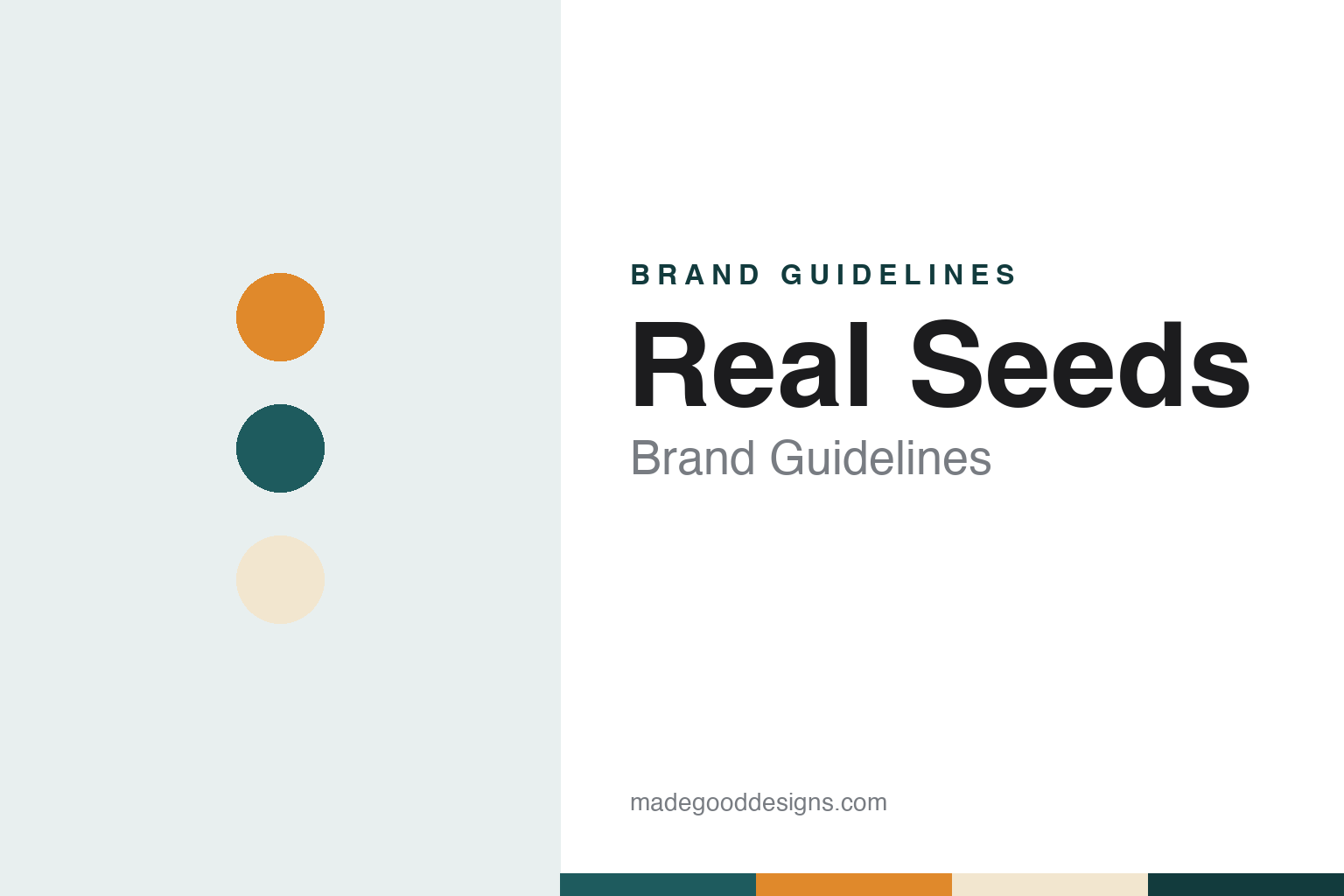
Real Seeds Brand Guidelines
The Pembrokeshire seed company that sells only seed you can save.
Aa
Two constants: a Real Seeds teal and orange palette and a slab serif register. Abstract homage — not a Real Seeds product or mark; no packet, logo or artwork is reproduced.
From Cambridge allotments
Two gardeners, and seed bred for the wrong job.
Real Seeds — the business trades as The Real Seed Catalogue — was started by Kate McEvoy and Ben Gabel. The company’s own account begins with allotments in Cambridge in the 1990s. Growing their own vegetables, it says, the pair came to realise that most modern varieties had been bred for large-scale chemical farming and for supermarkets that want tough, shiny produce, and that those varieties did poorly in a home garden without fertilisers and sprays.
So they went looking for older ones. In an interview published by the Gaia Foundation in December 2018, Kate McEvoy said they first grew seed for their own use and to swap with other enthusiasts, and began growing seed for sale in the late 1990s. The foundation’s profile adds that the business spent several years in Spain before settling in west Wales. The company says it has been based on a small farm in Wales since 2004; McEvoy described offices in Newport, in north Pembrokeshire, with the growing land a couple of miles away. A 2012 summer report on the company website is signed simply “Ben & Kate, Newport.”
The division of labour is plain on the company’s About page: Kate runs the farm and seed production, while Ben runs the office side — seed processing, packing and dispatch. The company says Kate had grown vegetables since childhood and Ben studied as a plant scientist. A Seed Sovereignty programme listing from 2018 also describes Ben as having a background in plant science, when he tutored a seed-selection workshop in East Devon with the South West Seed Savers Co-operative.
Colour
Only seed that breeds true.
The company’s legal home is The Real Seed Collection Ltd. Companies House lists it as a private company limited by guarantee without share capital, incorporated on 5 September 2006 and registered in Newport, Pembrokeshire. The website calls it a family-owned company registered in Wales, and says one of its aims — written into its deeds — is to encourage home seed saving.
That aim shapes the whole catalogue. Real Seeds sells no F1 hybrids and no genetically modified seed; every variety is open-pollinated, so a gardener can save seed that grows true the next year. The company argues the point at length on a page called “Why ‘Real’ Seed?”, setting out its case that hybrid seed ties growers to whichever company knows the parent lines. Orders come with printed growing notes and seed-saving instructions, and the company publishes freely copyable seed-saving guides alongside a more detailed book.
The varieties come from many places. The company says it trades with other collectors and heirloom vegetable projects, with government seed banks and with members of the public, and looks for plants well known abroad that could suit the UK. Everything is trialled first, it says, and the staff grow the vegetables for their own families too.
As for where the seed is grown, the company says it produces about half of its seed itself, which it calls an unusually high proportion, and buys in what it cannot grow in its climate from other seed companies. It also works with a network of growers on their own farms. In the 2018 Gaia Foundation interview, McEvoy said the company was working with the foundation’s Seed Sovereignty Programme to train new local growers, and pointed to an asparagus kale grown for Real Seeds by Debbie Rees at a permaculture market garden at Blaenffos, nearby in west Wales. The company describes itself as registered with DEFRA and the Soil Association as a seed merchant.
Typography
A homemade website and an old machine.
The seven brands in this group are all seed companies from Britain, France and Germany: Suttons, Vilmorin, Chiltern Seeds, Real Seeds, Unwins, Mr Fothergill’s and Bingenheimer Saatgut. Seed companies sit at many different points in the trade, from small specialist catalogues run by a handful of people to names that now belong to much larger horticultural groups, and a single brand can be sold through garden centres, supermarkets, mail-order catalogues and websites at once.
Some of them sell F1 hybrid varieties, bred from two parent lines, whose saved seed does not come true; others concentrate on open-pollinated varieties, which gardeners can save and re-sow. Some sell organic or biodynamic seed, certified to the standards of an inspection body, and some work with networks of growers who multiply the seed on their own farms.
A seed brand’s identity is usually carried less by the seed itself than by a name, a catalogue and the packet — the picture of the plant, the variety name and the sowing instructions — because the company behind the name may have changed hands, moved where its seed is grown or packed, or grown far beyond the place where it started. That makes the questions behind each name worth asking plainly: who started it, who owns it now, and where its seed is produced and packed.
Each guide separates what independent sources record from what the company says about itself — its founding story, its owners over time, where its seed is grown and how its catalogues and packets have changed — and marks plainly what rests only on the company’s own word.
Aa
A sturdy slab serif — the register of a plain, text-led seed list. (Specimen set in Bitter, a slab-serif STAND-IN; NOT the Real Seeds logo.)
Real Seeds
Made by the people who pack the seed.
Real Seeds’ identity is unusually homemade, and the company says so. “We make this website ourselves,” it tells visitors, adding that the text and pictures are by real people; it describes the site as written by gardeners for gardeners, and admits it “may not be particularly flashy.” The company once posted out a paper catalogue but has since dropped it, and now sells through the website alone, which it says lets it list rare seed in small quantities with live stock control.
The seed packet was designed in-house. The company says a member of its staff, Melissa, designed both the envelope artwork and its T-shirts. A later range of tote bags uses a line drawing by her based on the packet and on seeds drawn from opened packets, with coriander and fennel seedheads at the centre. The company describes the look as a nod to the artwork and colours of early lithography, from the heyday of traditional seed companies a century ago, and has printed it in colourways of oranges, teals and greens.
The machinery is part of the story too. The company says it packs a lot of its seed on two “Brown Bag Filling Machines” dating back to the 1890s — its About page says Melissa runs the antique packing machines — and that in 2022 it found four of the machines abandoned in a warehouse being redeveloped and saved three of them from scrap. Ben Gabel has published plans for a small seed-cleaning machine under a Creative Commons non-commercial licence instead of patenting it, saying he wanted to help small seed companies everywhere.
For a design guide, Real Seeds shows how a small company can make its beliefs its brand, through a plain website, a lithograph-inspired packet and seed-saving instructions in every order. Compare Bingenheimer Saatgut, a German seed company that also sells open-pollinated organic seed, and Chiltern Seeds, another family-run mail-order seed house in Britain. For this guide we use a lithograph teal, a seed-packet orange and a kraft cream with a slab serif, an unofficial interpretation; no product or logo is reproduced.
Explore & save
Keep Real Seeds’s identity on hand — save it to a board in the Made Good inspiration library.
Real Seeds identity set
Pin the Real Seeds teal and orange palette and the slab serif register to your own board.


