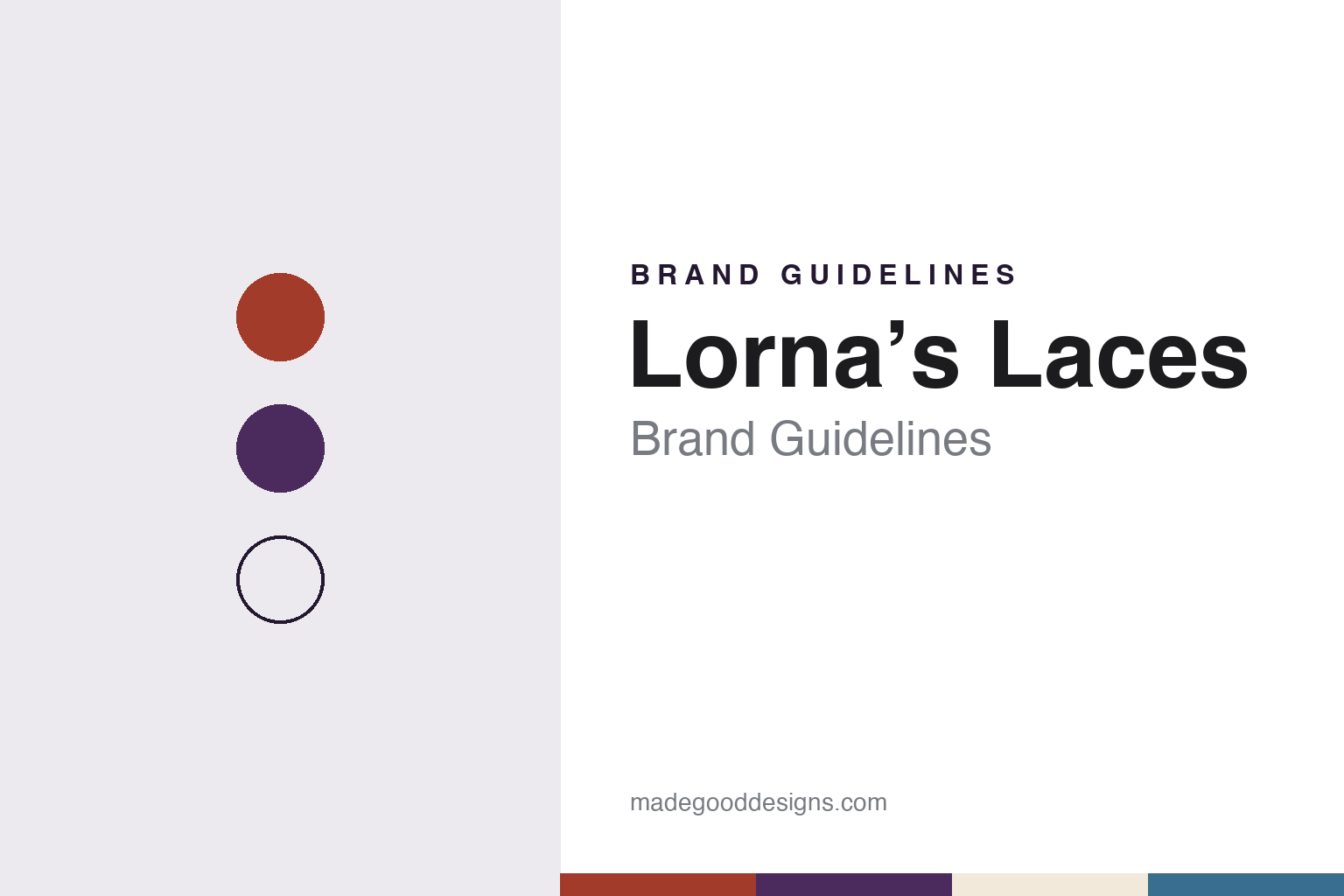
Lorna’s Laces Brand Guidelines
The California hand-dyer that moved to Chicago and named its colours after the city.
Aa
Two constants: a brick red, violet and cream palette and a warm editorial serif register. Abstract homage — not a Lorna’s Laces product or mark; no skein tag, logo or label is reproduced.
Lorna Miser
A California hand-dyer that changed hands through a classified ad.
Lorna’s Laces was a hand-dyed yarn company named after its founder, Lorna Miser, a knitter and designer who built the business in California. The company’s own blog calls her “the founder of Lorna’s Laces,” and some of its colours go back to her time in charge. A colourway called Aslan, the blog says, was designed by Lorna Miser “way back in 1996” and named after her cat. The laceweight yarn Helen’s Lace was named after her maternal grandmother, who knitted lace doilies. We could not find a documented founding year in the sources we checked, so we give none.
The company changed hands through a classified advertisement. In a 2007 blog post titled “How it all began,” the next owner, Beth Casey, wrote that she had spent eleven years as a college-textbook sales representative. Then she spotted a half-inch ad in the back of a knitting magazine: “Hand dyed yarn company for sale. Can be relocated.” She contacted the seller, Lorna Miser, and in the autumn of 2002 flew to California to see the business. She spent two days with Miser and learned that Shepherd Sock was the best-selling yarn. Casey wrote that the sale was announced at the TNNA trade show in January 2003. The deal closed, and the company “opened for business in Chicago,” on 10 February 2003, a date the blog marked as an anniversary for years afterwards.
In Chicago the dye studio was in the Ravenswood neighbourhood on the city’s north side. In 2009 the blog described the building as an old warehouse converted into small spaces for artisan companies that make physical products. Casey thanked Lorna Miser publicly for trusting her to carry on what she had built, and the founder stayed involved. In 2010 the company dyed a colourway, Lorna’s Purple Mustang, to mark the release of Miser’s book The Knitter’s Guide to Hand-Dyed and Variegated Yarn.
Colour
Shepherd yarns, Chicago names and guest colourists.
The core of the range was the Shepherd family of Shepherd Sock, Sport, Worsted and Bulky. Alongside it were yarns such as Solemate, Sportmate, Honor and Cloudgate, all still listed on the company’s website. The site gives Shepherd Sock as 80% superwash merino and 20% nylon. In the 2010s the homepage made a point of flexibility: “ANY of our yarns can be dyed in ANY of our colorways,” it said. The colours were sorted into Nearly Solids, Multis and, later, Splattershot!.
The colour names became a signature. The blog explained in 2009 that colours were often named after places connected to the company. Ravenswood was named for the studio’s neighbourhood and Bittersweet for a street where the owner once lived. Later seasons toured the city, with names such as Grant Park, Midway, Hermosa, Magnificent Mile and The “L”. In 2013 came a series named after Chicago mayors, starting with Byrne, after Jane Byrne, the city’s first female mayor.
Lorna’s Laces also worked with well-known knitters. It launched its Color Commentary series in June 2008, inviting guests into the dye studio, and the first colourway was made with the blogger and designer Franklin Habit. Later partners named on the blog include Annie Modesitt, Clara Parkes of Knitter’s Review, Ysolda Teague and Jared Flood of Brooklyn Tweed, whose Grand Street Ink came out in 2011. A separate series of limited-edition colourways was sold through the retailer Jimmy Beans Wool; the blog said in 2014 that it had been running for seven years.
The company was open about its methods. In March 2008 Casey wrote about an organic merino range, the Green Line, which had been meant to use natural dyes. The three-step scour, mordant and dye process needed around 36 gallons of water and eight hours of heating. The company’s usual single-step method used about seven gallons to dye ten pounds of yarn. Casey concluded that natural dyes were using more natural resources than made sense, and the line went back to conventional dyes. These are the company’s own figures.
Typography
Yarn makers and documentation.
The seven brands in this group all sell yarn for hand knitting and crochet, and they come from six countries: Gepard Garn from Denmark, Berroco and Lorna’s Laces from the United States, Retrosaria from Portugal, Biches & Bûches from France, Kremke Soul Wool from Germany and Lanas Stop from Spain. Between them they show several very different ways of putting a ball or skein of yarn on a shop shelf.
Some yarn brands are the visible face of a mill or a family firm, and their names are bound up with a place, a fibre or a long run of pattern books. Others are design-led labels that choose fibres and colours and commission the spinning from someone else. Some dye by hand in small batches; some pass from one owner to another while the name on the label stays the same; and a few survive mainly as a name inside another company’s range.
Each guide separates what independent sources record from what the company says about itself — who founded it, who owns it now and where its yarn is made — and marks plainly what rests only on the company’s own word.
Aa
A warm, soft-edged serif for a dye studio that told its story in a blog. (Specimen set in Fraunces, a serif STAND-IN; NOT the Lorna’s Laces logo.)
Closing notice
“What do you say after a lifetime?”
Lorna’s Laces has announced its closure. In October 2026 its homepage carried a notice headed “What do you say after a lifetime?” The notice says that “the very difficult decision has been made to close up shop at Lorna’s Laces and Mrs. Crosby,” its sister brand. It adds that “the last few years have been incredibly difficult with sales dropping 93%” and that “we just could not stay afloat.” The 93% figure is the company’s own. Archived copies of the homepage date the notice to the summer of 2021. It does not appear in a copy captured on 18 June 2021 but does appear in one from 15 July 2021, and it has stayed on the site since. We found no independent news report of the closure in the sources we checked, so the date rests on those archived copies.
The notice thanks “everyone who supported us over the years” and points knitters to a list of shops that bought inventory in the company’s final year. The website still shows its yarn and colour pages. But its menu no longer has the shop and wholesale links it carried before the announcement, and the notice ends: “Here’s to the next chapter.”
For a design guide, Lorna’s Laces shows how a small hand-dyer can build an identity out of colour names and place: first a founder’s cat and grandmother, then a city’s parks, trains and mayors. Compare madelinetosh, a Texas hand-dyer, and Hedgehog Fibres, the Cork hand-dyer known for speckled colour. For this guide we use a brick red, a deep violet and an undyed cream with a serif, an unofficial interpretation; no product or logo is reproduced.
Explore & save
Keep Lorna’s Laces’s identity on hand — save it to a board in the Made Good inspiration library.
Lorna’s Laces identity set
Pin the Lorna’s Laces brick red, violet and cream palette and the warm editorial serif register to your own board.