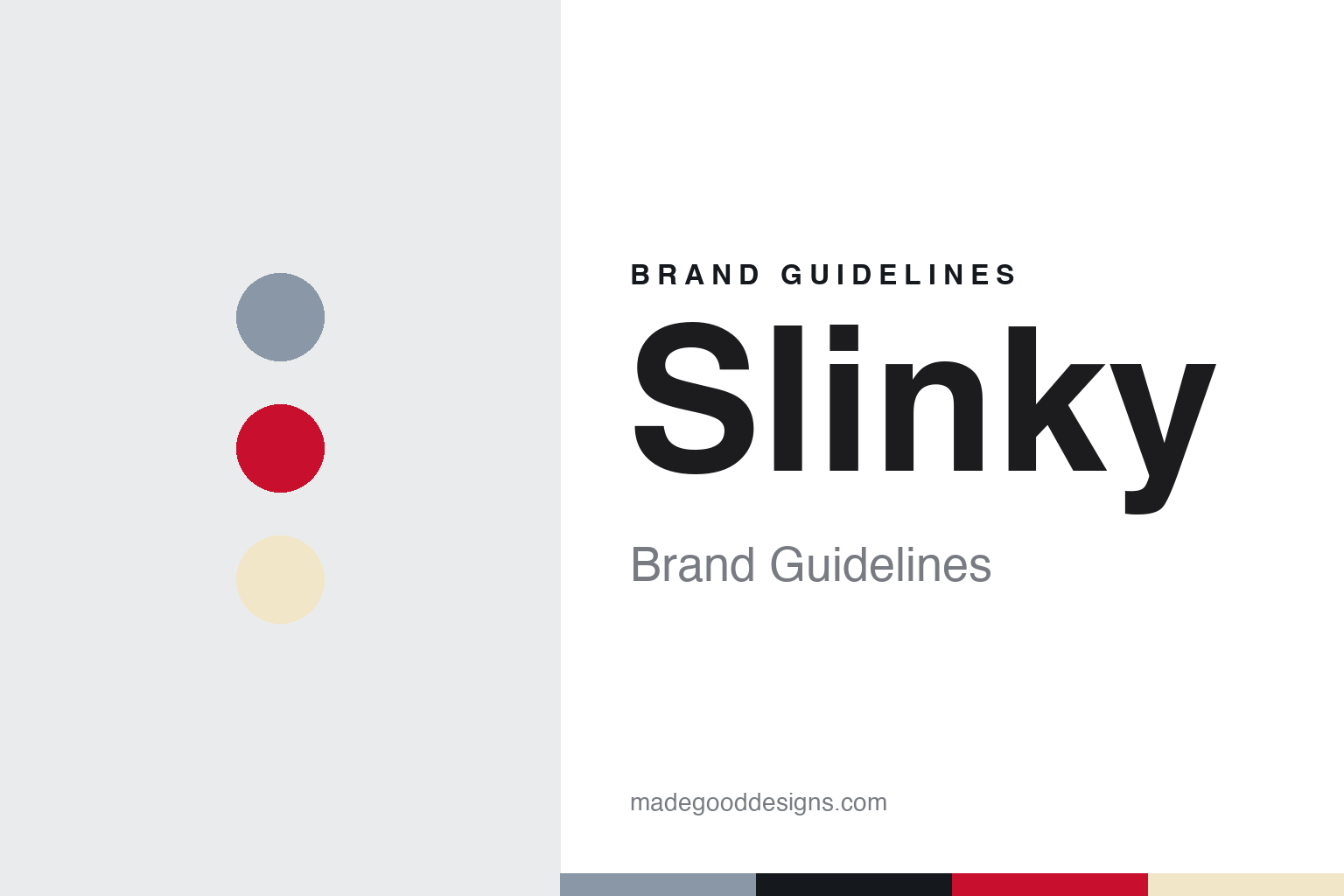
Slinky Brand Guidelines
A steel coil, a staircase and a name from the dictionary.
Aa
Two constants: a spring steel, box red and stair cream palette and a soft display serif register. Abstract homage — not a Slinky product or mark; no spring, box or logo is reproduced.
A spring that walked
A naval engineer, a shelf and a dictionary.
The Slinky story begins with a spring that fell off a shelf. The Strong National Museum of Play in Rochester, New York, says on its National Toy Hall of Fame page that mechanical engineer Richard James was working in 1943 on springs that could keep sensitive equipment steady on ships at sea. When he knocked some samples off a shelf, the museum says, he watched them “walk” down rather than simply fall. Together with his wife Betty, James set out to turn that movement into a novelty toy.
The name came from Betty. The Strong says she combed the dictionary for a suitable word and settled on “Slinky”, and Smithsonian magazine, in an August 2019 article by Rachael Lallensack, dates her search to 1944 and says that it was Betty who masterminded the toy’s success. The museum adds that Richard James designed a machine to coil 80 feet of wire into a two-inch spiral, the format that still defines the product.
The couple then set up a business to make it. Smithsonian says they co-founded James Industries in 1945, the year the Slinky reached shops, and that it was originally made in Clifton Heights, a suburb of Philadelphia. Selling it took a demonstration. The Strong says early sales were slow until the Gimbels department store in Philadelphia allowed the couple to show the spring in action for Christmas 1945, and that shoppers responded quickly once they saw it move. Just Play’s 2020 acquisition release adds that the Slinky made its trade debut at the American Toy Fair in 1946.
Colour
A coil, a staircase and a jingle.
The Slinky’s identity is unusually tied to motion. The product itself is a plain helix of flat wire with no printed surface, so the brand has been carried by the way the spring moves and by the advertising that showed it. The Strong describes an advertising jingle that made the name familiar across the United States, quoting its opening line, “What walks down stairs alone or in pairs and makes a slinkety sound?”, and its answer: “A spring, a spring, a marvelous thing. Everyone knows it’s Slinky!” The museum notes that Slinkys glided down stairs on television, though most household steps proved too tall and too wide for a long descent.
That mix of a simple object and a demonstrated trick links the toy’s two public moments. The 1945 store demonstration at Gimbels relied on letting shoppers see the coil step down a slope, and the later television advertising repeated the same idea for a national audience. The visual cues that follow from it are few and specific: the stacked rings of the coil, the arc it makes as it moves from one step to the next, and the name itself, which the Jameses chose to describe the movement rather than the material.
The museum recognised the Slinky formally in 2000, when it was inducted into the National Toy Hall of Fame at The Strong. Just Play’s 2020 release adds that the toy was given a place at the Smithsonian’s National Museum of American History in 2002, a claim made in the company’s own announcement. Smithsonian’s 2019 article notes that the toy’s invention is commemorated in Clifton Heights, the town where it was originally made.
Typography
Design and documentation.
The brands in this group are classic toys: simple objects and materials whose names have outlasted the people who first sold them. Classic toy brands in general sit in an unusual place in the trade, because a name that began with a single maker, a small workshop or an inventor’s idea can pass through several owners and end up as one line among many in a much larger toy or craft group.
A toy brand’s identity is often carried less by the object itself, which can be simple to describe, than by a name, a container, a colour and the advertising that first made it familiar. The company behind that name may have changed hands, moved its production or widened the range far beyond the original product, so the useful questions stay plain: who started it, who owns it now, and where it is made.
Each guide separates what independent sources record from what the company says about itself — its origin story, its owners over time, where its products are made and how its packaging and marks have changed — and marks plainly what rests only on the company’s own word.
Aa
A soft, high-contrast display serif with rounded terminals. (Specimen set in Fraunces, a display-serif STAND-IN; NOT the Slinky logo.)
Slinky
From Alex Brands to Just Play, and back to Hollidaysburg.
The brand has passed through several owners in recent decades. In a release dated 2 July 2020 and reported the same day by James Zahn in The Toy Book, Just Play said it had acquired Slinky and the craft brand Shrinky Dinks in the auction of Alex Brands’ assets held that May. Just Play said Alex Brands had acquired Slinky in 2013 and Shrinky Dinks the following year. The Toy Book reported that Alex Brands had begun celebrating Slinky’s 75th anniversary at Toy Fair New York in February 2020, before those plans were halted by the COVID-19 pandemic and the closure of Alex Brands.
Just Play describes itself as a Pennsylvania-based toy company, and its release says it was founded in 2010 by toy industry veterans Charlie Emby and Geoffrey Greenberg, who served as its co-presidents. The company said it was reopening the facility in Hollidaysburg, Pennsylvania, where Slinky and Shrinky Dinks are produced, and rehiring employees to keep the jobs and manufacturing in the United States. It also announced a 75th Anniversary Slinky collection for the US market in August 2020, and said it wanted to celebrate the toy’s heritage as an American-made product with a long Pennsylvania history. “We are very excited to add the beloved and celebrated Slinky and Shrinky Dinks brands and team members to Just Play’s family,” Greenberg said in the release, and The Toy Book reported that new products from both brands were due in shops that autumn, in time for the holiday season.
For a design guide, Slinky shows how a brand can rest on a single movement: a coil stepping down a staircase, a name chosen to describe it and a jingle that put the two together. Compare the slingshot-named company in our Wham-O brand guidelines and the bouncing putty in our Silly Putty brand guidelines. For this guide we use spring steel, box red and stair cream with a serif, an unofficial interpretation; no product or logo is reproduced.
Explore & save
Keep Slinky’s identity on hand — save it to a board in the Made Good inspiration library.
Slinky identity set
Pin the Slinky spring steel, box red and stair cream palette and the soft display serif register to your own board.


