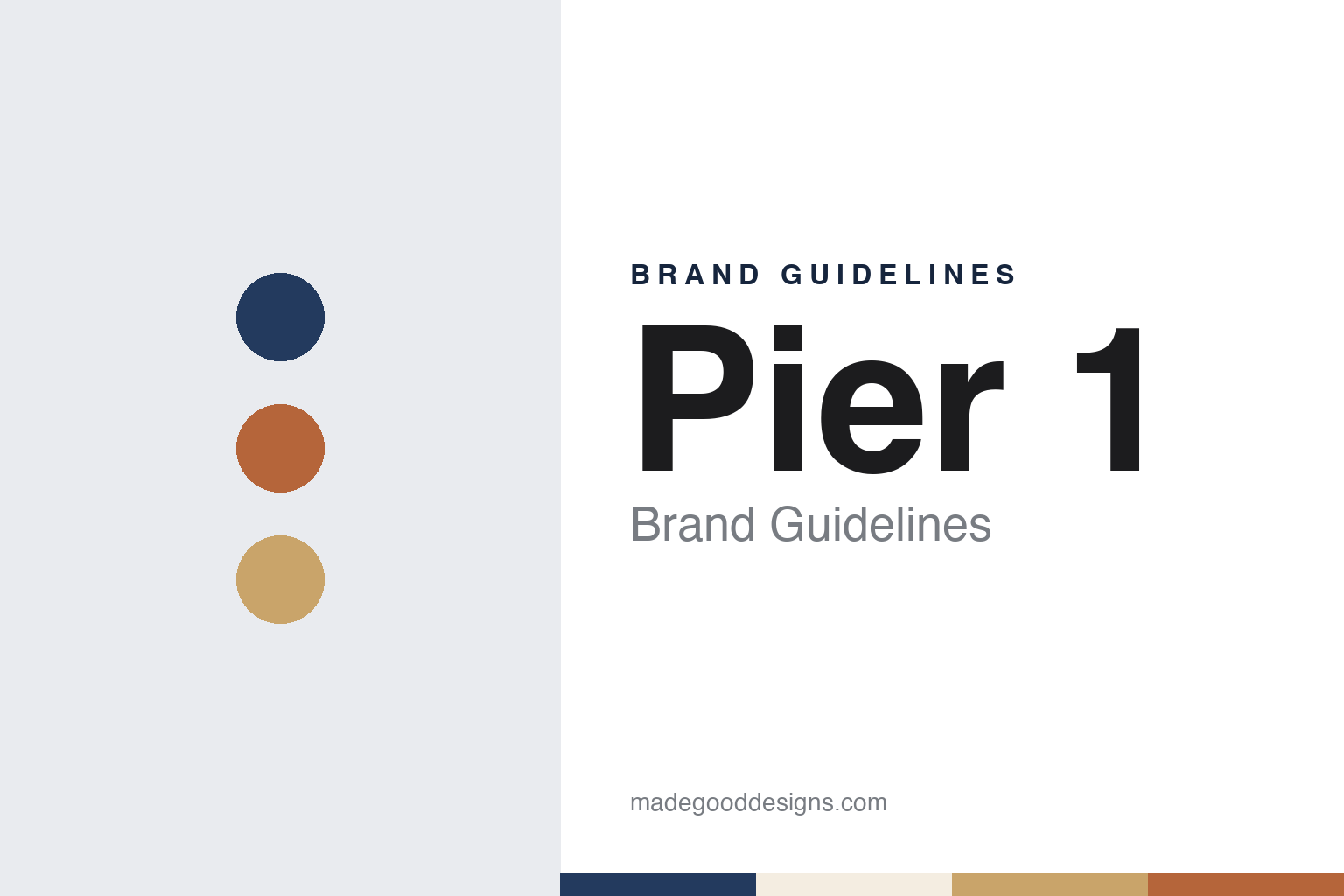
Pier 1 Brand Guidelines
An import shop that became a national chain, then a name carried on online.
Aa
Two constants: a harbour indigo, terracotta and rattan tan palette and a high-contrast import serif register. Abstract homage — not a Pier 1 product or mark; no store sign, bag or logo is reproduced.
A franchise in San Mateo
A Texas investment in a California import shop.
Pier 1 started under another name. English Wikipedia says that in 1962 Charles D. Tandy and Luther Henderson of the Tandy Corporation lent money to the California chain Cost Plus Imports in exchange for franchise rights, and that their first franchised store opened that year in San Mateo, California. The International Directory of Company Histories (volume 34, St. James Press, 2000) traces Cost Plus itself to 1958, when the owner of a San Mateo rattan furniture importer and wholesaler opened a liquidation outlet under that name, and says Henderson was serving at the time as treasurer of the Tandy Corporation.
The idea was imports sold plainly. The same directory says the plan relied on buying goods at low cost from countries such as Mexico, India and Thailand, and it quotes a later chief executive, Clark Johnson, recalling that the early stores “had the look of an old grocery store”. Wikipedia says that by 1966 the franchised shops stood in both California and Texas, so the business was already split between the West Coast where the concept came from and the Texas base of its backers.
The name arrived in 1966. Wikipedia says that year the franchises were rebranded Pier 1 Imports and a new corporate headquarters was set up in Fort Worth, Texas, alongside Radio Shack, another Tandy holding. The International Directory of Company Histories gives a more specific account: it says that on 10 February 1966 a group of investors led by Henderson bought Tandy’s Cost Plus operation and changed the name to Pier 1 Imports “to reflect the store’s import emphasis”. Both accounts place the birth of the Pier 1 name in 1966 and its home in Fort Worth.
Colour
A listed chain built on imported goods.
Pier 1 became a public company within a few years of taking its name. Wikipedia says it listed on the American Stock Exchange in 1970 and moved to the New York Stock Exchange in 1972, where it traded under the ticker PIR, and that around that time it opened stores abroad in Australia and Europe. It also records a later venture in Asia: from April 1996 to early 2002, Wikipedia says, Pier 1 had a presence in the Greater Tokyo Area through franchised stores operated by Akatsuki Printing Co.
The merchandise was the brand. Wikipedia describes Pier 1 as a specialist in imported home furnishings and décor, particularly furniture, tabletop items, decorative accessories and seasonal decorations. It lists candles, vases and picture frames alongside upholstered furniture, hand-carved armoires, large vases and eclectic wall décor, and says items were imported, created with foreign designers or produced by Pier 1’s own Trend and Product Development team. The International Directory of Company Histories says Pier 1 launched its first national television advertising in July 1995, and Wikipedia names the actor Kirstie Alley and the designer Thom Filicia as former spokespeople seen largely in broadcast commercials.
Pier 1 also lent its shop floor to a charity. Wikipedia says the company became a corporate partner of the U.S. Fund for UNICEF in 1985, selling UNICEF greeting cards and supporting cause marketing and emergency relief through the partnership. For a chain whose stock was gathered from many countries, the link with an international children’s charity sat comfortably next to the merchandise.
Typography
Design and documentation.
The brands in this group are American home-furnishings retailers: store and catalogue chains that sell furniture, tableware, lighting and decorative goods under their own names. A retailer of this kind usually designs or commissions much of what it sells and has it made by outside suppliers, so the name on the shopping bag is often the same name that appears on the product itself.
For a home-furnishings retailer, identity is carried less by any single object than by the whole experience around it: the wordmark over the door, the catalogue that arrives in the post, the way a room is staged on the shop floor or on a website, and the bag a customer carries home. Because these companies are often owned by larger groups, sold, merged or rebuilt after hard years, the questions behind each name are worth asking plainly: who started it, who owns it now, and where the goods it sells are designed and made.
Each guide separates what independent sources record from what the company says about itself, covering its founding story, its owners over time and how its stores and catalogues have changed, and it marks plainly what rests only on the company’s own word.
Aa
A high-contrast display serif for a catalogue-cover register. (Specimen set in DM Serif Display, a serif STAND-IN; NOT the Pier 1 logo.)
Pier 1
From store closures to an online brand.
The store chain ended in 2020. FOX 13 reported on 17 February 2020 that the Fort Worth company, founded in 1962, was filing for Chapter 11 bankruptcy protection, and that the closures it had announced in January included all of its stores in Canada. Wikipedia says the filing was made that day in the federal bankruptcy court for the Eastern District of Virginia, and that on 19 May 2020 the company asked the court to close all of its stores, citing in large part the COVID-19 pandemic and its failure to find a buyer. Retail Dive reported in July 2020 that Retail Ecommerce Ventures (REV) had won the bankruptcy auction for Pier 1’s intellectual property, data and e-commerce assets, with Sycamore Partners named as the backup bidder. Wikipedia says the last stores closed at the end of October 2020.
The name went online. CultureMap Dallas reported on 29 October 2020 that REV, which it described as a Miami-based investment firm, had relaunched the brand as Pier1.com, an online store based in Dallas, selling furniture, lighting, fragrance, tableware and décor, and that it had hired former Pier 1 buying, marketing and customer-support staff. Ownership then moved again. Retail Dive reported on 22 May 2024 that Omni Retail Enterprises, a new company that had acquired most of REV’s assets, was the parent of Pier1.com, and that the deal had allowed REV to dissolve as an operating entity without a bankruptcy filing. Omni Retail Enterprises has owned Pier 1 since 2024.
For a design guide, Pier 1 shows how a retail name can carry a promise of somewhere else: the word “pier” and the word “imports” point to cargo and travel, and the brand has kept that name from a San Mateo franchise through a Fort Worth chain to a Dallas web shop. Compare the American home retailers in our Pottery Barn brand guidelines and our Crate & Barrel brand guidelines. For this guide we use harbour indigo, terracotta and rattan tan with a serif, an unofficial interpretation; no product or logo is reproduced.
Explore & save
Keep Pier 1’s identity on hand — save it to a board in the Made Good inspiration library.
Pier 1 identity set
Pin the Pier 1 harbour indigo, terracotta and rattan tan palette and the import serif register to your own board.


