Waterworks Brand Guidelines
A family bath shop in Connecticut that grew into a house of fittings.
Aa
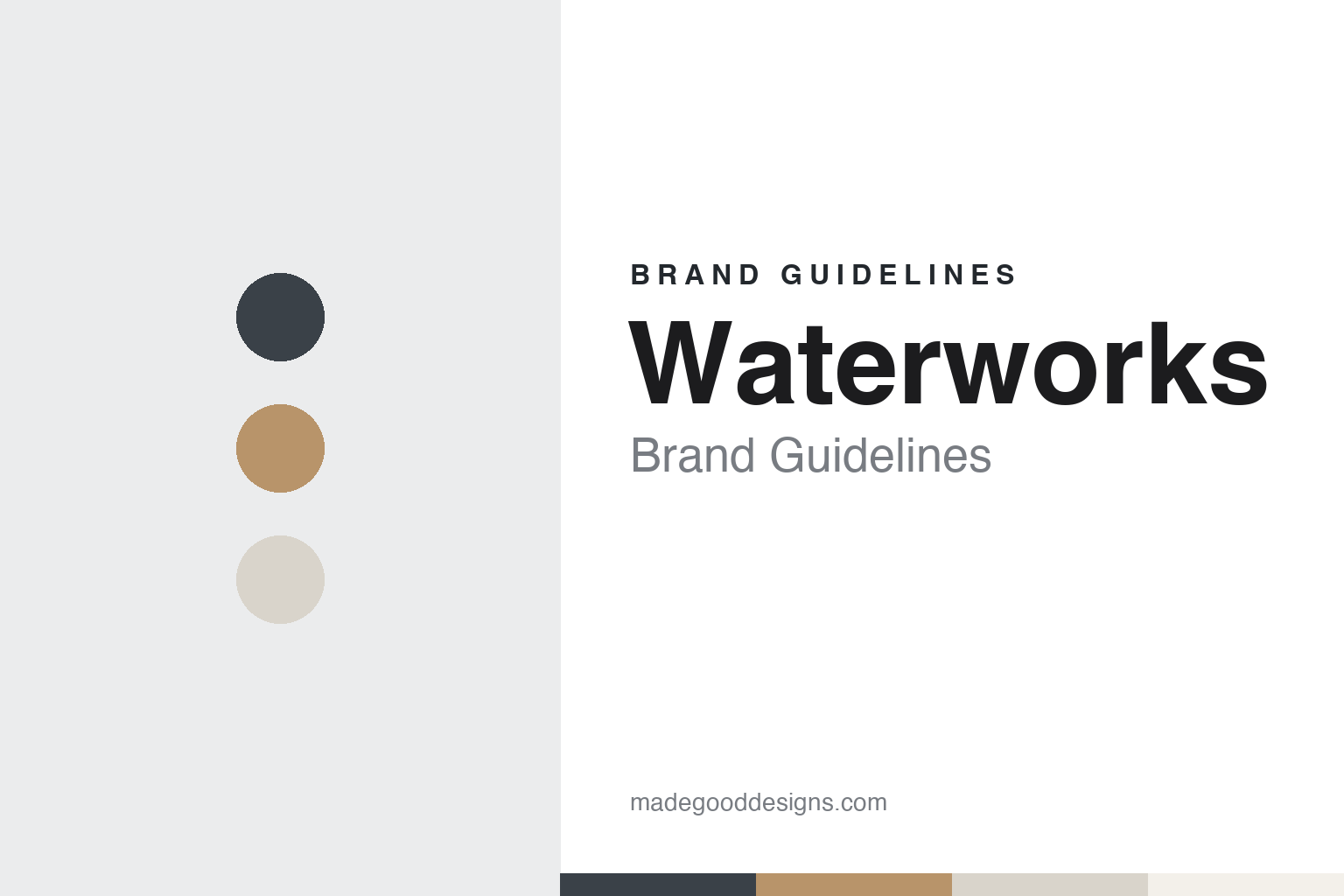
Two constants: a nickel grey, brass and marble palette and a classic bookish serif register. Abstract homage — not a Waterworks product or mark; no fitting, finish or logo is reproduced.
A family business in Connecticut
From a local bath store to a house of fittings, fixtures and tile.
Waterworks dates itself to 1978. A Form 8-K filed by Restoration Hardware Holdings, now RH, in May 2016 describes Waterworks as co-founded in 1978 by Barbara and Robert Sallick, and the company’s own About Us page, as archived by the Internet Archive in July 2026, says it started “as a small family business” that year. The same page says Waterworks was founded as a seller of specialty bath fittings for homes in Connecticut.
The family story is told most fully in an older version of the company’s website. A “Company History” page captured by the Internet Archive in December 2001 said that Waterworks had grown “from the local store his parents started in 1978 in Connecticut”, the parents being those of Peter Sallick, under whose direction the page said the business had expanded. It named Barbara Sallick as Vice President of Design and credited her with bringing the Waterworks aesthetic to life through “clean, classic, and functional designs”.
Peter Sallick has led the company for a long stretch. Business of Home reported on 13 April 2016 that he had been chief executive since 1993, and the company’s current About Us page describes him as CEO and Creative Director and says he has led Waterworks for more than thirty years. That page also says his collecting instincts, his approach to design and his connections in the design community inform the way the company develops products, working with a team of creators, product developers, engineers and production specialists.
The 2001 history set out how wide the range had already become. It listed fittings, fixtures and tubs, accessories, furniture, kitchen and bar, tile, stone and mosaics, textiles and apothecary among the company’s categories. The company said its tiles were hand-glazed and its mosaics hand-assembled to keep colour balanced. It also said Peter Sallick had conceived the Waterworks Collection, introduced in 1998, to bring towels, baskets, bath textiles, furniture scaled to the bathroom, and apothecary items into the same setting as faucets and tile.
The Built In company directory lists the company’s headquarters in Danbury, Connecticut.
Colour
Three brands, a new owner and a showroom network.
By 2016 Waterworks was organised as more than one brand. The 8-K that RH filed with the US Securities and Exchange Commission says Waterworks “is comprised of the Waterworks, Waterworks Kitchen and Waterworks Studio brands”. Business of Home, reporting the announcement of the deal in April 2016, listed the same three names and said the company’s products were sold through its showrooms in the United States and the United Kingdom, through boutique retail partners, through a hospitality division and online.
Ownership changed in 2016. Restoration Hardware Holdings announced its agreement to acquire Waterworks in April, and the company’s 8-K states that on 27 May 2016 it “completed its previously announced transaction with Waterworks”. RH has owned Waterworks since May 2016. Business of Home reported that the two businesses would operate separately until the transaction closed, and quoted Peter Sallick saying, “We enter this new partnership with a great sense of excitement and pride.”
Within RH, Waterworks has kept its own name and its own shops. RH’s annual report on Form 10-K for the fiscal year ended 1 February 2025 lists Waterworks Showrooms among the company’s retail locations alongside RH Galleries, notes that its locations in the United Kingdom include a Waterworks Showroom, and says that Waterworks products are sold online through both waterworks.com and rh.com. The same filing reports Waterworks separately as part of its segment information and says one fulfillment centre in the United States services Waterworks products.
The range today reaches well beyond the bathroom tap. The company’s About Us page lists bath and kitchen fittings, bathtubs and sinks, accessories and lighting, surfaces and cabinetry, and describes them as a proprietary vision for the bath and the kitchen. It says the collection covers traditional, transitional and contemporary aesthetics, and names the materials it works with: brass, glass, ceramic, stone, cotton, leather and wood.
On making, the company speaks in general terms. Its About Us page says that design and engineering meet “in our factories”, where it aims for what it calls a “just right” mix of artisanship and technology, and it cites AI-enabled machine tools to turn metal, water-jet lathes to shape marble, and LED lighting. It lists casting, forging, turning, carving, engraving, enamelling, weaving and glazing among the techniques that interest it, and says its engineering defines the waterways, connections, valves and compliance standards that a fitting needs. The page does not name the countries where those factories are. Waterworks also says it sells most of its products directly to customers, and uses select retail partners for the rest.
Typography
Design and documentation.
The brands in this group all make faucets and bath fittings: the taps, spouts, shower valves, drains and accessories that sit at the most visible points of a kitchen or bathroom. Brands in this trade sit at many different points in it, from family firms that still carry a founder’s outlook to names that now belong to much larger building-products groups, and a single brand may be sold through specialist showrooms, trade counters, home centres or online.
A fittings brand’s identity is usually carried less by a single logo than by a set of finishes, a catalogue of named collections and the shapes of its handles and spouts, because the company behind the name may have changed hands, moved its manufacturing or grown far beyond the place where it started. That makes the questions behind each name worth asking plainly: who started it, who owns it now, and where its fittings are actually made and finished.
Each guide separates what independent sources record from what the company says about itself — its founding story, its owners over time, where its products are made and how its range has changed — and marks plainly what rests only on the company’s own word.
Aa
A classic, bookish serif in the spirit of a heritage showroom catalogue. (Specimen set in Cormorant Garamond, a serif STAND-IN; NOT the Waterworks logo.)
Waterworks
A brand told through materials, showrooms and a family name.
Waterworks presents itself through materials as much as through any mark. Its own description of the range returns again and again to the physical stuff of a bathroom: brass, glass, ceramic and stone in the fittings and surfaces, cotton and leather in the textiles and accessories, wood in the cabinetry. The techniques it names run from casting and forging to glazing and weaving, and the company says it sells most of its products directly to the customer.
The idea of the whole room is an old one at Waterworks. The 2001 company history described the business as a source for the well-furnished bath and explained the 1998 Waterworks Collection as an attempt to bring towels, baskets, furniture and apothecary into the same environment as faucets and tile. The current About Us page carries the same thought into the kitchen, speaking of the bath and the kitchen as the two rooms the company sets out to furnish, from fittings and sinks to lighting, surfaces and cabinetry.
The showroom is the brand’s other constant. Business of Home in 2016 named showrooms in the United States and the United Kingdom among the places its products were sold, and RH’s 2025 annual report still lists Waterworks Showrooms as a distinct kind of store within the RH estate. The brand’s website is waterworks.com, and RH also sells Waterworks products through rh.com.
The family thread runs through the whole story. Barbara and Robert Sallick co-founded the business in 1978, the company’s early website named Barbara Sallick as Vice President of Design, and their son Peter Sallick has led it since 1993, through the sale to RH that closed in May 2016.
For a design guide, Waterworks shows how a brand built on fittings can widen into a full room — tile, textiles, lighting and cabinetry — while keeping one family’s taste at its centre. Compare its owner in our RH brand guidelines and a German fittings maker with its own design tradition in our Dornbracht brand guidelines. For this guide we use nickel grey, unlacquered brass, marble and bath white with a serif, an unofficial interpretation; no product or logo is reproduced.
Explore & save
Keep Waterworks’s identity on hand — save it to a board in the Made Good inspiration library.
Waterworks identity set
Pin the Waterworks nickel grey, brass and marble palette and the classic serif register to your own board.