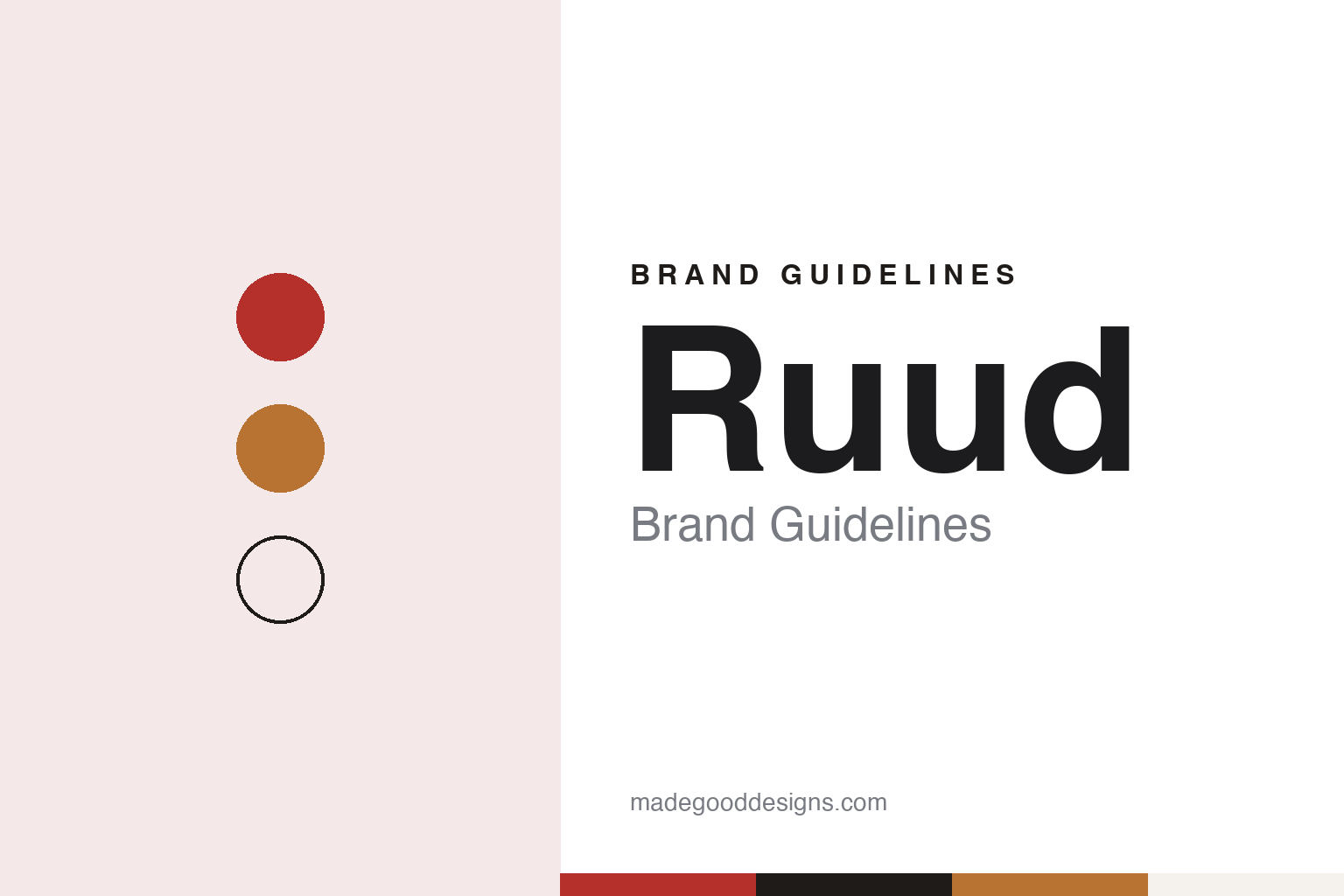
Ruud Brand Guidelines
A copper coil in a cast-iron shell, and the engineer’s surname on the door.
Aa
Two constants: a red, cast-iron and copper palette and a sturdy slab-serif register. Abstract homage — not a Ruud product or mark; no heater, unit, badge or logo is reproduced.
A heater from Westinghouse’s Pittsburgh
A Norwegian engineer, a gas company and a patent of his own.
Ruud is named after its founder. English Wikipedia describes Edwin Ruud as a Norwegian-American mechanical engineer and inventor, born in the parish of Askim in Østfold, Norway, and educated at the Horten Technical School. In the 1880s, it says, he went to work for George Westinghouse at the Fuel Gas and Manufacturing Company in Pittsburgh, Pennsylvania, and assigned several of his patents to that company.
The water heater came out of that work. According to the same article, Ruud designed an automatic storage-tank gas water heater in 1889, with a gas burner at the bottom and a temperature-controlled gas valve, and patented the design in 1890. On 22 January 1897 he filed a patent in his own name, separate from the Fuel Gas company, for an Automatic Water Heater: a cast-iron shell enclosing burners, a coil of copper tubing through which the water flowed, and a thermostat controlling the gas valves. The patent was issued on 6 September 1898. With that design, English Wikipedia says, citing a 1922 article in Gas Age-Record marking the company’s quarter century, he left the Fuel Gas company and started the Ruud Manufacturing Company, his own engineering and manufacturing shop, making water heaters for homes, businesses and industry.
The Ruud brand tells the same story in its own words. On its website it says Edwin Ruud travelled to America to work as a mechanical engineer, then “left his job, bought the rights to his invention and started his own company,” and that homeowners and businesses have relied on Ruud “since 1889,” the year of the first design rather than of the company. English Wikipedia’s article on Rheem gives 1897 as the founding year of Ruud in Pittsburgh, and says Ruud bought the rights to produce the heater from Westinghouse before forming the company. Rheem itself, in a news release about two early heaters, describes the Norwegian immigrant as having pioneered heated-water technology in Pittsburgh.
Colour
Kalamazoo, Rheem and a line of furnaces and air conditioners.
The company grew through the early twentieth century. English Wikipedia says that in 1908 Ruud Manufacturing took in two local heating and plumbing firms: James Hay closed the James Hay Company to become president of Ruud Manufacturing, and J.H. Folsom left the Folsom-Webster Co. to run the company’s Cincinnati branch. By 1915, it says, Ruud had offices in Pittsburgh, Kalamazoo, Michigan, Toronto and Hamburg, Germany. Its best-known product of those years was the Ruud Instantaneous Automatic Water Heater; the article describes the Thermal Valve Model, Type F, which heated water on demand, ran on natural gas, LP gas or gasoline with a change of burner orifices and came in several residential sizes.
Kalamazoo became the company’s home. English Wikipedia’s article on Rheem says that in 1913 Ruud merged with and absorbed the Humphrey Company of Kalamazoo, another water-heater maker, and continued to run and expand its large manufacturing operation there. In 1954, it says, Ruud moved all of its operations from Pittsburgh to Kalamazoo. The Ruud brand says on its own site that the 1950s brought the introduction of the Ruud brand of heating and air-conditioning equipment, extending the name beyond water heaters.
Then came Rheem. Rheem Manufacturing Company began in California in 1925, founded by Richard and Donald Rheem, according to English Wikipedia. Rheem says in its news release that it purchased the Ruud Manufacturing Company in 1959, and English Wikipedia’s article on Edwin Ruud gives the same year for Rheem’s purchase of the company’s water-heater arm; the article on Rheem instead says Ruud was headquartered in Kalamazoo until the purchase by Rheem in 1960. Rheem’s own ownership changed in 1988, when its parent company, Pace Industries, was bought by Paloma, a privately held company based in Nagoya, Japan, English Wikipedia says. Rheem is now headquartered in Atlanta, Georgia, and English Wikipedia describes it as an independent subsidiary of Paloma Industries that also produces and sells products under the Ruud name.
Typography
Design and documentation.
The brands in this group are all names found on heating and air-conditioning equipment: furnaces, air conditioners, heat pumps and rooftop units. Heating and air-conditioning brands in general sit at many different points in the trade, from names sold mainly through local installers to names that belong to large building-technology groups.
A heating or cooling brand’s identity is usually carried less by one product than by a name on a metal cabinet, a badge on a grille and a colour on a truck. The company behind that name may have been sold, merged, split or licensed to another owner, and the plants where the equipment is made may have changed more than once. That makes the questions behind each name worth asking plainly: who started it, who owns it now, and where its equipment is actually made.
Each guide separates what independent sources record from what the company says about itself — its founding story, its owners over time, where its equipment is made and how its marks have changed — and marks plainly what rests only on the company’s own word.
Aa
A sturdy slab serif — a cast-nameplate, trade-catalogue register. (Specimen set in Roboto Slab, a serif STAND-IN; NOT the Ruud logo.)
Ruud
A founder’s surname inside a family of brands.
Today Ruud is one name in a larger group. On its website the brand calls itself “a proud member of the Rheem® Family of Brands,” and it sells water heaters — tank, tankless, hybrid, gas and electric — alongside air conditioners, heat pumps, gas furnaces and air handlers for homes and commercial buildings. The site also runs a programme for contractors who want to become Ruud dealers, and names Rheem’s EcoNet platform among its owner services. English Wikipedia lists Ruud among Rheem’s divisions and describes the brand as covering air conditioning and heating.
English Wikipedia says that in August 1970 Rheem began producing heat pumps and residential heating and air-conditioning units in Fort Smith, Arkansas, and that the Fort Smith site was still operating in 2024. Ruud’s own history is tied to two industrial towns: Pittsburgh, where the company was founded, and Kalamazoo, where it moved in 1954. Rheem’s news release tells of two early Ruud heaters that came back to the company: a 1904 unit found in Ohio and a 1913 unit discovered in the basement of a Pittsburgh carriage house.
The name itself does much of the brand’s work. Ruud’s website writes it both as “Ruud” and in capitals as “RUUD”, a short, four-letter surname that sits on equipment beside the larger Rheem name its owner also uses. For a design guide, Ruud shows how a founder’s surname can keep its own place inside a family of brands, carrying a Pittsburgh engineer’s story onto furnaces and heat pumps sold by a company that bought it decades later. Compare it with Rheem, the company that has owned it since 1959, and with the American heating and cooling name Lennox. For this guide we use red, cast-iron black and copper with a serif, an unofficial interpretation; no product or logo is reproduced.
Explore & save
Keep Ruud’s identity on hand — save it to a board in the Made Good inspiration library.
Ruud identity set
Pin the Ruud red, cast-iron black and copper palette and the sturdy slab-serif register to your own board.


