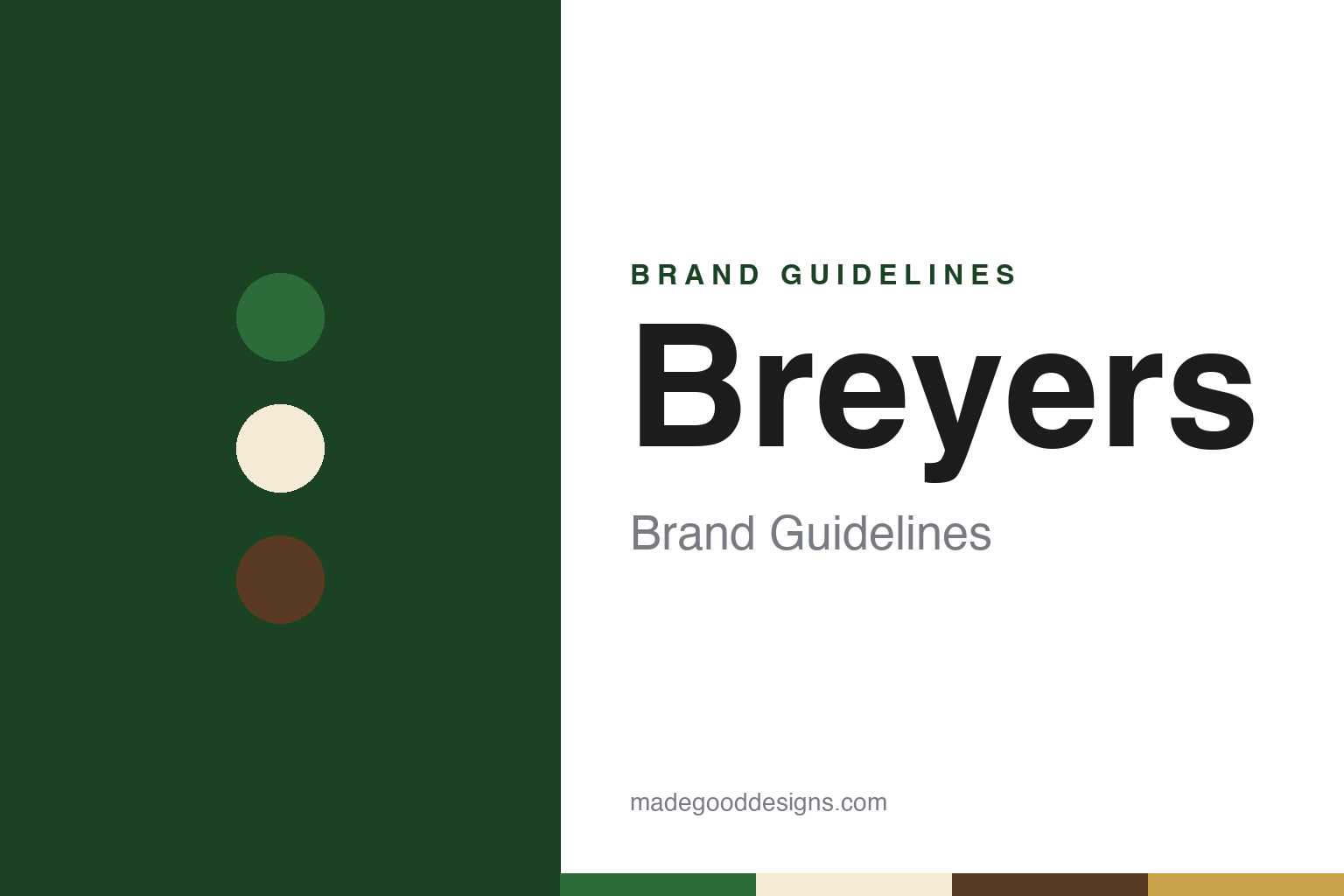
Breyers Brand Guidelines
A Philadelphia ice cream that sold itself on a pledge.
Aa
Two constants: a green, vanilla-cream, chocolate and gold palette and a bookish serif register. Abstract homage — not a Breyers product or mark; no carton or logo is reproduced.
A kitchen, a wagon and a bell
William A. Breyer’s Philadelphia ice cream.
Breyers began in a Philadelphia home. English Wikipedia says William A. Breyer began to make and sell ice cream in Philadelphia, Pennsylvania, in 1866, and that it was hand-cranked and made from cream, sugar, fruit and nuts. The Los Angeles Times also gave the brand’s founding year as 1866 in a report published on 19 June 1986. A company history of Good Humor-Breyers, republished by the business-history site FundingUniverse, says Breyer made and sold his ice cream from his kitchen, selling initially to neighbours and people in the nearby community.
The same company history describes how the business moved onto the street. It says Breyer bought a horse and wagon to sell ice cream around Philadelphia and fitted the wagon with a large dinner bell, which he rang along his route to announce that the ice cream had arrived. Wikipedia likewise says he sold from his home and then by horse and wagon as demand grew. By 1882, according to the company history, Breyer had opened a retail ice cream store on Frankford Avenue, where the ice cream was made in the back and sold across the counter, and Wikipedia says he had five ice cream shops and a delivery service by that year.
The business stayed in the family. The company history says Breyer’s wife Louisa took charge with the help of their sons Frederick and Henry, and that the family opened a wholesale manufacturing plant in Philadelphia; Wikipedia dates the wholesale plant to 1896. The company history says a second plant opened on Cumberland Avenue by 1904.
Colour
Henry Breyer’s pledge, National Dairy and Kraft.
Henry Breyer gave the business its corporate form. Wikipedia says Breyer’s Ice Cream Company was incorporated in 1908, and the company history says Henry Breyer, by then sole owner, incorporated it that year. The company history says that soon afterwards he introduced the Breyer Pledge of Purity, issued under his own name, which guaranteed that each container held natural ingredients. The company history says Henry Breyer arranged deliveries across Philadelphia and nearby communities by trolley freight, auto express, boat, railway express and horse-drawn wagons.
The family business then joined a national group. Wikipedia says Breyer’s Ice Cream Company was sold to the National Dairy Products Corporation and Sealtest in 1926. The company history says National Dairy Products renamed itself Kraftco Corporation by the early 1970s and began distributing Breyers in Florida and Georgia, that Kraftco shortened its name to Kraft, Inc. by 1976, and that by the mid-1980s Breyers was being distributed to states across the Midwest and West.
That westward move is documented in the press. On 19 June 1986 the Los Angeles Times reported that Breyers, then owned by Dart & Kraft and described as an East Coast brand, had only recently reached Southern California, where it met Dreyer’s, the Oakland ice cream sold in the East as Edy’s. The paper said Breyers was running advertisements stressing “It’s Breyers with a B”, and that it had pulled a commercial showing a Breyers carton beside a Dreyer’s carton after Dreyer’s objected. Its reporter, Denise Gellene, opened the story with the line that William A. Dreyer never met William A. Breyer.
Typography
Design and documentation.
The brands in this group are all American ice-cream names. Ice-cream brands in general reach people in several ways at once: a carton in a supermarket freezer, a wrapped novelty in a corner-shop cabinet, a cone handed out of a truck window or a sundae served at a restaurant counter. A single name can travel through all of these, and the same product can be sold under different names in different parts of the country.
Because the product is frozen, much of an ice-cream brand’s identity is carried by its packaging and its outlets rather than by the ice cream itself: the shape and colour of a carton, the print on a paper or plastic wrapper, the livery of a truck, a jingle or a slogan, and the lettering on a sign. The company behind the name may have changed hands, merged its factories or licensed the name to someone else, so the questions worth asking are plain ones: who started it, who owns it now, and where it is made.
Each guide separates what independent sources record from what a company says about itself, and marks plainly what rests only on the company’s own word.
Aa
A bookish serif — the plain, traditional register of a Philadelphia dairy name. (Specimen set in Libre Baskerville, a serif STAND-IN; NOT the Breyers logo.)
From Good Humor-Breyers to Magnum
Unilever in 1993, a demerger in 2025.
Breyers moved to Unilever in the 1990s. Wikipedia says Kraft sold its ice cream brands to Unilever in 1993, and that Unilever merged Breyers with Gold Bond and Good Humor that year to create the Good Humor-Breyers division. The company history says Unilever moved the Breyers headquarters to Green Bay, Wisconsin, and that the wider Good Humor-Breyers family came to include Klondike, Popsicle and Sealtest. Wikipedia says Unilever closed its last Breyers plant in Philadelphia in 1995, and that the Good Humor-Breyers headquarters moved to Englewood Cliffs, New Jersey, in 2007.
The brand’s range widened under Unilever. Wikipedia says Unilever introduced frozen dairy desserts under the Breyers name in 2013, and that Breyers now sells products labelled either “original ice cream” or “frozen dairy dessert”, grouped into flavour families it calls Classics, Better For You and Cookies & Candies.
Breyers then left Unilever with the rest of its ice cream. CNN reported on 19 March 2024 that Unilever planned to separate its ice cream business and named Breyers alongside Magnum, Ben & Jerry’s, Wall’s and Cornetto as brands the new company would hold. Wikipedia says the ice cream brands were demerged into a stand-alone company, The Magnum Ice Cream Company, headquartered in Amsterdam, in July 2025. Food Manufacture reported on 9 December 2025 that Unilever had completed the demerger of its ice cream business, now known as The Magnum Ice Cream Company, and Storyboard18 reported on 8 December 2025 that the newly independent company had begun trading in Amsterdam. The Magnum Ice Cream Company has owned Breyers since that demerger.
For a design guide, Breyers shows how a family name and a written pledge from the early twentieth century can stay on the carton through a century of corporate owners, from National Dairy and Kraft to Unilever and Magnum. Compare it with Klondike, a Good Humor-Breyers stablemate, and Edy’s, the rival whose western name is one letter away. For this guide we use leaf green, vanilla cream, chocolate brown and bean gold with a serif, an unofficial interpretation; no product or logo is reproduced.
Explore & save
Keep Breyers’s identity on hand — save it to a board in the Made Good inspiration library.
Breyers identity set
Pin the Breyers green, vanilla-cream, chocolate and gold palette and the bookish serif register to your own board.


