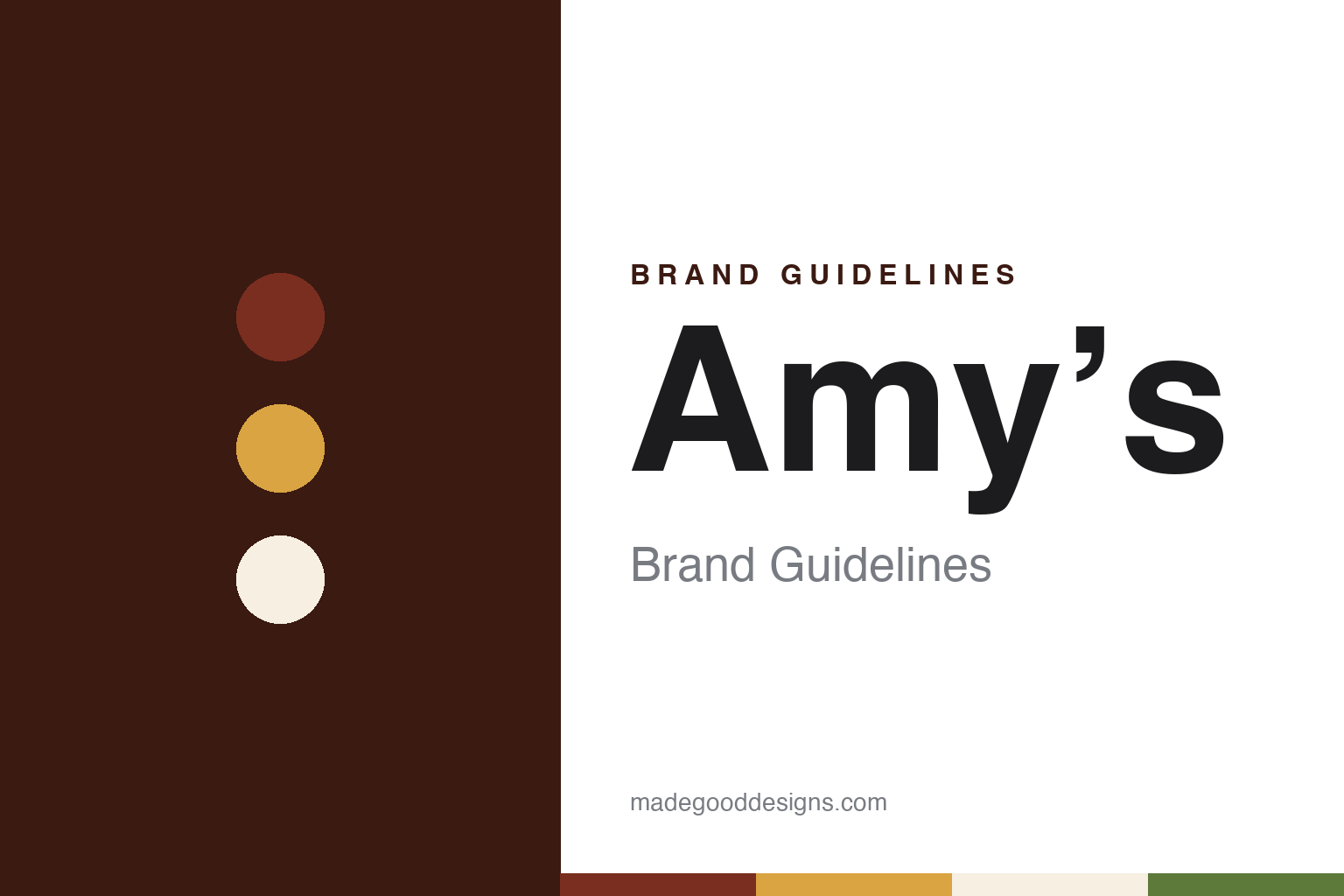
Amy’s Brand Guidelines
A pot pie, a family kitchen in Sonoma County and a business named for a newborn.
Aa
Two constants: a crust brown, golden crust and kitchen cream palette and a warm soft serif register. Abstract homage — not an Amy’s product or mark; no package, label or logo is reproduced.
A pot pie for Amy
A pregnancy, a disappointing freezer aisle and a grandmother’s recipe.
Amy’s is the brand name of Amy’s Kitchen, a family-owned company based in Petaluma, California, that makes vegetarian frozen meals, pizzas, burritos and bowls, along with canned soups, beans and chili. It was started in 1987 by Andy and Rachel Berliner, and it is named after their daughter, Amy, who was born the same year. Food Business News described it in December 2020 as privately held and family-owned, and the Mercury News called it a family-run business in August 2021.
The founders have told the start-up story themselves. In an as-told-to account published by Fortune Small Business in February 2009, Rachel Berliner said that near the end of her pregnancy in 1987 she pulled a muscle and could not stand long enough to cook or shop, so Andy went to the local health-food store for frozen meals. The couple did not think much of what they found. Andy Berliner told Food Business News in 2020 that the meals they tried were poor, and that they felt other people must also want convenient food in natural food stores made without preservatives or additives.
Both founders came to the idea with some background in food. Fortune Small Business reported that Andy’s first business was Magic Mountain, an herb tea company he sold in 1981. Food Business News said Rachel grew up tending her family’s vegetable garden in Compton, California, that Andy was a Chicago native, and that his father had made chocolates and caramels for a Chicago department store.
The first product was a vegetable pot pie. In the 2009 account the Berliners said pot pies were then a popular frozen meal, and Food Business News called the Berliners’ version a meatless take on the Swanson pie. The recipe came from Rachel’s mother, Eleanor Goodman, who, according to both Food Business News and the Mercury News, developed it. In the 2009 account the Berliners said she also suggested naming the company after the baby, since the business was being started to support her. The company’s own about page, archived in January 2017, says the founders began “on a shoestring,” using their house and barn as headquarters.
Colour
A trade-show booth, a borrowed bakery and a family that kept the company.
The pot pie needed buyers before it had a factory. In the 2009 Fortune Small Business piece, the Berliners said they made pies by hand to show at a San Francisco health-food show in March 1988. Food Business News wrote in 2020 that the following March they took a small booth at Natural Products Expo West in Anaheim, offering samples of a nearly finished prototype. Orders from small natural grocers followed.
Filling those orders took improvisation. The founders told Fortune Small Business that an organic bakery near their home first baked the pies for them, that they later cooked in a kitchen at the same bakery, and that Andy telephoned the engineering department at Swanson for advice on how pot pies were assembled. Food Business News said that by June 1988 the couple had opened a production facility in Sonoma County. In the 2009 account they dated real growth to the late 1990s, when supermarket chains such as Kroger began stocking frozen natural foods.
The range spread across the store. FoodNavigator-USA reported in November 2020 that the pot pies were followed by burritos and macaroni and cheese, that pizzas, soups, beans and chili arrived in the 1990s, that a range of gluten-free products came in the early 2000s, and that candy bars followed in the 2010s. The company’s archived about page dates its grocery line of canned soups, beans and chili, jarred pasta sauces and salsas to 1999. Food Business News reported that every Amy’s product is vegetarian.
Amy’s makes its food in its own plants, which the company has compared to a big restaurant kitchen, according to Food Business News. FoodNavigator-USA listed facilities in Santa Rosa, California, Pocatello, Idaho, and Medford, Oregon, in 2020, and the Mercury News reported in August 2021 that the company had opened a new production centre in San Jose and was building one in Goshen, New York. Food Dive reported in April 2023 that the company had closed a California frozen pizza factory in 2022, amid worker complaints that year.
Day-to-day leadership has changed hands while the family has kept ownership. Food Business News reported that Andy Berliner handed the chief executive role to Xavier Unkovic, a former Mars executive, in August 2020, and that the founders had turned down takeover approaches over the years. The Press Democrat reported in May 2021 that Unkovic had left and that Andy Berliner had resumed as chief executive. In April 2023 Just Food reported that longtime employee Paul Schiefer had been named president, reporting to Andy Berliner as CEO, and that a new board of directors had been formed alongside the two founders.
Typography
Design and documentation.
The brands in this group are sold in three familiar grocery formats: the frozen-meal carton, the cracker box and the coffee can or bag. Each format asks a package to do a different job. A frozen-meal carton has to read through the glass door of a freezer case, a cracker box sits upright in a long row on a dry-goods shelf, and a coffee can or bag is often bought out of habit and spotted by its colour before its name is read.
Because grocery names are often bought, sold and merged into larger food companies, the brand on the front of a package may outlast several owners, factories and redesigns. A recipe, a jingle or a colour can stay in place while the company behind it changes, which makes the plain questions worth asking: who started the name, who owns it now, and where the food or coffee is actually made.
Each guide separates what independent, dated sources record from what the company says about itself — its founding story, its owners over time, where its products are made and how its packaging and advertising have changed — and marks plainly what rests only on the company’s own word.
Aa
A warm, soft-edged serif — the homely, recipe-card register of a family kitchen brand. (Specimen set in Fraunces, a soft serif STAND-IN; NOT the Amy’s logo.)
A first name on the box
A child’s name, letters addressed to her and dishes named for their recipes.
The core of the Amy’s identity is the name itself: the first name of the founders’ daughter, chosen, in their telling, because the business was being started to support her. The Press Democrat noted in May 2021 that Amy and her husband, Jace, were part of the family business. Food Business News reported in 2020 that Amy did not want to run the company but was involved in its critical decisions, and that she had pushed it towards sustainability.
The company has leaned into that personal voice. Its about page, as archived in January 2017, was written in the first person by the founders, and it printed customer letters addressed simply “Dear Amy.” In the 2009 Fortune Small Business account the founders said they had been approached about selling a few times and had always said no, because they wanted it to remain a family business.
The products are named in the same plain way. Food Business News listed frozen meals such as Thai Stir-Fry, Indian Palak Paneer, Spaghetti Italiano and Enchilada Verde, and reported that Rachel Berliner, described as the company’s “official taster,” traced many dishes to food she had eaten on her travels.
The family name also stretched to restaurants. Food Business News reported that the first Amy’s Drive Thru opened in Rohnert Park, California, in 2015, modelled on a classic fast-food restaurant with a vegetarian menu of burgers, fries, burritos and shakes, and that locations in Corte Madera and at San Francisco International Airport followed.
For a design guide, Amy’s shows how a single first name, a homely first-person voice and plainly named dishes can carry a frozen food brand from one pot pie to a whole aisle. Compare it with Swanson, whose pie it set out to rework, and with Stouffer’s and Healthy Choice in the same freezer case. For this guide we use crust brown, golden crust and kitchen cream with a warm soft serif, an unofficial interpretation; no product or logo is reproduced.
Explore & save
Keep Amy’s’s identity on hand — save it to a board in the Made Good inspiration library.
Amy’s identity set
Pin the Amy’s crust brown, golden crust and kitchen cream palette and the warm soft serif register to your own board.