Fresca Brand Guidelines
A fresh name, a test market and a launch party snowed in by a real blizzard.
Aa
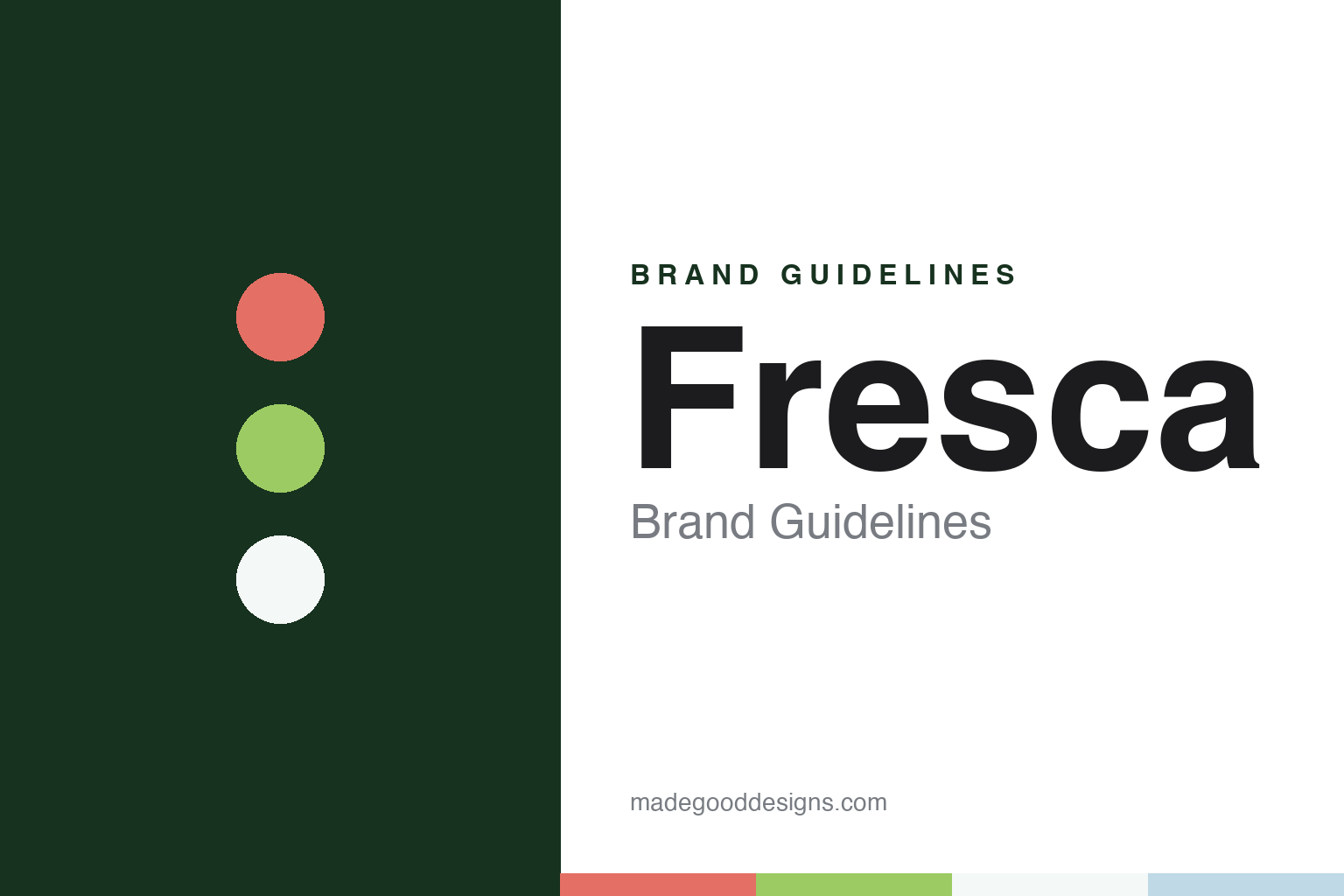
Two constants: a grapefruit pink, lime zest and frost white palette and a geometric light sans register. Abstract homage — not a Fresca product or mark; no can, bottle or logo is reproduced.
A fresh name for a citrus soda
A trademark from 1962, test markets from 1964 and a New York launch in the snow.
Fresca is a grapefruit-flavoured citrus soft drink made by The Coca-Cola Company, which has owned the brand since it created it. The name is borrowed from the word for “fresh” in Italian, Spanish and Portuguese, English Wikipedia notes. The same article records, citing the United States Patent and Trademark Office, that Coca-Cola registered “Fresca” as a trademark in July 1962 as a name for frozen concentrated orange and tangerine juice, and that it applied the same year for the name for a non-alcoholic soft drink and its syrups.
The soda took several years to reach the whole country. A history article published by The Coca-Cola Company on 1 June 2016 says Fresca was introduced in test markets across the United States as early as 1964. The company describes it as a citrus-flavoured drink positioned both as a mixer and as a refreshing sparkling alternative to bottled waters and seltzers. It followed TaB, a diet cola that Coca-Cola had launched in 1963, the company says, and years of research and taste tests had given it confidence. Food Dive, reporting on the brand on 19 April 2018, said Fresca came to market in 1966.
After successful pilots in selected cities, the company says, Fresca was ready for New York. Its launch plans centred on the Four Seasons Restaurant, which had opened in 1959 in the Seagram Building, in a space designed by Ludwig Mies van der Rohe and Philip Johnson, with a large pool at the centre of the dining room. Coca-Cola considered it the ideal venue to unveil its newest product. The Four Seasons bar staff created a set of Fresca cocktails, printed in a guidebook that the public could order to make at home, and the company hired Mitch Miller and his band to record a “Blizzard Theme” for the national rollout.
The weather then supplied its own publicity. On 7 February 1967, the company’s history says, a major winter storm swept across the Northeast and New York essentially shut down. Bill Free, head of the Marschalk agency, which handled Fresca for Coca-Cola, took out an advertisement in The New York Times apologising for the “blizzard” that the Fresca introduction had caused in the city. The party went ahead: the company says the fountain in the middle of the restaurant was frozen, costumed Fresca bottles skated and danced through the night, and the Mitch Miller Orchestra played the Blizzard Theme.
Colour
One owner throughout, and a makeover roughly every decade.
Fresca has belonged to The Coca-Cola Company from its early test markets to the present, and the later chapters of its story are about its look, its flavour range and its audience. English Wikipedia says the drink began as a bottled sugar-free soda, and that sugar-sweetened versions were later introduced in some markets outside the United States.
A documented makeover came in 2005. CSP Daily News reported on 25 May 2005 that Coca-Cola North America had announced a makeover for Fresca, with a fresh, contemporary look that included a new logo and new packaging graphics, launching in the United States that September. New flavours came with it, Sparkling Peach Citrus and Sparkling Black Cherry Citrus, while the citrus flavour of the original drink was left unchanged. The relaunch was supported by television, radio, outdoor and online advertising and sampling, in a campaign developed by the Minneapolis agency Campbell Mithun. CSP said the move was part of Coca-Cola North America’s “100 Days of Diets” strategy, which also brought a Diet Coke sweetened with Splenda and the launch of Coca-Cola Zero, and that the Fresca flavours would be sold in cans, single-serve bottles, large bottles and multi-can packs.
The next came in 2018. Food Dive reported on 19 April 2018 that Coca-Cola was introducing a new look for Fresca, aimed at millennials, among whom the brand was not well known. It quoted Ryan Hughes, the company’s associate brand manager for Sprite and Citrus Brands, saying that Fresca “hits the sweet spot somewhere between a soda and a flavored sparkling water”, and that the brand had not said anything to consumers since 2008, so it was “time for a refresh after about a decade of silence.” Lettering on the redesigned cans called the drink a “sparkling flavored soda”, and the company said Fresca, though sugar-free, was not being marketed as a diet soft drink.
The 2018 range comprised Original Citrus, Black Cherry Citrus and Peach Citrus. According to the product labels, Food Dive noted, each contained concentrated grapefruit juice, which sits third in the ingredient list of the original flavour. Coca-Cola described the taste as “grapefruit-forward”, Food Dive reported.
Typography
Design and documentation.
A soft drink rarely meets its buyer as a single object. The same name has to work on a can, on a glass bottle, on a plastic bottle, on a cardboard carton and on the front of a fountain machine in a restaurant or a cinema, often at very different sizes and under very different light.
That is why a soda brand’s identity tends to live in a few portable pieces rather than in one fixed layout: a wordmark that can be printed around a curved surface, a colour that can be recognised across a store aisle, and a flavour cue that tells the drinker what is inside before the lid comes off. Bottles and cans also change over time as packaging technology moves on, so a brand’s look is often a record of several decades of redrawn labels.
Each guide in this group asks the same plain questions: who started the drink, who owns it now, how its labels and cans have changed, and which parts of its story rest on independent dated reporting rather than on the company’s own account.
Aa
A clean, geometric light sans — the crisp, frosted register of a citrus soda sold as a mixer. (Specimen set in Josefin Sans, a geometric STAND-IN; NOT the Fresca logo.)
A blizzard, a bottle and a canned cocktail
A frosty campaign, a dimpled bottle and a licence that put the name on vodka and tequila.
From the start, Fresca’s identity leaned on cold. The Coca-Cola Company says the unifying line for the drink centred on a “blizzard” of taste, describing its grapefruit-inspired citrus flavour as cool, crisp, frosty and refreshing, and that the Marschalk agency handled the account. English Wikipedia credits F. William Free, Marschalk’s creative director, with the campaign that branded Fresca the “Blizzard of Flavor”, and says the theme song, “The Blizzard Song”, was written by Gary McFarland and recorded by both Mitch Miller and Trini Lopez.
The bottle was part of the idea. English Wikipedia says Fresca was originally sold in green glass bottles designed by the New York industrial design firm Hodgman-Bourke, with a groove under the label panel meant to catch condensation running down from the top half, and dimples on the lower half meant to suggest the bubbles of carbonation. The same article says Coca-Cola described the original drink as a soft drink and a mixer “all in one”, and chose the name because it was “short, memorable and distinctive”.
The mixer idea eventually became a separate product. CNN Business reported on 8 September 2022 that Fresca Mixed, an alcoholic version of the soda, would go on sale in the United States that month, following an announcement in January. The drinks came as a vodka spritz and a tequila paloma, both built on the citrus soda. Constellation Brands, which CNN described as the brewer behind Corona, said in a release the same day that Fresca Mixed was the outcome of an agreement with The Coca-Cola Company allowing Constellation to use the Fresca brand to manufacture, market and distribute the cocktails. The release quoted Dan White, of Coca-Cola North America, saying that many Fresca drinkers already enjoyed it as a mixer with spirits.
CNN placed the launch in a wider pattern. Fresca Mixed joined Coca-Cola’s other alcoholic lines, a Jack Daniel’s and Coca-Cola drink announced that June, and Topo Chico Hard Seltzer and Simply Spiked Lemonade, both made in partnership with Molson Coors.
For a design guide, Fresca shows how a soft drink can make its temperature its personality: a name that means fresh, a launch framed as a blizzard and a bottle shaped around condensation and bubbles. Compare it with Squirt, the Phoenix grapefruit soda that began as a cocktail mixer in the 1930s, and Topo Chico, a fellow Coca-Cola brand whose name also moved into an alcoholic line. For this guide we use grapefruit pink, lime zest, frost white and rind green with a geometric sans, an unofficial interpretation; no product or logo is reproduced.
Explore & save
Keep Fresca’s identity on hand — save it to a board in the Made Good inspiration library.
Fresca identity set
Pin the Fresca grapefruit pink, lime zest and frost white palette and the geometric light sans register to your own board.