ACCO Brand Guidelines
The paper-clip company that became a house of office brands.
Aa
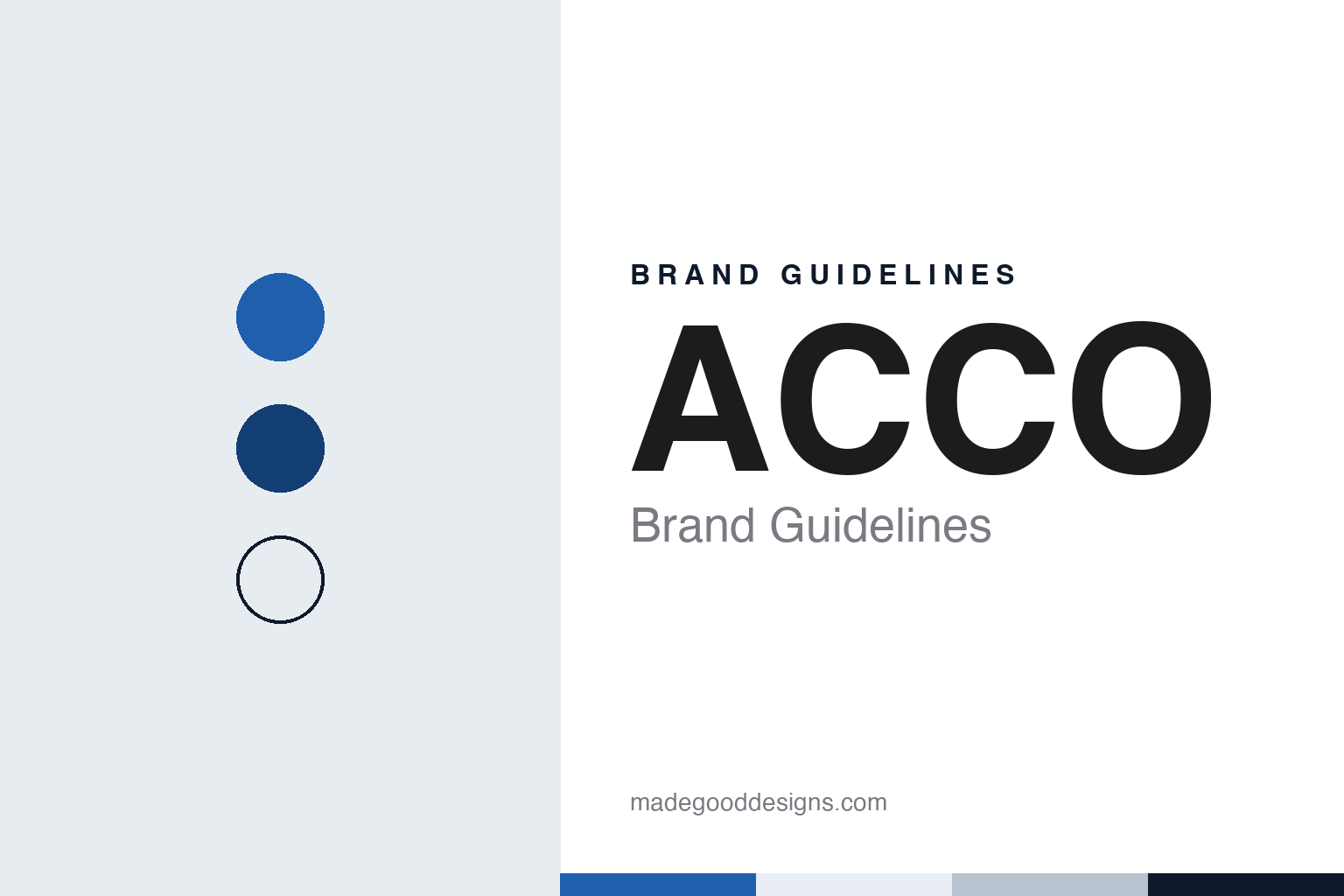
Two constants: an ACCO blue, navy and steel palette and a Corporate sans register. Abstract homage — not an ACCO product or mark; no stapler, binder, logo or nameplate is reproduced.
From the paper clip
A clip maker’s initials become a company name.
ACCO is an acronym with a long history. English Wikipedia says the name derives from the American Clip Company, and an earlier version of the same article sets out the sequence: in 1903 Fred J. Kline founded the Clipper Manufacturing Company, a maker of paper clips, in New York; in 1910 it became the American Clip Company and first used the initials “ACCO”; and in 1922 ACCO became the company’s formal name. ACCO Brands gives 1903 as its own founding year on its company page.
From paper clips the business grew by acquisition into a broad office-products maker. Wikipedia records that ACCO went public in 1983 and was acquired in 1987 by American Brands, later renamed Fortune Brands. Under that ownership ACCO gathered names that are still in its portfolio. English Wikipedia says the stapler maker Swingline, which American Brands had bought in 1970, became a division of ACCO in 1987, and that the computer-accessory maker Kensington, founded in 1981 as Kensington Microware, was acquired by ACCO in 1986.
Europe came next. According to an earlier version of English Wikipedia’s ACCO article, ACCO UK was created in 1992 from the integration of ACCO Europe and the British office-products company Rexel, the shredder, stapler and binding brand that ACCO still sells today.
Colour
ACCO World meets General Binding.
The modern company dates from 2005. English Wikipedia says Fortune Brands spun off its office-products unit, ACCO World, that year and merged it with General Binding Corporation (GBC) to create ACCO Brands Corporation. GBC had its own long history: English Wikipedia says it was founded in 1947 by William N. Lane II and Edgar Uihlein, who bought a small trade bindery in Chicago, and that it makes binding, laminating and other presentation equipment and supplies. GBC remains a brand of ACCO Brands and, like the group, is headquartered in Lake Zurich, Illinois, English Wikipedia says. In 2009 the thermal-lamination division GBC Commercial Print Finishing was sold to Cosmo Films, according to the same article.
A second large step followed in 2012, when ACCO Brands combined with the Consumer & Office Products business of MeadWestvaco. English Wikipedia says the deal added brands including Mead, Five Star, Trapper Keeper, AT-A-GLANCE, Day Runner, the Canadian school-supplies brand Hilroy and the Brazilian brand Tilibra.
The third step was European. In a press release datelined Lake Zurich, 1 February 2017, ACCO Brands announced that it had completed its acquisition of Esselte Group Holdings AB, the owner of the Leitz, Esselte and Rapid brands. ACCO said the deal strengthened its position in Europe. Leitz, Esselte and Rapid all still appear in the brand list on ACCO Brands’ company page, next to Rexel and Swingline.
Typography
A group of office brands.
The seven brands in this group are all office-supply names: Leitz, Rexel, Fellowes, Swingline, Esselte, Bostitch and ACCO. Office-supply brands in general sit at many different points in the trade, from family companies that still carry a founder’s name to labels that now belong to much larger groups, and a single brand can be sold everywhere from a stationery shop to an office-furniture catalogue.
An office-supply brand’s identity is usually carried less by a single stapler or file than by a name, a colour and the products people recognise on a desk, because the company behind the name may have changed hands, moved its factories or grown far beyond the place where it started. That makes the questions behind each name worth asking plainly: who started it, who owns it now, and where its products are actually made.
Each guide separates what independent sources record from what the company says about itself — its founding story, its owners over time, where its products are made and how its identity has changed — and marks plainly what rests only on the company’s own word.
Aa
A clean corporate sans — the register of ACCO’s office-products catalogues. (Specimen set in Archivo, a sans STAND-IN; NOT the ACCO logo.)
ACCO Brands
Work, learn, play — and gaming.
In the 2020s the portfolio moved further from the desk. English Wikipedia says ACCO Brands acquired PowerA, a maker of video-game controllers and gaming accessories, in 2020, and that Thomas W. Tedford succeeded Boris Elisman as chief executive in 2023. On 2 October 2026 the company announced that it had completed the acquisition of Trust, a Dutch maker of computer, gaming, mobile and smart-home accessories founded in 1983, which it says will sit in its Global Technology Peripherals business alongside Kensington, PowerA and EPOS.
Today ACCO Brands is headquartered in Lake Zurich, Illinois, and is listed on the New York Stock Exchange. Its company page lists brands including AT-A-GLANCE, Derwent, Esselte, Five Star, GBC, Hilroy, Kensington, Leitz, Mead, PowerA, Quartet, Rapid, Rexel, Swingline and Tilibra. The company describes its purpose with the line “Work. Learn. Play.”, and says it creates tools that make everyday challenges easier at the office, in the classroom and at play.
Ownership has also meant decisions about where things are made. English Wikipedia records that Swingline, founded in New York in 1925 by Jack Linsky as the Parrot Speed Fastener Company, made its staplers in Long Island City, Queens, for decades, and that ACCO closed that plant in 1999 and moved production to Nogales, Mexico. The closure was announced in 1997 and drew public criticism from New York’s mayor, Rudy Giuliani, the same article says. In 1999 a custom-painted red Swingline stapler appeared in the film Office Space, and in 2002 Swingline introduced an official red model in response to demand from the film’s fans.
Kensington, the other long-held American brand, is based in Burlingame, California, and English Wikipedia says it was co-founded by Philip Damiano, that its first product was the System Saver, a cooling-fan accessory for the Apple IIe, and credits it with the Kensington laptop lock, offered since 1992, and the Expert Mouse trackball line, made since 1989.
For a design guide, ACCO shows how a company built from a paper-clip maker’s initials can become a holding house for other brands’ identities. Compare Swingline, the New York stapler maker that joined ACCO in 1987, and Leitz, the Stuttgart filing brand that arrived with Esselte in 2017. For this guide we use a binder blue, a deep navy and a clip steel with a sans, an unofficial interpretation; no product or logo is reproduced.
Explore & save
Keep ACCO’s identity on hand — save it to a board in the Made Good inspiration library.
ACCO identity set
Pin the ACCO blue, navy and steel palette and the Corporate sans register to your own board.