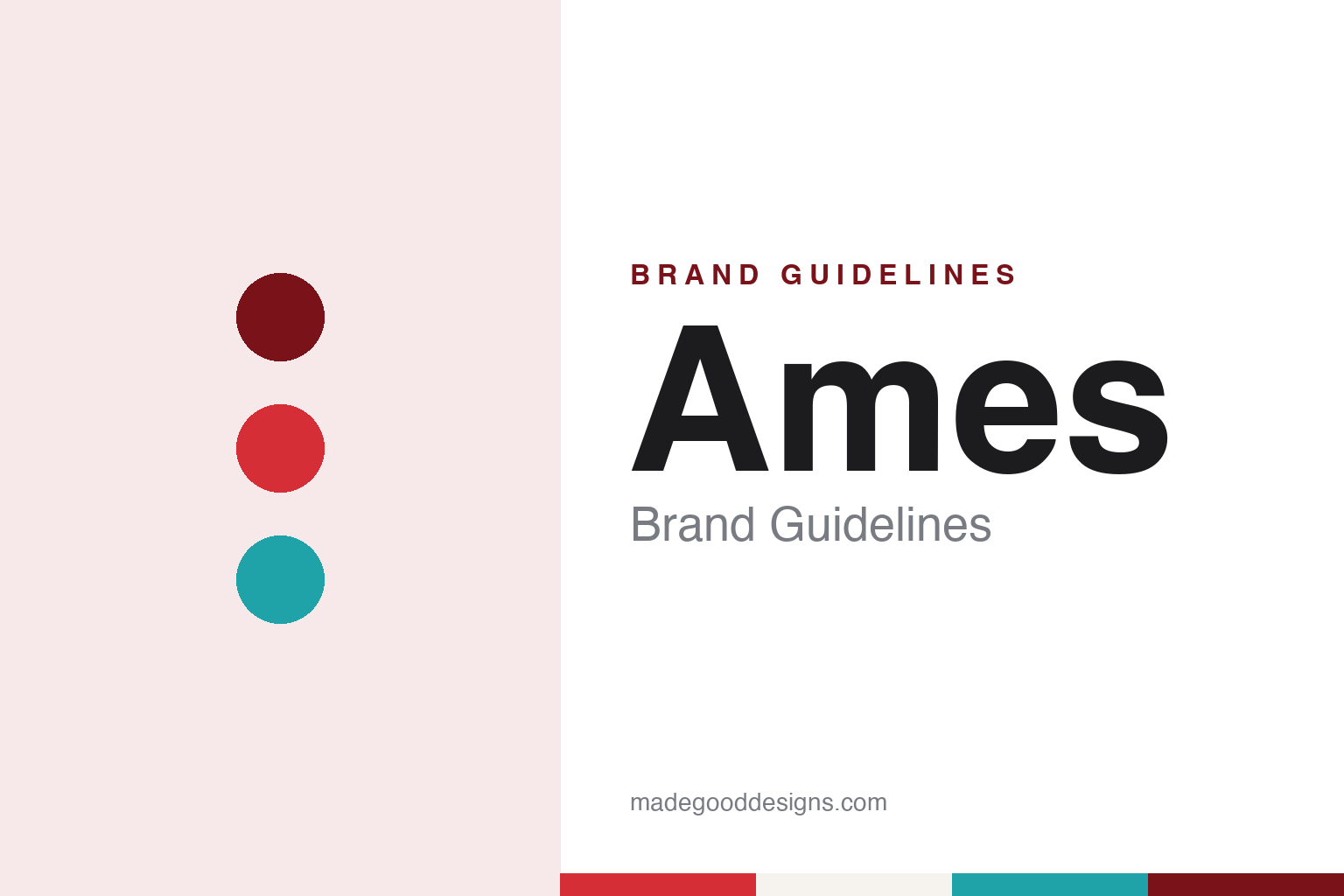
Ames Brand Guidelines
The discount chain named for a Southbridge mill.
Aa
Two constants: a sign red, turquoise and mill white palette and a heavy store sans register. Abstract homage — not an Ames product or mark; no sign, bag or logo is reproduced.
A name from a mill
A discount store in a disused Southbridge textile mill.
Ames began in 1958 in Southbridge, Massachusetts, in a disused textile mill. A company history published by FundingUniverse names the founders as two brothers, Milton and Irving Gilman, who opened a general store in an old mill there; English Wikipedia names three Gilman brothers — Milton, Irving and Herbert — together with a partner, Philip Feltman. In each account the name comes from the building: its earlier tenant was the Ames Worsted Textile Company, and, English Wikipedia says, the founders simply reused the mill’s old sign for the new business.
The idea, according to the FundingUniverse history, was to bring a discount store to a rural area with no large competing stores nearby; when that formula paid, Ames was incorporated in 1962. English Wikipedia dates a second store to October 1959, in St. Johnsbury, Vermont, and says many early stores were in converted industrial buildings, where rents were cheap, before the company moved to custom-built stores with standard planning and marketing. The original Southbridge store was replaced in 1971 by a new building in neighbouring Sturbridge, it says.
The company was run from Rocky Hill, Connecticut, as the Chicago Tribune noted in 1990 and the Hartford Courant in 1996. English Wikipedia says Ames shares were listed on the American Stock Exchange in May 1967 and moved to the New York Stock Exchange in November 1972.
The FundingUniverse history describes the early formula: merchandise by well-known manufacturers, sold in bright, well-organised stores, at prices kept low all the time rather than set high and then cut for periodic sales, with advertising carried mainly by direct mail to shoppers who lived near the stores. It says Ames kept to small towns and to sites near highways that shoppers from the surrounding area could reach easily.
Colour
Acquisitions, Zayre and a change of colour.
Ames grew by buying other regional chains. English Wikipedia lists the Big N stores of Neisner Brothers in November 1978, King’s Department Stores in 1984 and G.C. Murphy of McKeesport, Pennsylvania, a discount and variety chain, in 1985. The FundingUniverse history says the company’s habit was to buy a struggling business and then work to turn it around.
The name’s reach changed with Zayre. Ames bought the Zayre discount stores from Zayre Corp. of Framingham, Massachusetts, in 1988 — in September, according to the Chicago Tribune, and in October, according to English Wikipedia. The Tribune quoted a retail analyst who said that before the purchase Ames had been successful but little known outside New England. The same report quoted Ames insiders as saying the company had erred in underestimating how changing the name of the well-known Zayre stores to Ames might affect customers, and that Ames had run fewer of the promotions Zayre shoppers were used to.
The rebranding left a visible trace in the other direction. English Wikipedia says that during its 1990 bankruptcy Ames changed its logo, trading its traditional red and white for the turquoise used in Zayre stores, a colour that became an identifying mark of Ames stores. Ames filed for Chapter 11 protection on 25 April 1990, the Chicago Tribune reported; English Wikipedia says it emerged on 30 December 1992.
In the mid-1990s the chain restated its message. The Hartford Courant reported on 2 June 1996 that Ames, under president and chief executive Joseph R. Ettore, had remodelled stores and opened new ones in a new prototype design, and had introduced a new marketing theme, “Bargains by the Bagful,” emphasising its discounted brand-name merchandise. The same profile said Ames planned new stores in locations formerly occupied by its competitor Jamesway. English Wikipedia says the company used the web address amesstores.com from 1996.
Typography
Design and documentation.
A discount or variety store’s identity is carried by things that are easy to overlook because they were made to be used and thrown away: the sign above the entrance, the weekly circular folded into a newspaper, the receipt, the price card on the shelf and the shopping bag a customer carries out of the car park. Each of these repeats the store’s name many times a week, often for decades, and together they do more to fix a chain in local memory than any single logo drawing.
Signage had to be read from a road and a parking lot, so store names were usually set large, short and in one or two strong colours. Circulars had a different job: crowding many items onto cheap paper while keeping the name and colours instantly recognisable on a doorstep or kitchen table. Bags travelled furthest of all, into homes, schools and other shops.
Each guide in this group looks at one store name — who founded it, who owned it, what became of the stores and of the name itself — and separates what independent sources record from what the companies said about themselves.
Aa
A heavy store sans for a four-letter name taken from a mill sign. (Specimen set in Work Sans, a sans STAND-IN; NOT the Ames logo.)
Ames
Competitors’ sites, a second bankruptcy and a closing in 2002.
Through the 1990s Ames moved into its competitors’ former sites. English Wikipedia says it took over some former Bradlees stores in the early part of the decade, opened stores in former Jamesway locations in 1996, bought Hills Department Stores in 1998 — a purchase the Associated Press also recorded — and took over several Caldor locations after that chain’s liquidation in 1999. In 2000, according to English Wikipedia, Ames opened stores in the Chicago area, advertised with employees singing “My Kind of Town” on television and billboards reading “Our Kind of Town, Your Kind of Discount Store.”
Ames filed for bankruptcy protection a second time in August 2001, the Associated Press reported. On 14 August 2002 the company announced that it would close its remaining stores and wind down the business, with “Going Out of Business” sales expected to follow, the Associated Press reported in a story carried by CBS News. English Wikipedia says the private investment firm Oak Point Partners acquired the residual assets of the Ames bankruptcy estates on 18 December 2012.
The name has resurfaced online since. In December 2022 a website at amesstores.com, the chain’s old address, said Ames Department Stores would return in spring 2023. The Providence station WJAR reported on 27 December 2022 that information about the claim was scant, that the project was linked online to a London-based Molyneux Group, and that its reporter could not reach the company by telephone or email beyond a brief statement. The Ames chain itself closed in 2002.
For a design guide, Ames shows a name borrowed from a mill sign, carried through a run of acquisitions and recoloured after it absorbed another chain’s stores. Compare Zayre, whose stores Ames converted, and Caldor, whose former locations it took over. For this guide we use a red, a turquoise and white with a heavy sans, an unofficial interpretation; no product or logo is reproduced.
Explore & save
Keep Ames’s identity on hand — save it to a board in the Made Good inspiration library.
Ames identity set
Pin the Ames sign red, turquoise and mill white palette and the heavy store sans register to your own board.


