Bonnaroo Brand Guidelines
A farm, a Creole word and stages called What, Which, This and That.
Aa
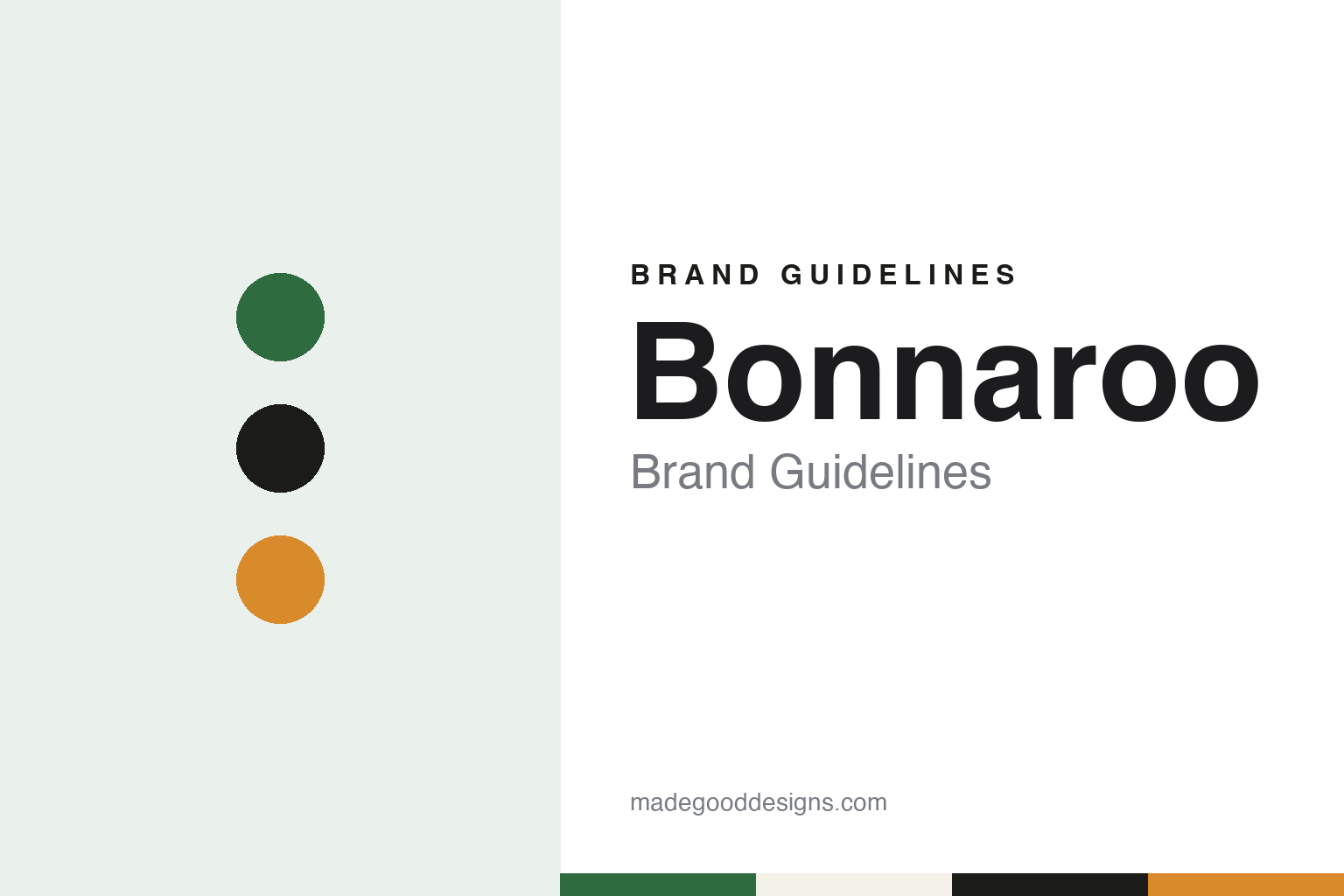
Two constants: a farm green, June amber and ink palette and a Stage-sign rounded sans register. Abstract homage — not a Bonnaroo asset or mark; no logo, arch, poster or wordmark is reproduced.
A Knoxville promoter, a New York company and a farm
A lost city-park festival, a Creole word and a launch in 2002.
Bonnaroo, billed as the Bonnaroo Music & Arts Festival, began in 2002 on a farm outside Manchester, Tennessee. English Wikipedia says it was developed and founded by Superfly Presents and AC Entertainment, and that it has taken place at the same site, now called Great Stage Park, since that year. It says the festival usually starts on the second Thursday in June and runs for four days, with music from Wednesday evening to Sunday night.
The idea grew out of a loss in Knoxville. Wikipedia says Ashley Capps, co-founder of AC Entertainment, developed Bonnaroo after the Hot Summer Nights concert series at Knoxville’s World’s Fair Park stopped in 1999 when city officials began construction there. It quotes Capps saying the closure pushed the team to find another way to take part in the summer outdoor concert business, and that Bonnaroo was the result. Wikipedia names the launch partners as Capps, Superfly, the manager Coran Capshaw and the agent Chip Hooper, and adds that the same farm had hosted the Itchycoo Park Festival in 1999.
Billboard, in an article by Ray Waddell published on 28 April 2015, gave the founding as a partnership between Superfly and AC Entertainment, significantly financed in the beginning by Capshaw, founder of Red Light Management. It named Superfly’s co-founders as Rick Farman, Rich Goodstone, Jonathan Mayers and Kerry Black, and Capps as president of AC Entertainment. The magazine said Bonnaroo had launched at the height of the neo-jam band movement and had since presented artists including Metallica, Paul McCartney, Bruce Springsteen and Elton John. A later Billboard report, by Dave Brooks on 24 June 2019, described it as conceived as an annual gathering for jam bands that then widened its line-up to many genres.
The name comes from New Orleans. Wikipedia says the founders took it from Desitively Bonnaroo, the 1974 album by Dr. John, choosing a word it glosses as Creole slang for a really good time, both for that meaning and to honour the music of New Orleans.
Colour
From an independent farm festival to a Live Nation event.
The site became the organisers’ own in 2007. Billboard reported in 2019 that the organisers had bought the farm that year, the property known to fans as The Farm and formally as Great Stage Park. Its 2015 article gave the site as 750 acres; Wikipedia gives 700. Billboard described a festival where the great majority of visitors stayed on site for the whole run, likening it to a four-day city with its own post office, newspaper, cinema and acres of campsites.
Control changed in two steps. On 28 April 2015, Billboard reported that Live Nation had acquired a controlling interest in the festival and an interest in The Farm, for an undisclosed amount, following similar deals with the Lollapalooza producer C3 Presents and the Electric Daisy Carnival producer Insomniac. Capps told the magazine that the talks had grown out of discussions about other festival concepts that might take place on The Farm, and that the key words were “enhance” and “evolve”. Farman said the arrangement included significant site improvements and a greater emphasis on bringing other events to the site, and both men said Superfly and AC Entertainment would stay on as operators. Capps added that the deal did not involve Live Nation buying either company.
The Billboard report of 24 June 2019 said Live Nation had bought a majority share of AC Entertainment a year after the 2015 deal, and that it had told the festival’s minority owners it would use a buyout clause to purchase the rest of Bonnaroo before the next edition. That step, the magazine said, effectively ended Superfly’s role as producer, and the festival would be produced from then on by AC Entertainment and C3 Presents, which Live Nation had bought in 2014.
The calendar since then has had gaps. Wikipedia says the 2020 edition was postponed and then cancelled during the COVID-19 pandemic, and that the 2021 edition was cancelled after rain from Hurricane Ida saturated the site. The music site mxdwn reported on 21 August 2026 that the organisers had announced there would be no festival in 2027, saying The Farm, and particularly the main venue, needed a break to rest and recover after storms at two successive editions. It said work before the 2026 festival had included improved drainage, new roadways and new grass across the property.
Typography
A site map that names its stages with questions.
Some festivals own a single field or park; others are spread across a whole city and borrow its concert halls, theatres, churches and squares for a few weeks. The second kind cannot rely on stage architecture to carry its identity, because the buildings belong to someone else and keep their own names, signs and colours. Its identity has to travel instead: on banners hung from lamp posts, on window cards in shops and cafés, on a printed programme that visitors carry from venue to venue, and on a central box office or information point that becomes the one permanent address. The printed programme often does more of the work than any logo. It sets the order of events, the way dates and venues are written and the tone of the descriptions, and for many visitors it is the object they keep afterwards.
A single-site festival faces the opposite task. It controls every structure, so it can build its scenery from scratch each year, and many such events choose an annual theme or story that governs the main stage, the campaign artwork and the merchandise for one edition before being replaced. When a festival of this kind licenses its name to editions in other countries or seasons, the theme can be reused, adapted or rewritten for the new site, while the name and mark stay fixed. Sponsors add another layer, sometimes lending their names to stages, tents or the event itself. For designers the practical question is the same in both cases: which elements must stay constant so that the name is recognised in any setting, and which can be allowed to change with the venue, the year or the partner.
Aa
Stage-sign rounded sans — a friendly, outdoor-sign register for a farm festival. (Specimen set in Righteous, a sans STAND-IN; NOT the Bonnaroo logo or any Bonnaroo lettering.)
Bonnaroo
Centeroo, Outeroo and a festival vocabulary of its own.
Bonnaroo’s own name reaches across its site plan. Wikipedia says the main venue area is called Centeroo and the campground area Outeroo. The stages in Centeroo carry names built from everyday questions and pointers: the What Stage, the Which Stage, That Tent, This Tent and The Other Stage. Wikipedia says the last was once The Other Tent and became a full stage as electronic music grew at the festival, that the What Stage is the one where headliners appear, and that campground stages vary from year to year, including Where in the Woods, a late-night electronic stage, since 2018. mxdwn, in its 2026 report, called the festival’s fans Bonnaroovians.
Wikipedia lists activities beyond the music, among them parades, dance shows, yoga, a 5k run, a marriage barn, a water slide and vendor markets. It says a dedicated comedy and cinema tent ran in the early years and was removed in 2008, and that a late-night jam session called the Superjam is an annual part of the programme; it records D’Angelo making a surprise Superjam appearance on 9 June 2012, backed by members of the Soulquarians including Questlove.
The festival’s civic side has its own name too. Wikipedia says the Bonnaroo Works Fund was set up in 2009 as a non-profit organisation that awards grants to local non-profits and schools. On screen, it says, Hulu streamed the festival from 2022 to 2024 alongside Austin City Limits and Lollapalooza, and the 2026 edition was streamed on Hulu and Disney+. The Live Nation era tied Bonnaroo to the same producer group as those festivals: Billboard reported in 2019 that C3 Presents, the company behind Lollapalooza and Austin City Limits, would co-produce it with AC Entertainment.
For a design guide, Bonnaroo shows how a festival can turn a borrowed album title and a set of plain words into a whole vocabulary for a site, so that the map itself carries the brand. Compare Lollapalooza, the Chicago festival produced by C3 Presents, and Kentucky Derby, another annual event held in a Southern state. For this guide we use farm green, June amber and ink with a sans, an unofficial interpretation; no product or logo is reproduced.
Explore & save
Keep Bonnaroo’s identity on hand — save it to a board in the Made Good inspiration library.
Bonnaroo identity set
Pin the Bonnaroo farm green, June amber and ink palette and the Stage-sign rounded sans register to your own board.