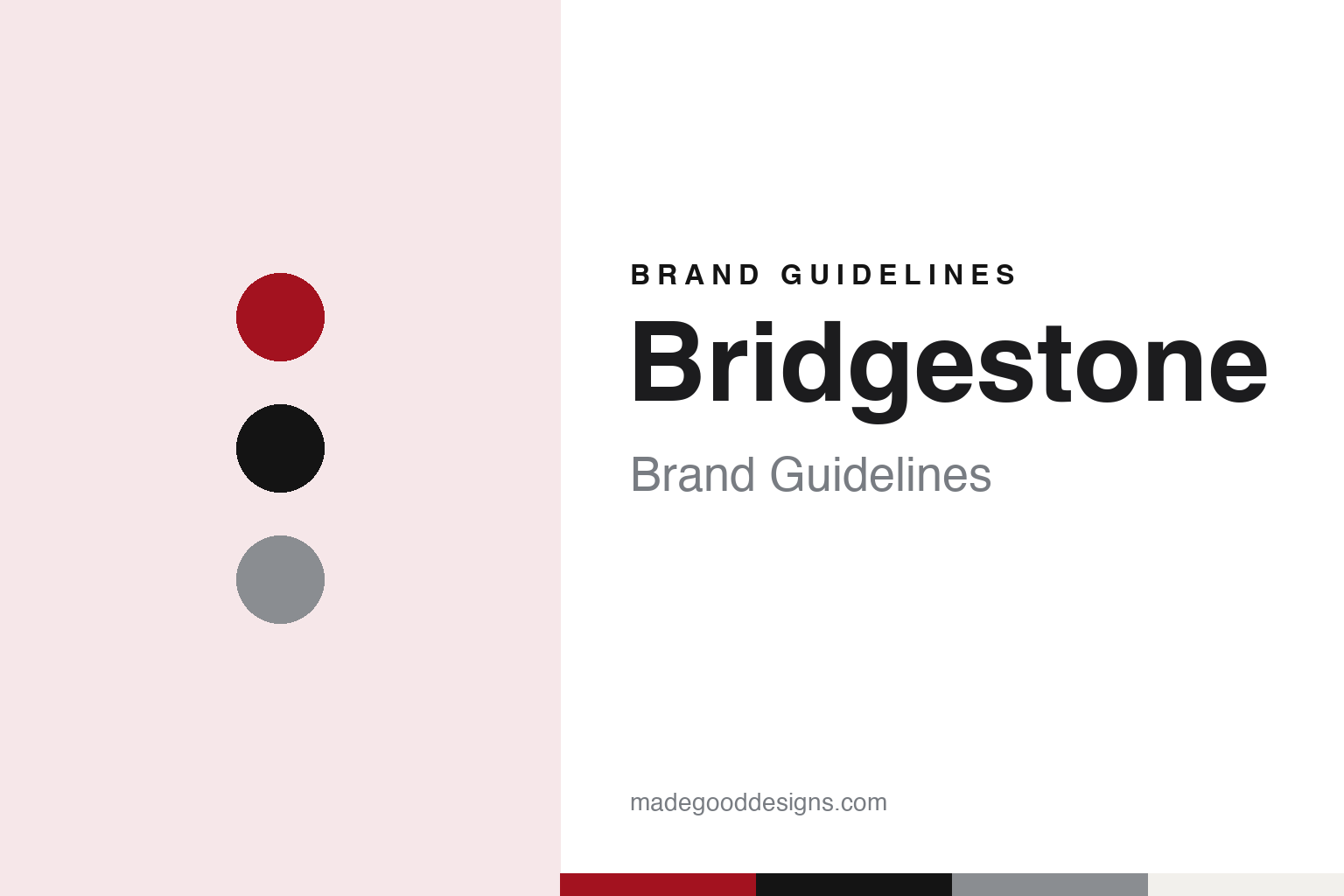
Bridgestone Brand Guidelines
A tabi maker’s surname, turned around and taken onto the road.
Aa
Two constants: a red, black and grey palette and a wide grotesque register. Abstract homage — not a Bridgestone product or mark; no tire, symbol or logo is reproduced.
A stone bridge
From tabi socks to tires in Kurume.
Bridgestone grew out of a clothing shop. In the “Bridgestone Story” on its global website — an abbreviated version of the company’s 75th-anniversary history — Bridgestone says Shojiro Ishibashi took over his family’s clothing business in Kurume, in Fukuoka Prefecture on the island of Kyushu, in 1906. He specialised in tabi, the traditional Japanese split-toe socks, and the company credits him with developing jika-tabi, tabi with rubber soles worn as work shoes, and with building a rubber shoe business that eventually included production overseas.
Rubber footwear paid for the leap to tires. The company says Ishibashi used the capital from jika-tabi and rubber shoes to start making tires, an industry that did not then exist in Japan, because he believed in the future of motor transport and wanted tires produced at home.
The tire came before the company. Bridgestone dates its first tire to 9 April 1930, built by the tire division of the Japan “Tabi” socks company. Roughly a year later, on 1 March 1931, Ishibashi made that division independent as the Bridgestone Tire Co., Ltd., established in Kurume. The company says it set out to make tires based on Japanese technology and faced early difficulties in technology, production and sales before the business grew at home and abroad. A photograph caption on its history pages dates the completion of the Kurume plant to 1933, and the corporate timeline records full-fledged tire production at the newly built Kurume Plant in 1934.
The name is the founder’s own, turned around. English Wikipedia explains that Ishibashi’s surname, written 石橋, means “stone bridge”, and that “Bridgestone” is a translation of the two parts of the name with their order reversed so that it reads as an English word.
The company then moved beyond Kurume. Its timeline records full-fledged production of golf balls from 1935, the move of the head office from Kurume to Tokyo in 1937, and the start of production of V-belts and rubber hoses the same year. In 1942, during the war, the company was renamed Nippon Tire Co., Ltd.; in 1951 the Bridgestone name returned, a company flag was established and construction began on a headquarters in Tokyo.
Colour
A keystone, a rename and a refined symbol.
On the “History of Bridgestone Symbols” section of its brand page, the company says its logo mark at the time of establishment in 1931 was designed to appeal globally, in anticipation of growth in the tire market.
The defining symbol arrived later. The company says the Keystone Mark was further elaborated with details and organised in 1974, and that the new marks and logos created an integrated brand image.
A full rename followed. According to the corporate timeline, in 1984 Bridgestone Tire Co., Ltd. became Bridgestone Corporation and adopted a new corporate logo, implementing a corporate identity programme to strengthen its domestic and overseas strategies. The brand page lists the same year as the adoption of a new corporate identity to communicate “the new Bridgestone.”
The words changed with the decades. The company says it set PASSION for EXCELLENCE as a tagline in 2004, unifying its brand image worldwide. In 2011, it says, it refined the symbol and logo, giving them a softer, rounded look, and introduced the tagline Your Journey, Our Passion. Since 2020, as it presents itself as a sustainable solutions company, the brand message has been Solutions for Your Journey.
A motto runs under all of them. The timeline says the company established the phrase “Serving society with superior quality” in 1968, and the brand page describes it as Bridgestone’s mission since its foundation.
Sport has carried the name to wider audiences. The timeline records Bridgestone entering Formula 1 racing in 1997. English Wikipedia notes that Bridgestone was the Official Tire of the Olympic Games until the partnership ended at the end of 2024, and that in 2010 it acquired the naming rights to the Nashville Predators’ arena, now Bridgestone Arena.
Golf is part of the same company history. The corporate timeline records that in 1993 the businesses of Bridgestone’s Sports Division were transferred to Bridgestone Sports, which consolidated the production and sale of sporting goods; that business is covered in our Bridgestone Golf guide.
Typography
Design and documentation.
The brands in this group are all tyre names. A tyre brand reaches people in an unusual way: its name is moulded into the rubber itself, so the lettering on a sidewall, the shape of a tread and the colours of a shop sign or a racing livery often do more of the identity work than any single advertisement. Many of these names have also travelled far from where they began, through mergers, new owners and factories in other countries.
That makes the plain questions behind each name worth asking: who started the business, which companies came together to form it, who owns it now, where its head office sits and where its tyres are made. A brand that began as a repair business, a rubber works or a family firm can end up as one name among several inside a much larger group, while still carrying the mark it was given decades earlier.
Each guide separates what independent sources record from what the company says about itself — its founding story, its owners over time, its factories and the history of its marks — and attributes each claim to the source it comes from.
Aa
A wide grotesque — a sidewall, corporate-identity register. (Specimen set in Barlow, a sans STAND-IN; NOT the Bridgestone logo.)
Bridgestone
A Japanese company with an Akron brand.
The American chapter began with a factory. The corporate timeline says that in 1983 Bridgestone acquired Firestone’s Nashville Plant as a U.S. production plant, after setting up a U.S. sales company in Los Angeles in 1967. Earlier, the timeline says, a plant in Malaysia had begun operating in 1965.
Five years later it took the whole company. Bridgestone has owned the Firestone Tire & Rubber Company of Akron, Ohio, since 1988; the timeline says Firestone announced plans in 1989 to merge with Bridgestone U.S.A. and take the name Bridgestone/Firestone, Inc., and that Bridgestone/Firestone Europe S.A. was established in 1990. In 1995, the company says, Firestone returned to Indy car racing and the Indianapolis 500. English Wikipedia says Bridgestone Americas is based in Nashville, and that in June 2022 the company opened an Advanced Tire Production Center in Akron, on the site of Firestone’s original 1910 headquarters, to make racing tires.
Tokyo remains the centre. English Wikipedia places the headquarters in Kyōbashi, Tokyo, the district where Ishibashi founded the Bridgestone Museum of Art in 1952. The company’s timeline records the Bridgestone Today Museum in Kodaira, Tokyo, completed in 2001; its Bridgestone Innovation Gallery in Kodaira now presents the company’s history. English Wikipedia adds that Bridgestone’s European head office is in Brussels.
For a design guide, Bridgestone shows how a founder’s surname, translated and reversed, can become a global word, and how a symbol can be refined across decades — 1931, 1974, 1984 and 2011 —. Compare Goodyear, the Akron neighbour of the Firestone business Bridgestone now owns, and Bridgestone Golf, the company’s sporting-goods name. For this guide we use a deep red, a near-black and a steel grey with a wide sans, an unofficial interpretation; no product or logo is reproduced.
Explore & save
Keep Bridgestone’s identity on hand — save it to a board in the Made Good inspiration library.
Bridgestone identity set
Pin the Bridgestone red, black and steel grey palette and the wide grotesque register to your own board.


