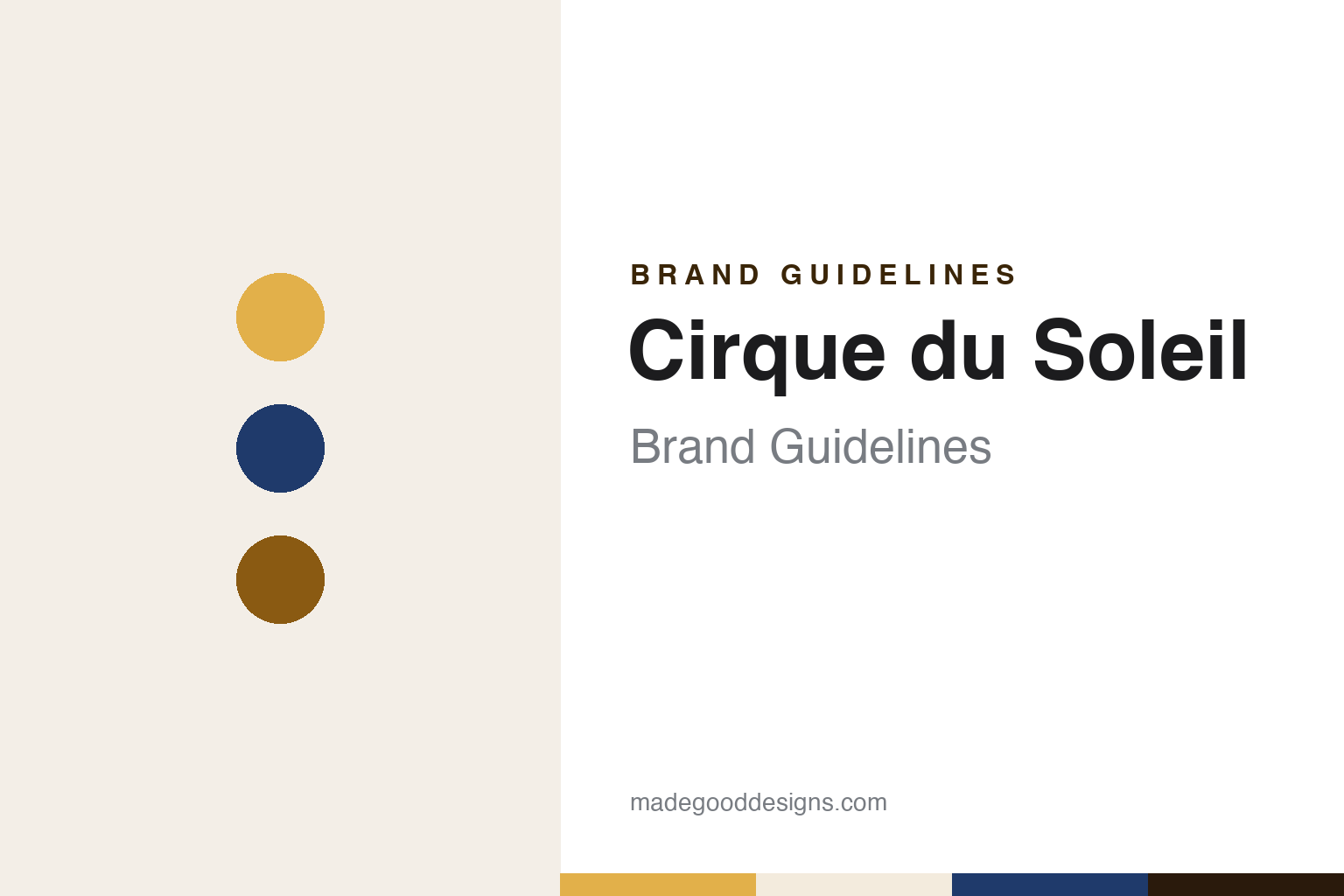
Cirque du Soleil Brand Guidelines
A stilt-walkers’ troupe from Charlevoix that named itself after the sun.
Aa
Two constants: a tarot sun, burnt ochre, big top canvas, sunburst blue and ring earth palette and a fine classical capitals register. Abstract homage — not a Cirque du Soleil asset or mark; no logo, poster, costume or photograph is reproduced.
Stilts, a fair and a circus of the sun
From the stilt-walkers of Baie-Saint-Paul to a touring circus funded for the Cartier anniversary, 1979–1985.
Cirque du Soleil grew out of a street troupe in a painters’ town. The Canadian Encyclopedia, in an article by Raymond Bertin published online on 20 February 2012 and last edited in June 2023, places the story in Baie-Saint-Paul, a municipality in Quebec’s Charlevoix region and a summer meeting place for painters. There a troupe of street performers known as Les Échassiers (“the stilt-walkers”), which included Guy Laliberté, was formed by Gilles Ste-Croix; its members entertained holidaymakers by juggling, dancing, breathing fire and playing music.
English Wikipedia fills in the early years. It says Laliberté, who had learned fire-breathing, organised a summer fair in Baie-Saint-Paul in 1979 with the help of Daniel Gauthier and Ste-Croix, and that Ste-Croix walked on stilts from Baie-Saint-Paul to Quebec City as a stunt to win provincial funding for Les Échassiers de Baie-Saint-Paul, which toured Quebec in 1980. To absorb the troupe’s losses the performers set up a non-profit, the Club des talons hauts (the High-Heeled Club), and in 1982 they launched the Fête foraine in Baie-Saint-Paul, a holiday fair that drew street entertainers from far beyond the town.
The encyclopedia says the dream that took hold at the fair was a Quebec circus that would travel the world, and that Cirque du Soleil was officially founded in 1984 with financial support from the Quebec government, as part of the celebrations of the 450th anniversary of Jacques Cartier’s arrival in Canada. Wikipedia gives the founding date as 16 June 1984 and names Laliberté and Ste-Croix as founders; Laliberté served as president until 2015. The opening production, Le Grand Tour du Cirque du Soleil, began in the Gaspé and went on to ten other Quebec cities under a tent.
The name came before the circus had a home. The company says Laliberté thought of “Cirque du Soleil” — circus of the sun — while watching a sunset in Hawaii, and that on his return he looked up the sun in a dictionary of symbols and found it stood for youth, energy and dynamism, words he felt described the troupe. The encyclopedia describes the artistic idea as dramatised circus and street-theatre technique: colourful costumes, lighting effects and original music joined to acrobatics, with no animals. Wikipedia says Guy Caron, head of Quebec’s National Circus School, became artistic director after the 1984 season, and that the Belgian director Franco Dragone began working on the shows in 1985.
Colour
Tours to Los Angeles, Las Vegas and a Montreal studio, then a run of owners from 2015 to 2020.
The circus crossed Quebec’s borders in 1985, the encyclopedia says, playing Ottawa, Toronto and Niagara Falls, and in 1986 took La Magie continue to Vancouver. Wikipedia says Le Cirque Réinventé opened at the Los Angeles Arts Festival in September 1987, the start of a run of American engagements, and the show reached London and Paris in 1990. Nouvelle Expérience premiered in Montreal the same year, and in 1992 the company visited Tokyo and seven other Japanese cities. Its permanent show Mystère opened in Las Vegas in December 1993; O in Las Vegas and La Nouba in Orlando followed in 1998.
The company built its own base in Montreal. The encyclopedia dates the inauguration of its international headquarters, known as le Studio, to 1997, describing it as a centre for creation and production, with an annex added from 2001. Cirque du Soleil says the building stands in the Saint-Michel district, next to the former Miron quarry and the city’s waste treatment centre, as the cultural centre of the district’s environmental complex. Wikipedia says Daniel Gauthier left at the start of 2001, bought out by Laliberté, and that Ste-Croix left soon afterwards to create a touring horse show, Cheval.
Ownership changed in 2015. The encyclopedia says that on 20 April 2015 Laliberté announced the sale of Cirque du Soleil to a consortium led by the American investment firm TPG Capital, keeping a minority stake, and that the deal required the headquarters to stay in Montreal. Wikipedia names the other buyers as Fosun and the Caisse de dépôt et placement du Québec, and says the company was restructured under a parent named Cirque du Soleil Entertainment Group, which in July 2017 acquired Blue Man Group. In February 2020 the Caisse bought Laliberté’s remaining stake.
The Canadian Press reported on 24 November 2020 that the company had completed its sale to a group of creditors led by Catalyst Capital Group and left court protection, with Jim Murren and Gabriel de Alba as co-chairs, Daniel Lamarre staying on as chief executive and the headquarters kept in Montreal. Wikipedia says Stéphane Lefebvre succeeded Lamarre in December 2021, and that Mark Cornell was appointed president and chief executive in November 2025.
Typography
A painted tarot sun, a sunburst in blue or gold and a two-logo system in 2017.
Live shows and comedy companies build identity in places where a printed logo is only one of many signals. A long-running show is often its own brand: the title, a single costume colour or a recurring piece of staging is what audiences remember and repeat, and the producing company sits quietly behind it. In comedy and immersive work, a character, a mask or a costume can do the job of a logo, travelling from the stage to television, posters and merchandise while the company name stays in small type. The building matters too. A theatre door, a marquee, a painted wall or a hand-lettered sign outside a club becomes the image that fans photograph, and a street name can attach itself to a company for decades.
Many comedy theatres also run training schools, and these shape the identity as much as any show. Class levels, house teams and recurring show formats acquire their own names, which act as an internal vocabulary for students, teachers and regular audiences; alumni carry the company name into their biographies, so the brand travels through the credits of people who once took a class. Festivals add another layer, with lanyards, wristbands, programmes and venue posters that must hold a recognisable look across many rooms and many performers at once. For a designer, the useful lesson is that identity in live performance is spread across names, formats, places and people, and a system needs to leave room for the show itself to take the lead.
Aa
Fine classical capitals — after the slim, letter-spaced wordmark under the sun. (Specimen set in Cinzel, a serif STAND-IN; NOT the Cirque du Soleil logo, wordmark or any Cirque du Soleil lettering.)
Cirque du Soleil
From Josée Bélanger’s tarot sun to a sunburst and a sun-face roundel.
The sun has been the mark since the founding year. Cirque du Soleil says its logo was created in 1984 by Josée Bélanger and is based on a tarot card representing the sun, a symbol the company links to youth, energy and dynamism, and that the logo has evolved only slightly since while keeping its tarot imagery. The fan newsletter Fascination!, in a report dated 11 December 2017, describes Bélanger as a stilt-walker who, with Gilles Ste-Croix, Serge Roy, Carmen Ruest and Guy Laliberté, founded the Club des talons hauts, the non-profit that preceded the circus.
The same report traces the mark’s path from a multi-coloured, tarot-inspired painting to the sunburst that the company used for more than twenty-five years, set in either blue or gold. It records one other notable change before 2017: in mid-2006 the tail of the Q in CIRQUE DU SOLEIL was extended to run beneath the U.
The larger change came with the new parent company. Fascination! says that on 21 November 2017, in a video posted across its social channels, Cirque du Soleil announced two distinct logos: a modified sunburst for Cirque du Soleil Entertainment Group, the umbrella company, and a roundel with the sun-face motif at its centre, labelled CIRQUE DU SOLEIL, for the circus arts brand. The newsletter quotes the video’s script, which calls the redrawn mark “a new interpretation of the sun” and “a symbol of life, energy, fun, and folly”, and describes the aim as simplifying and refining while building on the company’s heritage.
Both marks keep the sun at the centre. The group logo carries the rays of the sunburst, while the circus roundel keeps the sun-face motif that Fascination! traces back to Bélanger’s tarot-inspired painting, and the CIRQUE DU SOLEIL lettering remains in capitals.
For a design guide, Cirque du Soleil shows a touring company that took its symbol from a tarot card in its founding year and, three decades later, divided that sun between a group and a circus without letting go of the face. Compare the Blue Man Group and Just for Laughs guides. For this guide we use tarot sun, burnt ochre, big top canvas, sunburst blue and ring earth with a serif, an unofficial interpretation; no product or logo is reproduced.
Explore & save
Keep Cirque du Soleil’s identity on hand — save it to a board in the Made Good inspiration library.
Cirque du Soleil identity set
Pin the Cirque du Soleil tarot sun, burnt ochre, big top canvas, sunburst blue and ring earth palette and the fine classical capitals register to your own board.