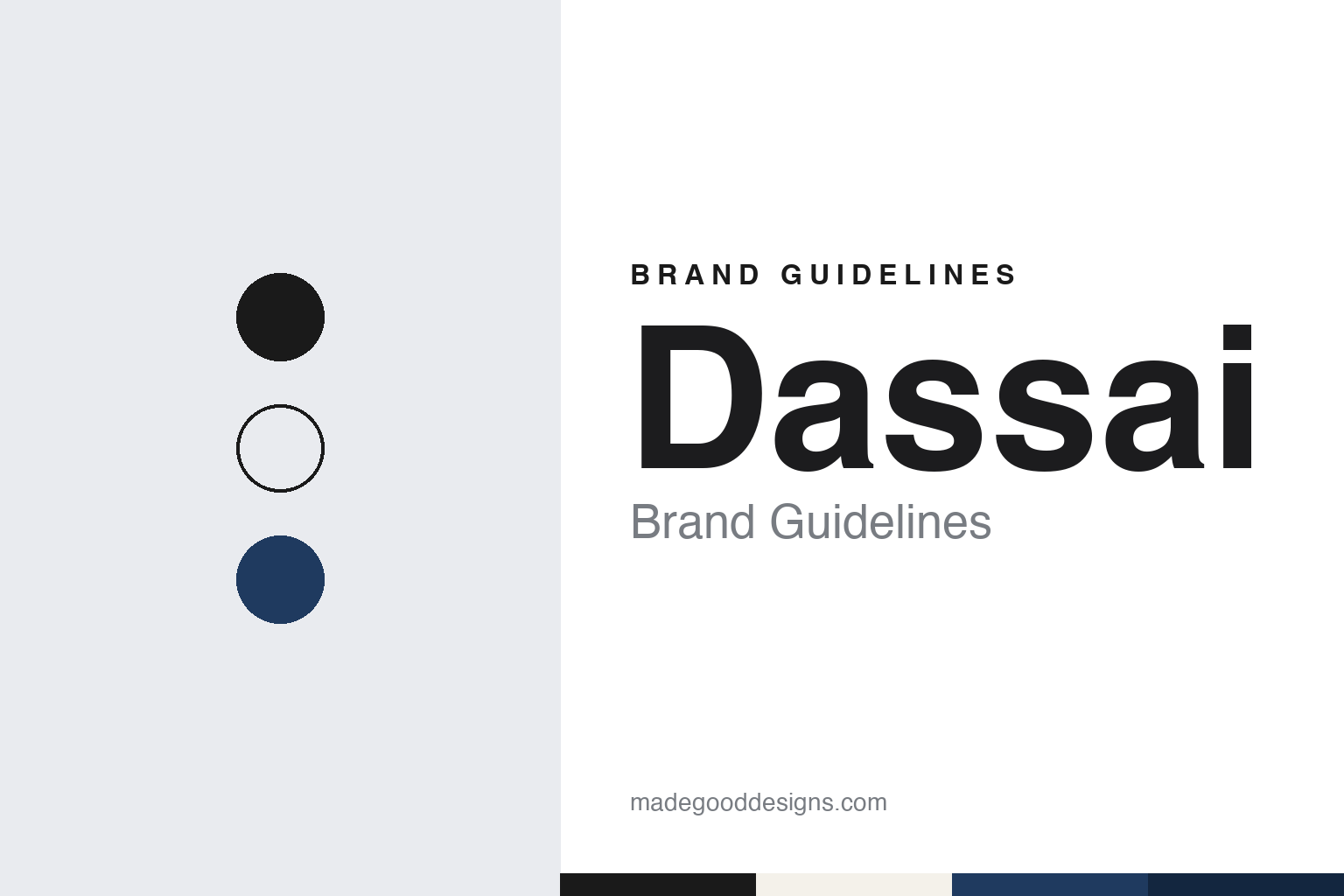
Dassai Brand Guidelines
The otter-festival sake from Iwakuni, launched 1990.
Aa
Two constants: a brush ink, rice white and river blue palette and a brush-cut Mincho serif register. Abstract homage — not a Dassai product or mark; no label, logo or bottle is reproduced.
An otter festival in the hills
A failing village brewery that bet everything on one style.
Dassai is made by a family brewery in the hills outside Iwakuni, in Yamaguchi Prefecture at the western end of Honshu. The company says the original brewery was founded in the 1700s on the same site, that the Sakurai family took it over in the Meiji era as Sakurai Sake Brewery, and that the family established Asahi Shuzo in 1948, after the Second World War.
The modern story begins with a rescue. Nippon.com reported in January 2014 that Hiroshi Sakurai took over from his father in 1984, at 34, when the brewery was close to bankruptcy and its everyday sake, Asahi Fuji, was losing ground in a shrinking market. Sakurai’s answer was to stop competing locally on price and to make only premium sake for Tokyo. The company’s own account says the Asahi Fuji name had a discount image at home, so the new sake needed a new name.
That sake, Dassai, a junmai daiginjo, went on sale in Tokyo in 1990. Nippon.com reported that in 1992 the brewery launched Migaki Niwari Sanbu, with rice polished down to 23 percent of the grain, and that it used only Yamada Nishiki rice. In 1998, when its master brewer, the tōji, said he would stop, Sakurai decided the company would brew without one, with its own staff and year-round production rather than the traditional winter season. Speaking in 2025, Hiroshi Sakurai said Dassai had become all of the brewery’s output by 2004, according to Fashionsnap.
The next handover came in 2016. Kazuhiro Sakurai, Hiroshi’s son, joined the company in 2006 and was appointed president in September 2016, the fourth generation, according to a profile in Gakusei Shinbun; the company names Hiroshi as chairman.
Colour
An otter, a poet and a set of polishing numbers.
The name is local. The company says “Dassai” literally means “otter festival,” a word once used in Yamaguchi, where otters played in the nearby rivers and laid the fish they caught along the bank, as if setting them out for a festival. The brewery’s address is Osogoe, in Shuto-machi, Iwakuni. The company also points to the haiku poet Masaoka Shiki, who used “Dassai” as a pen name because he spread his books and papers around his room the way otters spread out fish, and it presents Shiki’s reform of Meiji-era poetry as a model for its own attempt to change sake.
The other half of the identity is a number. Dassai’s range is named by polishing ratio — the share of each rice grain left after milling — so that labels such as Dassai 45 and Dassai 23 tell the drinker how far the rice was polished. Nippon.com reported that milling to 50 percent takes about 30 hours and milling to 23 percent about 96 hours.
The brewery has also been tested by weather. On 7 July 2018, during the heavy rains across western Japan, a landslide and debris made the river in front of the brewery overflow; the company’s president wrote that one building flooded and the other lost power, so sake in the tanks could not be pressed. The Drinks Business reported in July 2018 that production had been suspended, and the American importer True Sake reported that brewing resumed on 29 July. In August 2018 Anime News Network reported that the Iwakuni-born manga artist Kenshi Hirokane had lent his Shima Kosaku character to a label for sake from the affected batch, with part of the proceeds going to flood relief.
Typography
Design and documentation.
The seven brands in this group are all sake, shochu and soju names: Dassai, Hakkaisan, Kubota, Ozeki, Sho Chiku Bai, iichiko and Chum Churum. Sake, shochu and soju brands in general sit at many different points in the trade, from family breweries that still carry a founder’s name to labels that now belong to much larger drinks groups, and a single brand can be sold everywhere from a corner shop to a restaurant list.
A sake, shochu or soju brand’s identity is usually carried less by a single bottle than by a label, a name and the place it promises, because the company behind the name may have changed hands, moved its production or grown far beyond the place where it started. That makes the questions behind each name worth asking plainly: who started it, who owns it now, and where its drink is actually made and bottled.
Each guide separates what independent sources record from what the company says about itself — its founding story, its owners over time, where its sake, shochu or soju is made and how its labels have changed — and marks plainly what rests only on the company’s own word.
Aa
A brush-cut Mincho serif for a name written in Japanese characters. (Specimen set in Shippori Mincho, a serif STAND-IN; NOT the Dassai logo.)
Dassai
From Iwakuni to the Hudson Valley, and a new company name.
Exports came early. Nippon.com reported that Dassai went on sale in Taiwan in 2002 and that distribution in the United States began in 2003, and quoted Hiroshi Sakurai: “Unless we can sell globally, there is no future for sake.” The company says it began planning a brewery abroad in 2016.
That brewery is Dassai Blue, in Hyde Park, in New York’s Hudson Valley. The company announced its opening in September 2023, and the office of New York’s governor marked the grand opening on 23 September 2023, describing a 55,000-square-foot brewery and tasting room and the launch of the American brand. Dassai has worked with the Culinary Institute of America, also in Hyde Park, on sake education, a partnership Westfair Online reported was first announced in 2018. The company says Dassai Blue is junmai daiginjo made with Yamada Nishiki rice from Japan and the United States, including rice grown with Isbell Farms in Arkansas. In April 2024 it brought two of the New York sakes, Type 23 and Type 50, back to a few shops in Japan.
On 1 June 2025 Asahi Shuzo changed its name to DASSAI Inc. The change was announced in January 2025, Fashionsnap and Mynavi News reported, with Kazuhiro Sakurai saying that having a company name different from the brand name had made the company’s work harder. Japanese press coverage also noted that another sake company, the Niigata maker of Kubota, is also romanised Asahi Shuzo.
For a design guide, Dassai shows how a single word with a local story, paired with a plain polishing number, can carry a brewery from a village to New York. Compare Gekkeikan, the Fushimi house of 1637, and Kubota from Niigata; for the lettering question on its own, see What Font Does Dassai Use?. For this guide we use brush ink, rice white and a river blue with a serif, an unofficial interpretation; no product or logo is reproduced.
Explore & save
Keep Dassai’s identity on hand — save it to a board in the Made Good inspiration library.
Dassai identity set
Pin the Dassai brush ink, rice white and river blue palette and the brush-cut Mincho serif register to your own board.