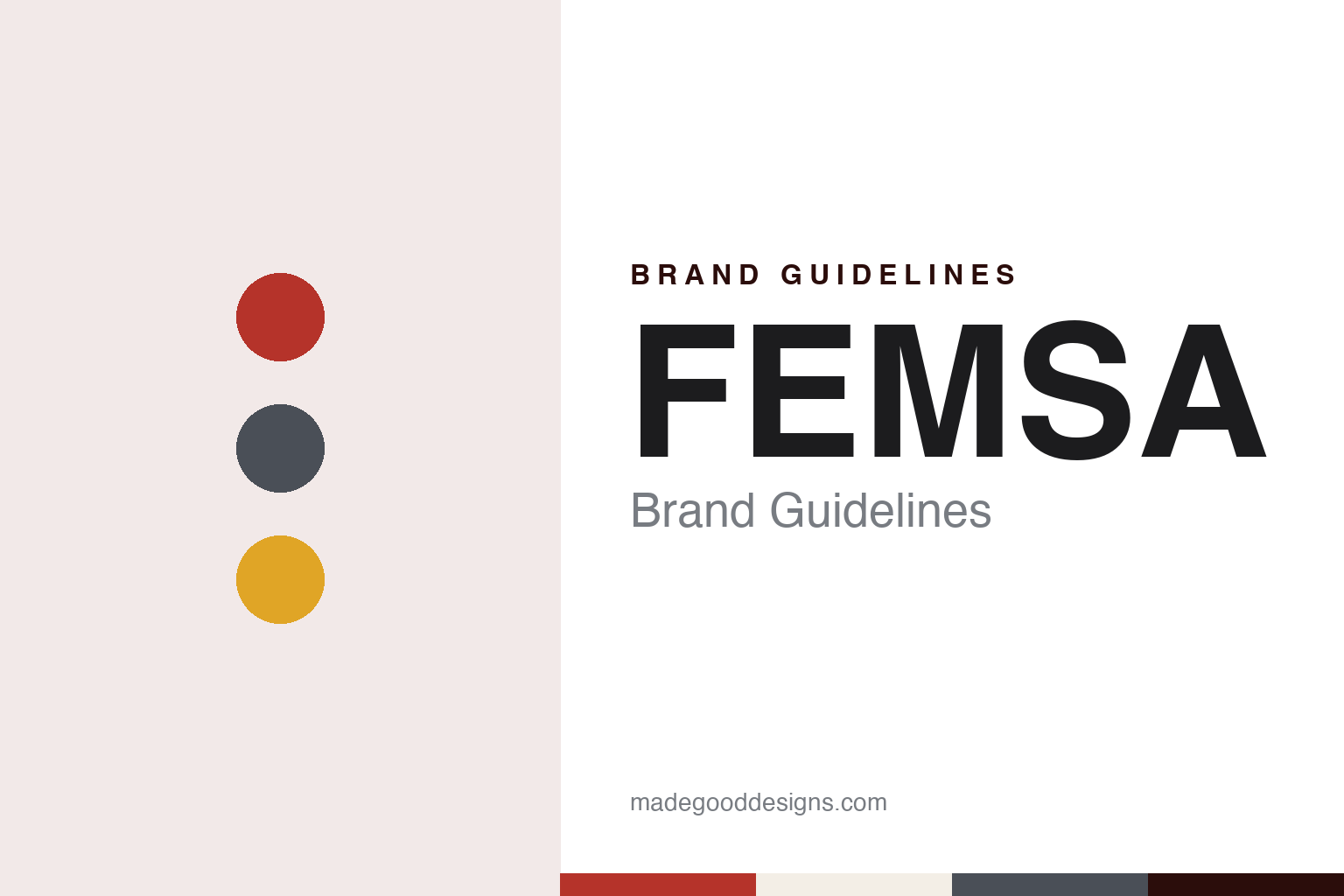
FEMSA Brand Guidelines
A brewery’s abbreviation over a bottler and a corner store.
Aa
Two constants: a brewhouse red, cerro grey and amber palette and an Industrial grotesque register. Abstract homage — not a FEMSA asset or mark; no logo, label or wordmark is reproduced.
A brewery that made its own bottles
Monterrey, 1890.
FEMSA is an abbreviation that spells out a purpose. The full name, Fomento Económico Mexicano, means roughly “Mexican economic development”, and Wikipedia says the company trades under the short form from its headquarters in Monterrey, the capital of the northern state of Nuevo León. The business that grew into FEMSA began as a brewery. Gale’s International Directory of Company Histories, in its entry on the holding company Valores Industriales, says Cervecería Cuauhtémoc was founded in Monterrey in 1890 by Isaac Garza Garza, his brother-in-law Francisco Sada Muguerza, José Muguerza and José María Schneider. The same entry says the brewery produced beer and ice in its early years, and that a sister company, Cervecería Central, was set up in 1901 to supply Mexico City and the surrounding states.
The brewery soon began making the things that surrounded its beer. Gale says a glassworks established in 1899 became Vidriera Monterrey in 1909, when it acquired the Owens patent for machine-made glass bottles, and that a cardboard factory was set up in 1900 to make boxes, caps and packaging. During the 1920s a crown cap replaced the cork stoppers on the brewery’s bottles, and in 1929 that work passed to a new company, Fábricas Monterrey, known as Famosa; another new firm, Malta, was set up the same year to make malt for the brewery. Gale says metal vats replaced wooden ones in 1930. Wikipedia describes the same chain of glass, caps, labels and flexible packaging as the start of the group’s vertical integration, and says the glassworks is now Vitro.
A holding structure followed. Gale says the Garza and Sada families reorganised their shares in 1936 through a new holding company, Valores Industriales, known in Mexico as Visa, which controlled the brewery and Famosa. Gale also says Isaac Garza’s sons Eugenio and Roberto Garza Sada, both graduates of the Massachusetts Institute of Technology, founded a technical school that became the precursor of Monterrey’s Technological Institute. Wikipedia says the wider family holdings, which also took in banking and steel, became known as the Grupo Monterrey, and that in 1974 descendants of the founding families divided it into two branches. The steel and packaging side went to the Garza Sada family and later became part of Grupo Alfa; the beverage and banking side became FEMSA, under the control of the Garza Lagüera family. Gale says Eugenio Garza Lagüera, a son of Eugenio Garza Sada, became chairman of Visa that year. Wikipedia says FEMSA was listed on the Mexican Stock Exchange on 19 September 1978, and that its shares have also traded in New York through depositary receipts since 1998.
Colour
Beer labels, a bottler and a store.
For much of the twentieth century, the group’s public face was a row of beer labels. Gale says that by the mid-1990s it was brewing and selling beer under names including Carta Blanca, Bohemia, Tecate, Indio, Superior and XX Lager, alongside soft drinks. Some of those names came from a rival. Gale says Visa acquired Cervecería Moctezuma in 1985, and Wikipedia says the two brewers merged that year as Cervecería Cuauhtémoc Moctezuma. Wikipedia adds that a corporate and financial restructuring of FEMSA was completed in December 1988.
The soft-drink side grew into a business with a double name. Gale says Visa began its soft-drink and mineral-water operations in 1979, and that in 1993 it sold a stake in FEMSA’s soft-drink business to a subsidiary of The Coca-Cola Company. Wikipedia says that sale created Coca-Cola FEMSA, the bottler that carries both companies’ names, is listed in its own right and has FEMSA and Coca-Cola as shareholders. Gale says that in the mid-1990s Coca-Cola FEMSA held the bottling franchise for the Mexico City metropolitan area, south-eastern Mexico and, through a subsidiary, metropolitan Buenos Aires. Wikipedia says the bottler bought the juice maker Jugos del Valle in 2007.
On the street, the group answers to a different word. The Mexican business site El CEO, in a history published on 26 August 2025, said OXXO was born in Monterrey in 1978 as a way to drive sales for the Cuauhtémoc Moctezuma brewery, at a time when FEMSA was led by Eugenio Garza Lagüera. El CEO said the stores at the outset sold beer, cigarettes and snacks, promoting labels such as Indio, Carta Blanca and Tecate, and that in the 1980s the range widened as the chain spread to other states, with branches in Hermosillo and Nuevo Laredo. The same report said the payment service OXXO Pay began in 2017 and the digital wallet Spin by OXXO in 2021, and that OXXO opened in Texas early in 2025 after FEMSA acquired the KD Market chain.
The beer labels left the group in 2010. FoodIngredientsFirst reported on 11 January 2010 that Heineken would acquire FEMSA’s beer operations in an all-share transaction, covering its Mexican beer business, including exports to the United States, and the rest of its Brazilian beer business. In return FEMSA would receive a stake in the Heineken Group and the right to name two non-executive members of Heineken’s Supervisory Board, one of them a vice chairman. The report named Dos Equis, Tecate and Sol among the brands moving to Heineken. Wikipedia says FEMSA sold Heineken shares back to the brewer in 2023.
Typography
A brewery, a bottler and a store.
Corporate identities across Latin America often begin with a long legal title. A founding name that strings together words for development, industry, bank or company is usually shortened in daily use to an acronym, and over time that acronym becomes the name people say, print and search for. For a designer, this means the wordmark often carries letters that once stood for something and now simply stand for the company.
Language is a second layer. A single group can trade in Spanish-speaking and Portuguese-speaking markets, and its name, tagline and legal suffix may appear in more than one form. Accents, the cedilla and the tilde have to survive in every typeface the company uses, from a shop sign to an app icon, so letterforms with full Latin character support matter more than they first appear.
Colour does a lot of the work. Store fronts, delivery vans, uniforms, cans, labels and packaging all repeat the same tones, so a company palette is read on the street as much as on a screen. The guides in this round treat those surfaces as part of each identity, and every palette shown here is our own interpretation rather than an official specification.
Aa
An industrial grotesque — after a group grown from a brewery and its packaging plants. (Specimen set in Archivo, a sans-serif STAND-IN; NOT the FEMSA logo or any FEMSA typeface.)
FEMSA
Five letters, many names.
Seen as a brand, FEMSA is chiefly an umbrella over names that customers know better. Its own five letters appear in the names of some subsidiaries: Wikipedia lists FEMSA Comercio, the retail arm that runs OXXO, and Coca-Cola FEMSA, the bottler. Other businesses carry names of their own. Wikipedia says the logistics arm, FEMSA Logística, was rebranded as Solistica in October 2017, and that FEMSA Comercio entered the drugstore trade in South America in 2015 through Socofar, the Chilean company behind the Cruz Verde pharmacies. Wikipedia also says FEMSA acquired the Swiss retail and food-service group Valora in 2022, and that FEMSA owns the Monterrey football club C.F. Monterrey.
That pattern has deep roots in Monterrey. Gale’s history describes a brewery that made its own bottles, caps, cartons and malt, each in a company with its own name: Vidriera Monterrey, Famosa and Malta. Gale says another subsidiary, Grafo Regia, was founded in 1957 to meet the group’s needs for printing and graphic materials, and Wikipedia says the group’s packaging operations expanded into labels and flexible packaging that year. Gale also says the group’s companies made refrigerators and vending machines by the mid-1990s, and Wikipedia describes the cooler maker Imbera as a FEMSA division in 2017.
The 2010 sale changed what the name stood for. The brewery that began the story in 1890, together with Carta Blanca, Tecate, Indio, Bohemia and Dos Equis, has belonged to Heineken since 2010, while FEMSA’s name stays on the holding company in Monterrey, on the bottler it shares with Coca-Cola and on the retail arm behind OXXO.
For a design guide, FEMSA shows how a company named for an economic purpose can keep its own identity in an abbreviation while its brands — beer labels in the past, a shared bottler and a chain of convenience stores today — carry the names people meet. Compare Carta Blanca, the beer of the Monterrey brewery where the group began, and Heineken, the brewer that has owned FEMSA’s former beer business since 2010. For this guide we use brewhouse red, cerro grey and amber with a sans, an unofficial interpretation; no product or logo is reproduced.
Explore & save
Keep FEMSA’s identity on hand — save it to a board in the Made Good inspiration library.
FEMSA identity set
Pin the FEMSA brewhouse red, cerro grey and amber palette and the Industrial grotesque register to your own board.


