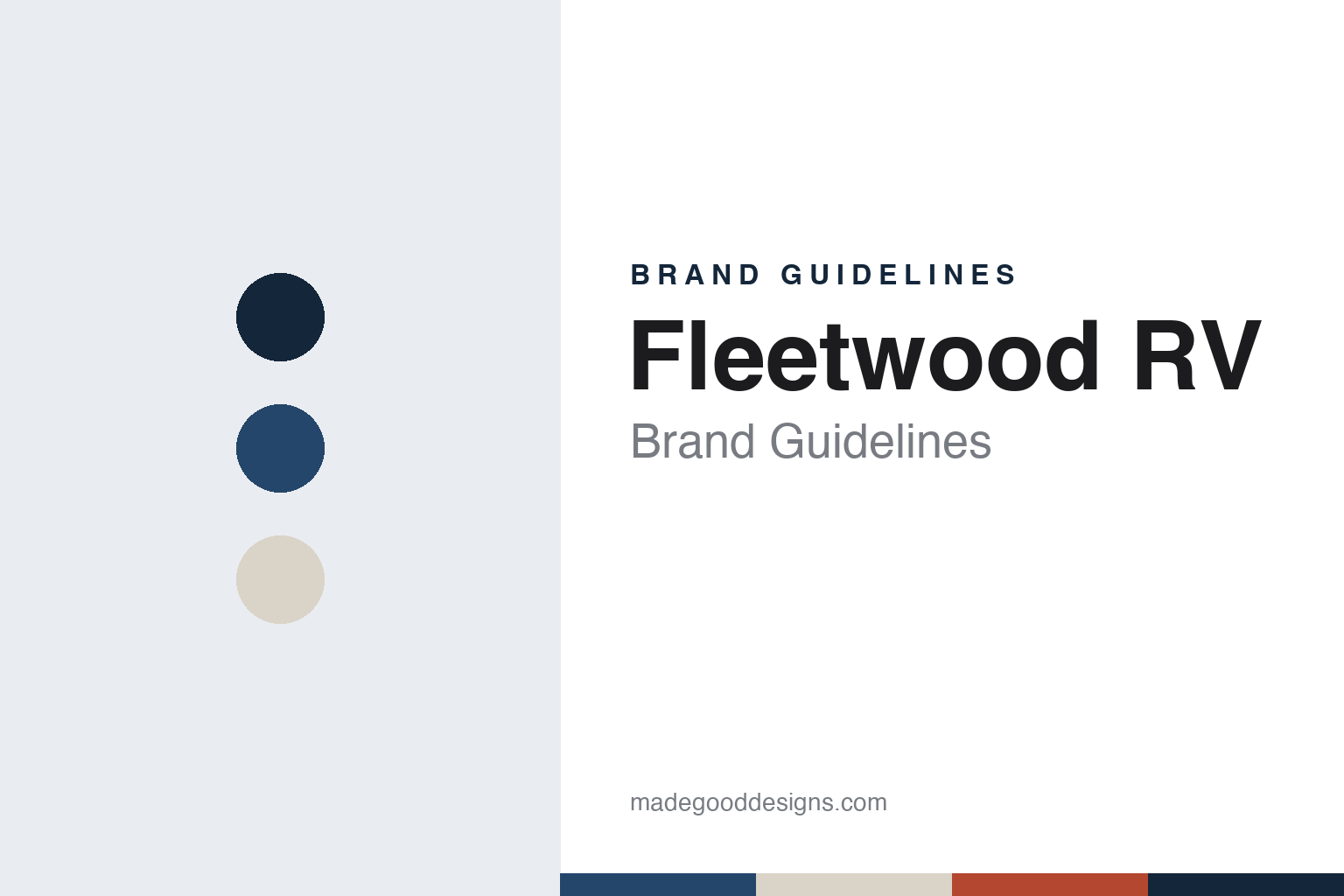
Fleetwood RV Brand Guidelines
A window-blind workshop in southern California, a name borrowed from coachbuilt Cadillacs, and a motorhome brand that kept going after its parent company did not.
Aa
Two constants: a highway blue, desert sand and tail-light red palette and a Wide grotesque sans register. Abstract homage — not a Fleetwood RV product or mark; no motorhome, decal or logo is reproduced.
Southern California, 1950
Window blinds first, then trailers, then a name off a Cadillac.
Fleetwood RV is a motorhome brand built today in Decatur, Indiana, but its story starts on the other side of the country. English Wikipedia, drawing on the Gale Directory of Company Histories, says the business began in 1950, when John C. Crean formed Coach Specialties Company in southern California. Its first product was not a vehicle at all: the company made window blinds for travel trailers.
Trailers soon followed. The same account says that around 1953 Crean renamed the business Fleetwood Trailer Company. The name was borrowed from the automotive world. Fleetwood was a coachbuilding name that had become attached to bodies used on Cadillac cars, and English Wikipedia says that connection inspired the choice.
A photograph used on the Wikipedia article shows a 1950 Fleetwood Sporter trailer on display at the RV/MH Hall of Fame in Elkhart, Indiana. It gives an idea of the shape of the early product: a compact towable with rounded ends, very different from the large motorhomes that carry the name now.
In 1957 the company was reincorporated as Fleetwood Enterprises, Inc., and for its first dozen years it moved more than once. English Wikipedia lists Compton, Paramount and Anaheim before a move in 1962 to Riverside, California, which became the company’s long-time base. Fleetwood Enterprises became a public company in 1965.
Over the following decades the business grew in two directions at once. English Wikipedia, citing a 2011 history in Riverside’s The Press-Enterprise, describes it as a maker of both recreational vehicles and manufactured homes. That double life matters for the brand story, because when the company eventually broke up, the two halves went to different buyers.
Colour
Bankruptcy, a sale and a move to Indiana.
The break came at the end of the 2000s. English Wikipedia says Fleetwood Enterprises announced the closure of several factories in November 2008, and on 10 March 2009 filed for Chapter 11 bankruptcy protection and announced the closure of its travel-trailer division.
What happened next is the reason the Fleetwood RV name still appears on new motorhomes. On 17 July 2009, according to a press release from the private equity firm American Industrial Partners, AIP completed its purchase of the Fleetwood motorized recreational vehicle business, including the Goldshield fibreglass supply business. English Wikipedia adds that Cavco Industries acquired the manufactured-housing division the following month.
The towable side of the brand took a third path. English Wikipedia, citing a February 2010 report in RVBusiness, says that on 2 February 2010 Heartland Recreational Vehicles acquired the remaining active trademarks of Fleetwood Enterprises’ towable brands. So the trailers that started the company and the motorhomes that carry its name today ended up with different owners.
The motorhome business settled in Indiana. English Wikipedia gives Decatur, Indiana as Fleetwood RV’s headquarters from 2009, and the brand’s own website, read in October 2026, invites visitors on tours of “our Decatur, Indiana factory.” The Riverside company itself, Fleetwood Enterprises, is listed by Wikipedia among defunct California companies; the RV brand lives on under new ownership.
The current range on the company website is organised the way the RV trade classifies motorhomes. In the large Class A diesel segment the 2027 models listed include the Palisade, Discovery, Discovery LXE and Frontier; the gas Class A line includes the Bounder, Fortis and Flair; and the Altitude name appears across the smaller Class C and Super C models. Most are single words.
The company also gives its construction methods their own trademarked names. It says its Powerlock System is an interlocking aluminium wall-joint structure, that the diesel coaches use a steel platform it calls the Freedom Bridge on a Freightliner chassis, and that its gas models are built on what it calls the Fleetwood Power Platform using a Ford drivetrain. The company also says its full-body paint can use up to four colours.
Typography
Design and documentation.
Small travel trailers and recreational vehicles occupy a particular corner of the road-going world. Some are built in compact factories in small towns, often by families who have run the business across more than one generation; others come from much larger groups that hold many nameplates under one roof. A lightweight moulded shell and a towing hitch can look much the same from one maker to the next, so the name on the side has to do a good deal of the work.
That is why the plain questions matter here: who started the company, who owns it today, where the trailers are actually built, and how the product range has changed over time, from the first floor plan to the latest one. Owner clubs, rallies and enthusiast forums often keep that history alive as carefully as the makers do. Model names, body shapes and liveries tend to persist for decades, while the people and owners behind them change.
Each guide in this group sets out what independent, dated sources record next to what the company says about itself, and marks clearly where a fact rests only on the maker’s own account.
Aa
A wide grotesque sans — broad and steady, like model lettering on a coach sidewall. (Specimen set in Archivo, a grotesque sans STAND-IN; NOT the Fleetwood RV logo.)
Fleetwood RV
From Allied Specialty Vehicles to REV Group and Terex.
American Industrial Partners did not keep Fleetwood on its own for long. According to an AIP press release dated 24 August 2010, cited by English Wikipedia, the firm combined Fleetwood with fire-truck maker E-One, bus and ambulance maker Collins Industries and Halcore Group to form Allied Specialty Vehicles. A motorhome brand that began with trailer blinds now sat alongside fire engines and ambulances.
The group changed its name in November 2015. Fire Apparatus & Emergency Equipment magazine reported on 2 November 2015 that Allied Specialty Vehicles had chosen REV as its new company name, and English Wikipedia says REV Group went public in January 2017. Fleetwood RV became part of the group’s recreation business, REV Recreation Group, based in Decatur, which Wikipedia says has also included American Coach, Holiday Rambler and Midwest Automotive Designs.
The ownership chain moved again in the mid-2020s. RV News reported on 10 February 2026 that REV Recreation Group had sold its Lance Camper division in June 2025 and its Midwest Automotive Designs division that month, leaving Class A production under the American Coach, Fleetwood RV and Holiday Rambler brands, plus Super C models from Renegade RV. The same report names Terex Corp. as REV Group’s owner, following a merger made public in October 2025. The Fleetwood RV website, read in October 2026, still describes the brand as part of REV Group.
For a design guide, Fleetwood RV shows how a borrowed coachbuilding name can outlast the company that chose it, carried through a bankruptcy, a sale and two new parent groups by model names and painted sidewalls. Compare Winnebago, another long-running motorhome name, and Tiffin Motorhomes, another Class A motorhome maker. For this guide we use highway blue, desert sand and tail-light red with a sans, an unofficial interpretation; no product or logo is reproduced.
Explore & save
Keep Fleetwood RV’s identity on hand — save it to a board in the Made Good inspiration library.
Fleetwood RV identity set
Pin the Fleetwood RV highway blue, desert sand and tail-light red palette and the Wide grotesque sans register to your own board.