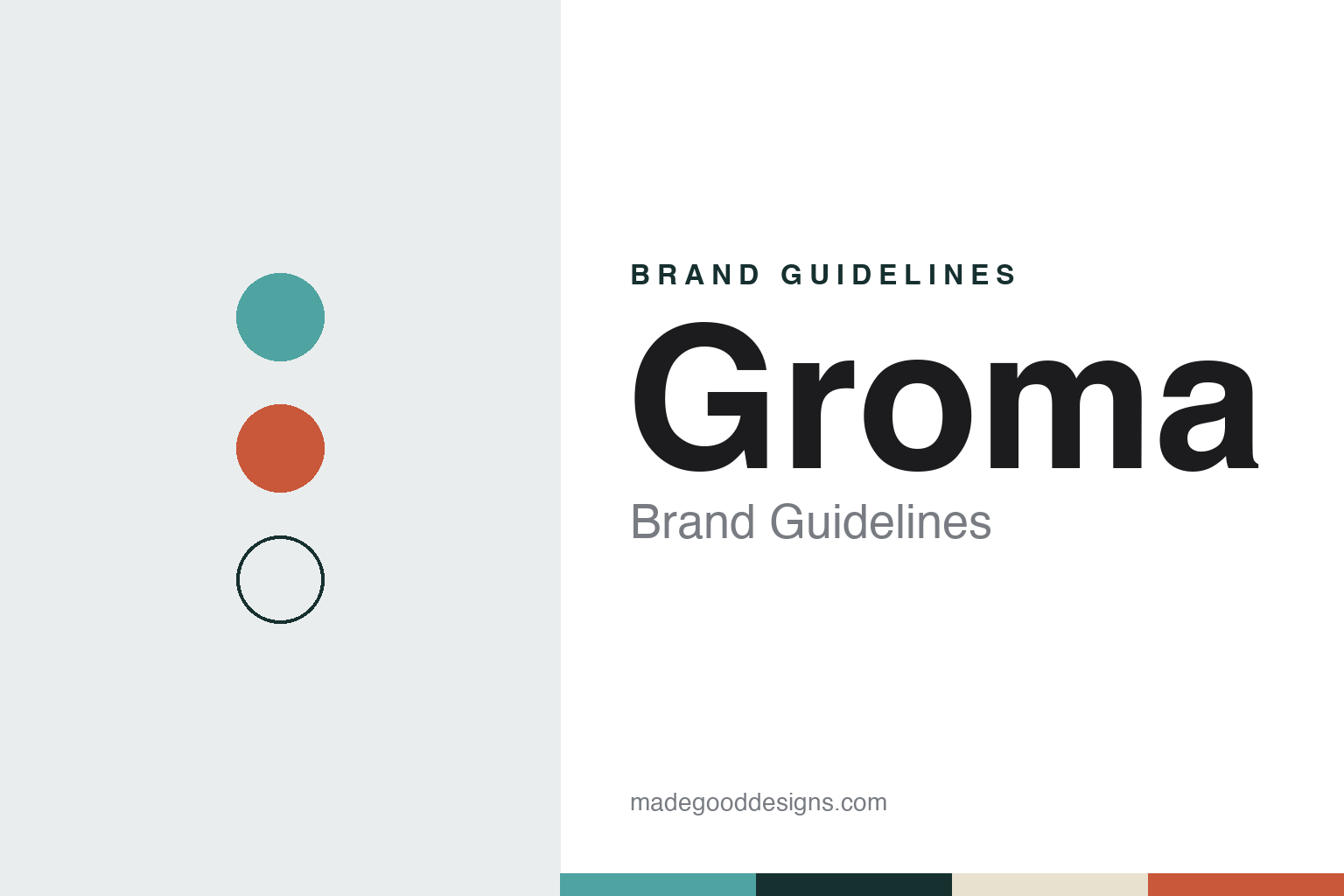
Groma Brand Guidelines
A Saxon knitting-machine works that turned to typewriters in 1924.
Aa
Two constants: a turquoise, coral and cream palette and a typewriter slab serif register. Abstract homage — not a Groma product or mark; no typewriter, logo or nameplate is reproduced.
Markersdorf, 1872
A knitting-machine works in the Chemnitz valley.
The name Groma is a contraction. German Wikipedia explains it as short for Grosser-Markersdorf: the family name of the founder joined to the village where the factory stood, Markersdorf im Chemnitztal in Saxony, today part of the municipality of Claußnitz. The company itself often wrote the name in capitals, as GROMA.
The firm did not begin with typewriters. German Wikipedia says it was founded in 1872 as a knitting-machine factory called Bach & Grosser, and that after Bach left, Gustav Friedrich Großer carried it on alone from 1878. Its early products were knitting and winding machines and accessories for the Saxon textile industry, and it sold increasingly abroad. Reinhold Schubert, whose website Sächsische Schreibmaschinen documents typewriter making in Saxony (history page first published in March 2018 and revised in April 2024), adds that Paul Großer, the founder’s son, took over the business in 1904, and explains that the difference between the family name Großer and the firm name Grosser comes from international spelling.
Schubert describes a main building on the Mittweidaer Straße, put up in 1913 when the older workshops became too small, and the first houses of a works estate along the Chemnitztalstraße, which local people still call the “Kolonie”. German Wikipedia notes that the estate survives, known today as the Chemnitztalsiedlung or “Kolonie Markersdorf”. During the First World War, both sources say, the works also made lathes and shell casings alongside its textile machinery.
Colour
An all-steel office machine, then small portables.
Typewriters arrived in 1924. German Wikipedia says the firm recruited a designer from the Chemnitz Wanderer-Werke for the project; Schubert names the designer as Max Pfau, who also ran production of the machine from the start. The standard office typewriter was sold under the name GROMA. Both sources stress that it was made entirely of steel, which German Wikipedia says made it unusually robust compared with machines by other makers, and Schubert notes that its steel frame was a point the advertising made a feature of. Schubert lists variants that followed, including a model K with a column setter in 1926 and a model S with a set tabulator in 1933.
The second line was the small typewriter. Schubert writes that in 1934 the firm bought the rights to a small machine designed by Leopold Ferdinand Pascher and hired him as chief designer, and that Erich Großer, Paul’s son, took over the management in 1936. From 1938 the small typewriter went into production in two versions, N for normal and T with a tabulator. German Wikipedia describes it as built from light metal with a plastic housing; Schubert names the metal as the magnesium alloy Elektron.
After the Second World War, German Wikipedia says, the Soviet occupying power first dismantled the works completely and it was soon nationalised. As VEB GROMA Büromaschinen Markersdorf/Chemnitztal it stopped making textile machinery and made only typewriters. A flat “pocket typewriter” developed before the war reached the market in the early 1950s as the Gromina and was later replaced by the Kolibri, which Schubert dates to 1954; in the mid-1950s the mid-size Combina joined the range. Unlike the prewar machines, both sources say, the postwar models came in coloured housings — German Wikipedia mentions injection-moulded cases, and Schubert describes some very colourful finishes.
Typography
Design and documentation.
The seven brands in this group are all typewriter names: Royal, Remington, Olympia, Erika, Groma, Torpedo and Optima. Typewriter brands in general sit at many different points in the history of office machines, from factories that carried a founder’s name to names that passed between owners, changed countries or outlived the machines that made them familiar, and a single nameplate can turn up on an office desk, a portable in a case or a collector’s shelf.
A typewriter brand’s identity is usually carried less by a single machine than by a nameplate, a decal and the factory behind it, because the company that owned the name may have been sold, divided, renamed or closed long after its last typewriter left the line. That makes the questions behind each name worth asking plainly: who started it, who owned it over time, where its machines were actually made and what became of the name.
Each guide separates what independent sources record from what a company says about itself — its founding story, its owners over time, where its typewriters were made and how its nameplates changed — and marks plainly what rests only on the company’s own word.
Aa
A typewriter slab serif for a Saxon portable. (Specimen set in Courier Prime, a typewriter-style STAND-IN; NOT the Groma logo or any Groma typeface.)
Groma
Export machines, an Olivetti licence and a liquidation.
Much of what Markersdorf made was sold far from Saxony. German Wikipedia says the postwar typewriters went almost entirely for export, and Schubert writes that they were usually sold through Western wholesalers such as the West German mail-order house Neckermann, often under quite different names.
The 1960s changed the works’ role. German Wikipedia says that as sales of mechanical typewriters fell, the Markersdorf plant was attached to VEB Buchungsmaschinenwerk Karl-Marx-Stadt, the former Astrawerke, and mainly made components for office machines; Schubert describes it as Werk 2 of that combine, under the Robotron name. Electromechanical typewriters were still built there. Under a licence from Olivetti, Schubert says, the plant made the electric Lettera 36, which was sold only through Olivetti; his history page and German Wikipedia run that licence until 1985, while his machines page says 1984. After it came the electromechanical Erika S 2020, sold under the East German Erika brand until 1990, much of it going to West Germany through mail-order houses including Neckermann and Quelle. Schubert also records an electronic typewriter, the croma 100, made from 1987 to 1990 and exported mainly as the SIGMA SM 8100.
Reunification ended the business. German Wikipedia says the firm had to file for insolvency as its markets fell away and was liquidated by 1992. Schubert writes that it was wound up under the name Ascota AG, Schreibmaschinenfabrik Markersdorf, and that its equipment was auctioned on 28 April 1992. German Wikipedia adds that the factory buildings had been completely demolished by 2013, and that a memorial stone to the founder was set up on the site in 2014. Typewriter making in Markersdorf ended with that liquidation.
For a design guide, Groma shows how a regional engineering firm carried its name from knitting machines to steel office typewriters and then to coloured East German portables that were often sold under other labels. It belongs beside its Markersdorf successor brand Erika and its licence partner Olivetti. For this guide we use turquoise, coral and cream with a typewriter slab serif, an unofficial interpretation; no product or logo is reproduced.
Explore & save
Keep Groma’s identity on hand — save it to a board in the Made Good inspiration library.
Groma identity set
Pin the Groma turquoise, coral and cream palette and the typewriter slab serif register to your own board.