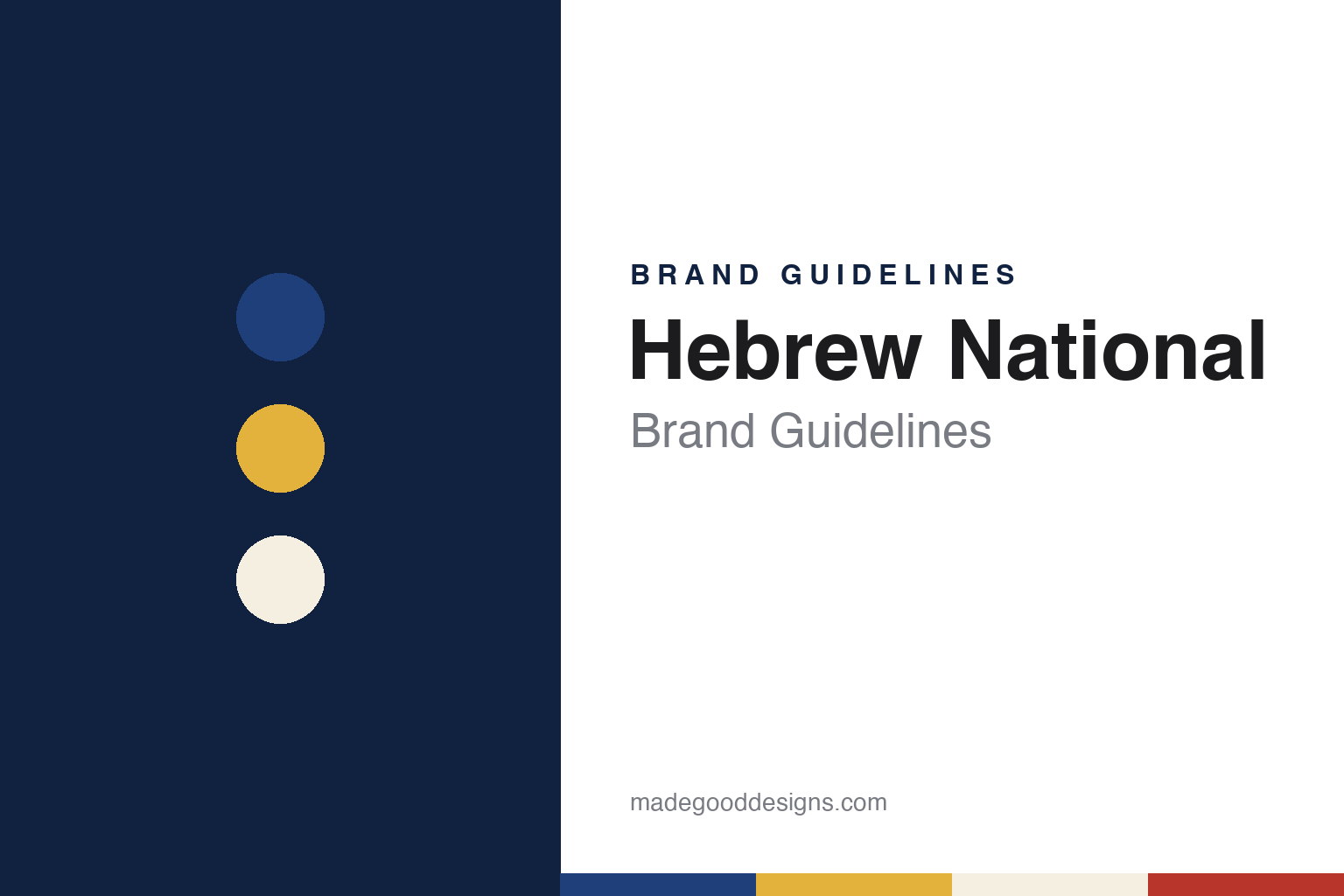
Hebrew National Brand Guidelines
A Lower East Side sausage factory, a family of butchers and a slogan about a higher authority.
Aa
Two constants: a deli blue, mustard yellow and rye cream palette and a display serif register. Abstract homage — not a Hebrew National product or mark; no package, label or logo is reproduced.
A factory on East Broadway
A kosher sausage maker for the delicatessens of the Lower East Side.
Hebrew National is an American brand of kosher hot dogs, sausages and deli meats. English Wikipedia says the business began in 1905 as the Hebrew National Kosher Sausage Factory, Inc., on East Broadway, on the Lower East Side of Manhattan, and that it was founded by Theodore Krainin, who had emigrated from the Russian Empire, from what is now Belarus, in the 1880s.
The company’s own history, in a version of its website archived in March 2001, tells the same opening story in more detail. It says the firm processed kosher meats, known then as “delicatessen,” for New York’s many deli restaurants, and that it worked from a six-storey walk-up on East Broadway. The neighbourhood, the company says, was made up of Jewish immigrants from Germany and Eastern Europe, who became loyal customers along with other New Yorkers. Wikipedia gives a similar picture, saying the business served the Jewish neighbourhoods of immigrants from Eastern Europe and Germany.
Early records put the factory inside the federal inspection system. Wikipedia says that by 1921 it was registered with the United States Bureau of Animal Industry as a government-inspected establishment, with Krainin named as proprietor. The same year, Wikipedia says, the journalist Alfred W. McCann, writing in the Globe and Commercial Advertiser on 28 July 1921 during a campaign for food standards, described Hebrew National as having “higher standards than the law requires.”
The business then passed to a new family. Wikipedia says the company went through a bankruptcy action in 1934, and that it was bought by Isadore Pines, a butcher who had emigrated from Romania and who was born with the surname Pinkowitz. His son, Leonard Pines, took over the business, Wikipedia says. The 2001 company history adds that during the 1940s Hebrew National began creating products especially for supermarkets, taking a brand built for delicatessen counters onto grocery shelves.
Colour
A rice company, a soap company, a grandson and ConAgra.
Hebrew National changed hands several times before it settled with its current owner. Wikipedia says the Pines family sold the company to Riviana Foods in 1968, and that Riviana was taken over by Colgate-Palmolive in 1976. In 1980, Wikipedia says, Isadore “Skip” Pines, the grandson of the earlier Isadore Pines, bought the company back from Colgate-Palmolive. Wikipedia cites a Forbes article by Phyllis Berman from 2 December 1985 for that period.
Under the family’s second spell of ownership, the company tried to grow beyond kosher meat. Wikipedia says that in 1982 Hebrew National opened a non-kosher division under the name National Deli. The parent business was known as National Foods; the 2001 company history says National Foods was the maker of Hebrew National, with its headquarters in the Bronx and meat processing plants in Indianapolis and Miami.
ConAgra bought the business in 1993. Wikipedia says National Foods was acquired by ConAgra Foods that year, and Kenneth Lasson, writing in The Jerusalem Post on 20 April 2016, also dated ConAgra’s purchase to 1993. Conagra Brands has owned Hebrew National since 1993, and the brand’s website today carries a Conagra Brands copyright line. Wikipedia says the National Deli brand was sold in 2001 to a former Hebrew National employee and operates from Miami.
Production moved more than once. Wikipedia says the manufacturing plant was in New York City for many years, moved to Indianapolis, Indiana, in 1989, and that the Indianapolis plant closed in 2004 when operations were consolidated at ConAgra’s hot dog plant in Quincy, Michigan. Lasson wrote in 2016 that ConAgra relocated Hebrew National to a kosher processing plant in Quincy in 2004.
Kosher supervision changed in the same period. Lasson wrote that in 2004 Hebrew National moved from its longtime in-house kosher control to an independent supervisory body, Triangle K, led by Rabbi Aryeh Ralbag. Wikipedia says the Conservative movement found the change sufficient to accept the products in 2004, and, citing The Forward of 11 June 2004, that many Orthodox authorities did not follow that endorsement.
Typography
Design and documentation.
The brands in this group sell hot dogs, sausages, sliced deli meats and breakfast meats, foods that are bought chilled or frozen and are often chosen quickly from a long refrigerated case. Packaging in this category has to work at a glance: a name, a colour and a picture of the food have to be legible through clear film or on a small carton, under bright supermarket lighting, next to many similar packs.
That is why identity in this part of the grocery trade tends to rest on a few repeated signals rather than on a single container. A wordmark, a founder’s name, a slogan, a mascot or a jingle can travel across packs, advertising and sponsorships, while the pack itself changes size and format many times over the decades.
The companies behind these names have often changed hands, merged their factories or moved production, so each guide asks plain questions: who started the brand, who owns it now, where its meat is processed and how its look has been presented. Each separates what independent sources record from what a company says about itself.
Aa
A high-contrast display serif — the formal, sign-painted register of a New York deli counter. (Specimen set in DM Serif Display, a display serif STAND-IN; NOT the Hebrew National logo.)
A higher authority
A slogan about kosher law, sold to shoppers of every background.
The line associated with Hebrew National is “We answer to a higher authority.” Sources give different years for it. Wikipedia says the company came up with the slogan in 1965 and has used it ever since. Kenneth Lasson, writing in The Jerusalem Post on 20 April 2016, dated the launch of the “We Answer to a Higher Authority” advertising campaign to 1975.
The two accounts agree on what the slogan meant. Wikipedia describes it as a reference to Jewish dietary laws and a claim to higher quality that could appeal to both Jewish and non-Jewish shoppers. Lasson wrote that the slogan sold the idea of kosher as if it were a stamp of quality, and that it strengthened the brand’s reputation for using beef without artificial colourings or flavourings.
The brand’s own words lean on the same ideas. In a version of its “Our Story” page archived in December 2019, the company says its hot dogs combine 100% kosher beef with an original spice blend, and that the recipe has not changed since 1905; it also says kosher salt remains part of its process. Those are the company’s own claims. Wikipedia says that during the 1980s the company kept to a recipe without artificial colours or flavours.
The range stays close to the delicatessen counter. Wikipedia lists beef franks, salami, bologna and pastrami among its beef products, along with corned beef and knackwurst, and says the brand’s condiment sales ended in 2010. The 2001 company history had listed sauerkraut, pickles and mustard alongside the meats.
For a design guide, Hebrew National shows how a single sentence can carry a brand’s identity for decades, turning a rule about how food is prepared into a promise that shoppers outside the community it was founded to serve could understand. Compare it with Nathan’s Famous and Oscar Mayer, two other American hot dog names in this collection. For this guide we use deli blue, mustard yellow, rye cream and frank red with a serif, an unofficial interpretation; no product or logo is reproduced.
Explore & save
Keep Hebrew National’s identity on hand — save it to a board in the Made Good inspiration library.
Hebrew National identity set
Pin the Hebrew National deli blue, mustard yellow and rye cream palette and the display serif register to your own board.


