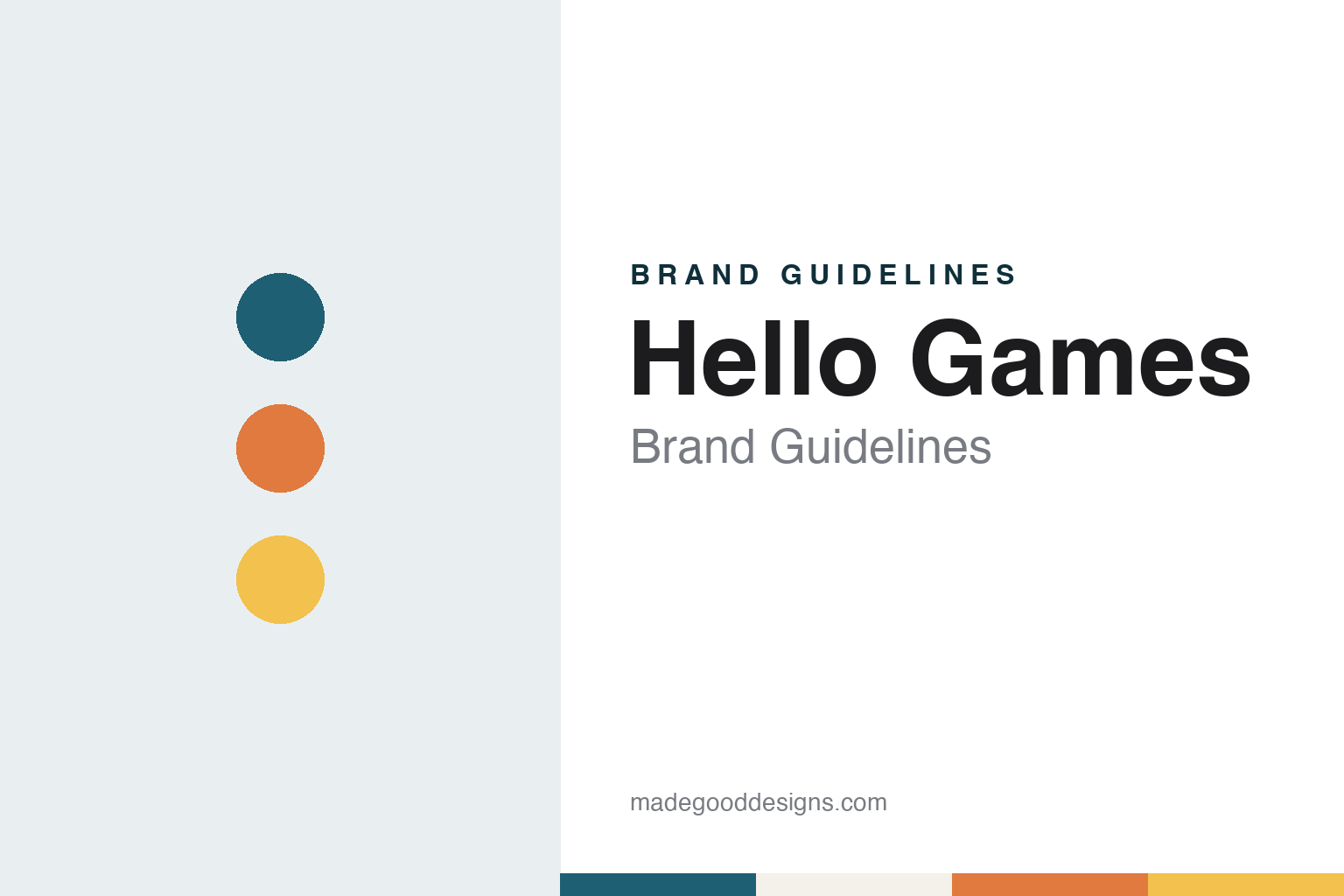
Hello Games Brand Guidelines
Four friends, a room above a tile shop and a universe built from code.
Aa
Two constants: a teal, sunset orange and stunt yellow palette and a Rounded friendly sans register. Abstract homage — not a Hello Games asset or mark; no logo, character, game image or wordmark is reproduced.
Four friends leave the sequel business
An EA developer, three friends and a stuntman, 2008–2010.
Hello Games is a Guildford studio founded by four people. English Wikipedia says the British company, based in Guildford, Surrey, was founded in February 2008 by Sean Murray, Grant Duncan, Ryan Doyle and David Ream, and was incorporated on 4 August 2008. Eurogamer, previewing the studio’s debut game in an article updated on 5 March 2010, described Murray and Duncan setting up their own studio with their friends Doyle and Ream, and said the four had a collective CV that took in stints at Criterion, Kuju and Sumo Digital.
The reason for leaving was sequels. In an interview with Polygon published on 2 September 2020, Murray said he had worked at EA before starting Hello Games and that everything he had worked on there was the sequel to something, which he found a bit depressing and which was part of the reason for moving. Polygon said that when he founded the studio it was just him and three others making the game they had always wanted to make. Hello Games’ own history describes those early days in physical terms: it says Joe Danger was created in a tiny room above a tile shop.
That debut was an arcade stunt game. Eurogamer’s 2010 preview described Joe Danger as a mix of platforming and trial biking, with left-to-right tracks, collectable coins and the letters D-A-N-G-E-R, and compared its blue skies and level design to classic SEGA games. Murray told the magazine that he joked the game was like a love letter to the team when they were kids, and that it was meant to offer the kind of replayability he remembered from games that had to last all year. Wikipedia says Joe Danger was released in 2010, and that it was followed by a sequel, Joe Danger 2: The Movie.
Colour
A midlife crisis, a flood and a universe built from procedural code.
No Man’s Sky grew out of the sequel the studio had tried to avoid. Murray told Polygon in 2020 that he had “a little bit of a midlife crisis” after Joe Danger 2, and that this was what started No Man’s Sky: he knew the studio wanted to make that kind of game eventually and worried that it might never happen if the team just kept doing the next thing. Polygon said Hello Games decided to make something big and ambitious that could still work within its small studio structure.
Wikipedia says the game, inspired by science fiction of the 1970s and 1980s, was built around a universe created through procedural generation, and that it was revealed at the VGX show in December 2013. On 24 December 2013, Wikipedia says, the studio’s offices were flooded after a nearby river broke its bank; the team recovered its project code and relocated. Hello Games’ own history describes the next stage as a dozen developers working in a leaking shed and borrowing a neighbour’s internet connection.
Sony Interactive Entertainment took on publishing for the PlayStation 4 version. Wikipedia says No Man’s Sky was released worldwide for the PlayStation 4 and Windows in August 2016, with Sony providing promotional and publishing help, and that versions followed for Xbox One in July 2018, PlayStation 5 and Xbox Series X and Series S in November 2020, Nintendo Switch in October 2022, macOS in June 2023 and Nintendo Switch 2 in June 2025. The studio has kept extending the game through free updates, which Wikipedia says have added virtual reality support and cross-platform play, and its website calls No Man’s Sky “our ever expanding science fiction epic”.
The studio’s own account ties its later growth to that game. Hello Games says the success of No Man’s Sky gave it a proper office and more freedom to expand creatively, and that it now tries to combine the stability and quality of large-scale development with the freedom of an independent studio.
Typography
A friendly name, an arcade stuntman and a sky full of planets.
For a games publisher, the catalogue often does more identity work than the logo. A label that signs games from many small studios is judged by the pattern of its choices: the genres it returns to, the art styles it is willing to back, the kinds of teams it works with. Players who follow a label learn to read that pattern, so a new announcement carrying a familiar publisher name arrives with expectations already attached. In that sense curation is a brand asset, and a short publisher sting before a trailer or a small mark on a store page works as a signature on a selection rather than on a single piece of work.
Much of that identity now lives in storefront formats. Capsule images, store banners, bundle pages and the running order of a showcase stream are where a publisher’s name sits beside the games it supports, usually at a small size and next to artwork it did not draw. A bundle groups several titles under one offer and one deadline; a showcase strings them together with a host, an ident and a shared visual frame. Credits add a quieter layer, separating the developer who made a game from the publisher who funded, marketed or released it, and the order and wording of those credits are part of how each company is presented. For designers, the practical lesson is that a publisher mark has to be modest enough to sit under someone else’s key art, clear enough to read in a thumbnail and consistent enough that repeated small appearances add up to a recognisable name.
Aa
Rounded friendly sans — after the cheerful arcade register of the Joe Danger years. (Specimen set in Rubik, a sans STAND-IN; NOT the Hello Games logo or any Hello Games lettering.)
Hello Games
Small games, a planet-sized project and other studios’ work.
After No Man’s Sky the studio spread its work across projects of very different sizes. Wikipedia says that in 2017 Hello Games announced Hello Labs, an initiative to fund experimental and procedural-generation projects based on its No Man’s Sky work. Polygon reported in September 2020 that the studio had just released The Last Campfire, an adventure and puzzle game, on consoles, PC and Apple Arcade, and that while part of the team kept supporting No Man’s Sky with updates, another part was working on the studio’s next big project. Murray told the magazine he wanted to keep making new, non-sequel games and preferred to keep the details of that project quiet for the time being.
That project was named three years later. Wikipedia says Murray introduced Light No Fire in December 2023, an exploration and survival game built, like No Man’s Sky, on procedural generation but centred on one single world shared by all players. The studio’s website describes it as “a game about adventure, building, survival and exploration together”.
In December 2024 Hello Games became a publisher. Engadget reported on 12 December 2024 that the studio would publish Stage Fright, a co-op game from Ghost Town Games, the makers of Overcooked, and that the deal marked Hello’s move into publishing other studios’ projects. The report said Ghost Town’s founders Oli De-Vine and Phil Duncan had been friends with the four Hello Games founders for years, and that after Joe Danger in 2010 Hello had helped connect them with Team17, the eventual publisher of Overcooked. Hello Games’ publishing lead Tim Woodley recalled the four founders playing an early Overcooked demo together. The studio’s about page now describes Hello Games as a development studio and publisher based in Guildford and Cambridge, and as “proudly independent”.
For a design guide, Hello Games shows how a plain greeting of a name can sit across very different work, from an arcade stuntman to a procedurally generated universe and a publishing label. Compare Team17, the British publisher that Hello introduced to the Overcooked team, and Team Cherry, another small independent studio whose guide follows a self-made world. For this guide we use teal, sunset orange and stunt yellow with a sans, an unofficial interpretation; no product or logo is reproduced.
Explore & save
Keep Hello Games’s identity on hand — save it to a board in the Made Good inspiration library.
Hello Games identity set
Pin the Hello Games teal, sunset orange and stunt yellow palette and the Rounded friendly sans register to your own board.