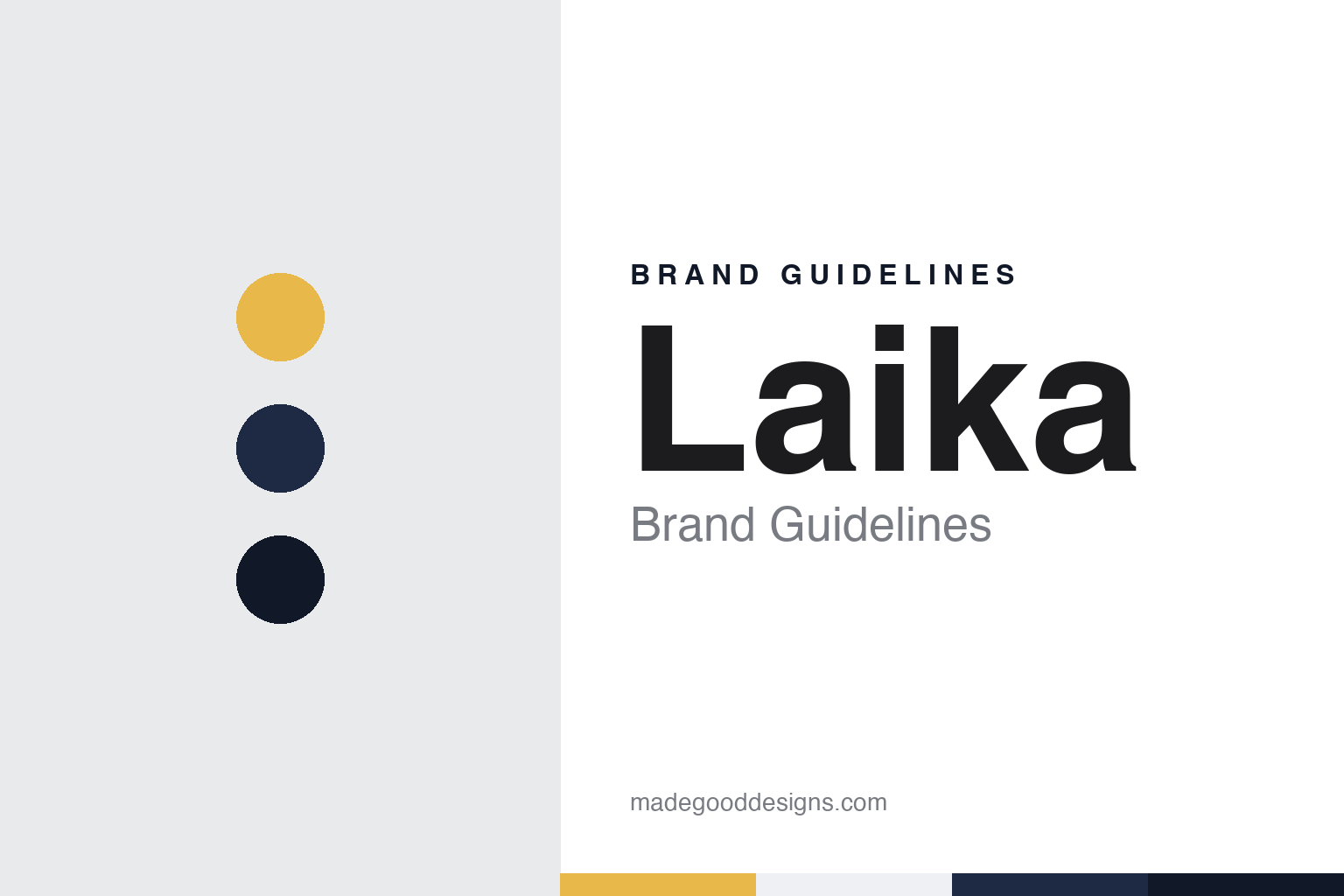
Laika Brand Guidelines
A street dog’s name on an Oregon stage.
Aa
Two constants: an orbit gold, night navy and deep space palette and a Geometric sans register. Abstract homage — not a Laika asset or mark; no logo, icon, puppet or wordmark is reproduced.
From Will Vinton Studios to Laika
Oregon, 1998 to 2005.
Laika did not start from scratch. Variety wrote on 26 January 2024 that the studio grew out of Will Vinton Studios, an Oregon company that spent decades on stop-motion work such as the California Raisins, and that its history still runs through Laika. A Variety profile of 15 December 2015 put it plainly: Laika began as Will Vinton Studios.
The Knight family arrived in stages. Wikipedia says Will Vinton Studios looked for outside investors in the late 1990s to fund more feature films, and that Phil Knight, the co-founder of Nike, made his initial investment in 1998. An Associated Press report carried by The Hollywood Reporter on 5 March 2009 said his son, Travis Knight, joined Vinton as a stop-motion animator in 1998, working on the television series The PJs and Gary & Mike; Variety in 2015 described him as starting there as an animation intern.
The date of the buyout is given two ways. Variety said in January 2024 that Phil Knight acquired the studio that would be renamed Laika in 2002, and Wikipedia gives the same year. The 2009 AP report said Knight purchased Vinton Studios in 2003 and renamed it Laika. Wikipedia adds that the director Henry Selick joined the studio as a supervising director in 2003.
The new name followed in July 2005. Wikipedia says Will Vinton Studios was rebranded that month as Laika, named after Laika, the dog the Soviet Union sent into space in 1957. Variety opened its 2015 profile with the same animal, describing the real Laika as a Russian street dog who was launched into orbit, and noted that the studio was marking its tenth year that year.
At the same time, Wikipedia says, the studio set up two divisions: Laika Entertainment for feature films and Laika/house for commercial work such as advertisements and music videos. It also announced its debut stop-motion feature, an adaptation of Coraline.
That structure lasted almost a decade. Willamette Week reported on 20 May 2014 that Laika would spin off its advertising division, Laika/house, and concentrate on feature films, noting that the move cut the studio’s last ties to the Vinton era, including the animated M&M’s characters Vinton had created in the 1990s. Wikipedia says the spin-off took place in July 2014 and that the independent commercial company is now called HouseSpecial.
Colour
A Hillsboro studio and a family at the top.
Laika’s home is Hillsboro, Oregon, part of the Portland metropolitan area. Wikipedia lists the headquarters there and names Phil Knight as chairman and Travis Knight as president and chief executive; it describes the studio as owned by Phil Knight. In its 15 December 2015 profile, Variety reported that executives were close to doubling the Hillsboro studio space so that Laika could move toward releasing a feature every year. Wikipedia dates the announcement of that expansion to March 2015.
Leadership passed to the next generation in 2009. The AP report of 5 March 2009 said Travis Knight had been named chief executive, replacing Dale Wahl, a long-serving Nike executive who had joined the studio after the purchase. Phil Knight said the timing had been Wahl’s idea, and Wahl was to help with the transition. The same report said Laika had named the producer Claire Jennings president of entertainment. Willamette Week also recorded in 2014 that Travis Knight became chief executive in 2009, the year of the studio’s debut feature.
Variety described the studio’s working method in 2015 as a hybrid of handmade puppets and digital tools. Travis Knight told the magazine that when Laika was starting in its current form, stop-motion seemed to be “withering on the vine”, and that the studio settled on combining high technology with hand craft. Variety said Brian McLean, later director of rapid prototyping, applied a 3D printer to making the replacement faces of puppets; on Coraline those faces were still painted by hand, while later films such as The Boxtrolls used colour printers. It said Georgina Hayns had overseen puppet fabrication since Coraline.
The studio has also widened where it works. Wikipedia says Laika has a Los Angeles-based subsidiary, Laika Live Action. Variety reported in January 2024 that the company had announced plans to build a stop-motion animation studio at Bowie State University in Maryland and hoped to set up an animation and motion graphics programme at Portland Community College, as part of an effort to lower the barrier to a career in stop-motion.
Its craft has been shown in public, too. Wikipedia says an exhibition called Laika: Frame x Frame, presenting the studio’s art and techniques, ran at BFI Southbank in London between August and October 2024 as part of a stop-motion season supported by the studio. Through each of these changes the Knight family has stayed in control: Phil Knight has owned the studio since the buyout of Will Vinton Studios, and Travis Knight has led it since 2009.
Typography
A borrowed name and a studio built on puppets.
For an animation or motion-design studio, the identity rarely stops at a static logo. The mark usually has to move, and the opening ident that plays before a film, a commercial reel or a festival screening is often the first place an audience meets the name. A few seconds of motion has to carry the studio’s character: the pace of the cut, the way a letterform assembles or dissolves, the sound that lands with the final frame.
Characters can also become part of the brand. A recurring figure, a mascot or a shape that first appeared in a piece of work may migrate into the logo, the website header or the end card, so that the studio is recognised by something it made rather than by its wordmark alone.
The reel and the website are the other main brand surfaces. A showreel is edited like a manifesto, and a studio site is usually built around full-bleed moving image, with typography and colour kept quiet so the work sits in front. When reading these identities, look at how the logo behaves in motion, how the studio frames its own reel, and how consistently that system carries across offices, credits and social channels.
Aa
A geometric sans — after a short, borrowed name set in capitals. (Specimen set in Jost, a sans STAND-IN; NOT the Laika logo or any Laika typeface.)
Laika
Feature films, one dated title at a time.
Laika presents itself through its features, and each has a clear date. The AP report of 5 March 2009 described Coraline as Laika’s debut full-length film, distributed by Focus Features. Wikipedia says it was released in 2009 and directed by Henry Selick, who left the studio later that year.
The films that followed were developed inside the studio. The 2009 AP report said ParaNorman was then in development from an original idea by Chris Butler, who had been head of storyboards on Coraline. Wikipedia says ParaNorman, directed by Sam Fell and Butler, opened on 17 August 2012; The Boxtrolls, based on Alan Snow’s novel Here Be Monsters! and directed by Anthony Stacchi and Graham Annable, followed on 26 September 2014; Kubo and the Two Strings, directed by Travis Knight, was released on 19 August 2016; and Missing Link, directed by Butler, on 12 April 2019.
The next title draws on the studio’s home region. Variety reported on 26 January 2024 that Wildwood, an adaptation of the novel by Colin Meloy of the Decemberists, was a love letter to Portland, with Travis Knight re-creating many of the city’s landmarks in miniature. Wikipedia says Knight directs it and that it was set for 2026.
Behind the titles, the craft itself carries the brand. Variety said in 2015 that Laika’s animators make puppets, sets, costumes and props by hand, photograph them, and combine them with digital techniques for set extensions, water and crowd scenes. Kubo animation supervisor Brad Schiff told the magazine the studio animates characters as if acting for the camera rather than the stage, and that something moves in every frame, even a breath.
For a design guide, Laika shows how a borrowed name with its own story, a dog that went to space, can give a renamed company a fresh start while the craft stays continuous. Compare Aardman, another stop-motion studio, and Cartoon Saloon or Pixar. For this guide we use orbit gold, night navy and deep space with a geometric sans, an unofficial interpretation; no product or logo is reproduced.
Explore & save
Keep Laika’s identity on hand — save it to a board in the Made Good inspiration library.
Laika identity set
Pin the Laika orbit gold, night navy and deep space palette and the Geometric sans register to your own board.