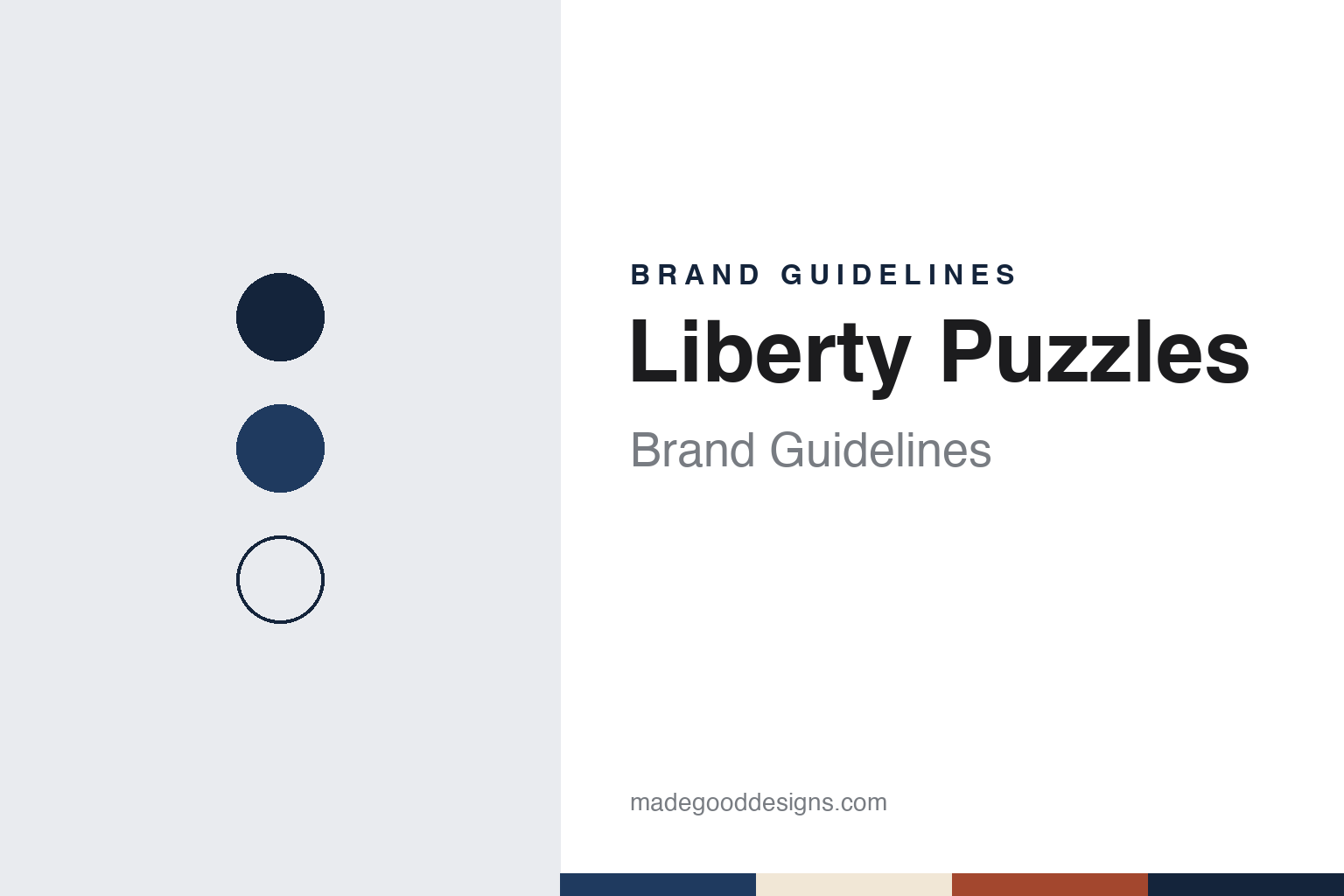
Liberty Puzzles Brand Guidelines
Laser-cut wooden jigsaws made in Boulder, Colorado.
Aa
Two constants: a Liberty Puzzles navy, maple and barn red palette and a Classic serif register. Abstract homage — not a Liberty Puzzles product or mark; no puzzle, logo or box is reproduced.
Sit Long, Talk Much
A family’s old puzzles and a Boulder workshop.
Liberty Puzzles makes wooden jigsaw puzzles in Boulder, Colorado. The company says it was “established in 2005 by Jeff Eldridge and Chris Wirth,” and its website lists Sage Wirth, Chris Wirth’s wife, alongside them as a co-owner. The University of Colorado’s alumni magazine, the Coloradan, described Eldridge in November 2022 as Wirth’s friend and business partner; Rocky Mountain PBS, in a February 2026 report, named Chris and Sage Wirth together with Eldridge as the founders.
The idea came from a family collection. Liberty says the Wirth family inherited a large set of puzzles made by Chagrin Falls, a small family puzzle company that began after the Great Depression, and that the founders wanted other families to share the same experience. Rocky Mountain PBS reported that the Wirths started Liberty with the permission of the Chagrin Falls makers’ descendants; the Coloradan described the puzzles Wirth grew up with as his mother’s antique, scroll-saw-cut “Falls” puzzles from the Depression years.
Wirth has described the purpose in social terms. “The original idea for Liberty Puzzles was jigsaw puzzle as social vehicle,” he told Rocky Mountain PBS; to the Coloradan he put it as “Bring people together. That was our goal starting this company.” The company’s slogan, “Sit Long, Talk Much,” comes from a wooden sign that once hung in the Wirths’ home in Crested Butte, Rocky Mountain PBS reported.
Colour
Maple plywood, lasers and whimsies.
Liberty’s puzzles look back to an older era of the craft. English Wikipedia, citing Games magazine in 2010, says its designs are modelled on puzzles of the early twentieth century, when wooden jigsaws were cut by hand; the company’s own history page credits the London mapmaker and engraver John Spilsbury with inventing the jigsaw in 1766 and notes that die-cut cardboard puzzles overtook wooden ones by the early 1940s.
What Liberty changed was the cutting. Its puzzles are laser-cut. The New York Times, as cited by English Wikipedia, reported in 2020 that the images are printed on archival paper with archival inks and bonded to quarter-inch maple plywood before being cut on computer-controlled lasers. Rocky Mountain PBS reported that the plywood comes from a mill in Oregon, that the puzzle boxes come from Denver, and that the business began with one room and one laser.
The signature of a Liberty puzzle is the whimsy — a piece cut in the shape of a recognisable figure rather than the usual knob-and-socket form. The company calls them “uniquely-cut pieces with a story.” The Coloradan explained that the whimsies are hand-drawn to suit each puzzle’s theme and then sent digitally to the laser; a puzzle of Boulder’s Chautauqua Park, it reported, included Colorado wildlife, pine trees, climbers and hikers. Rocky Mountain PBS gave the example of a ski scene cut with snowflakes, skiers and ski gear, and reported that Chris Wirth drew the cut patterns in the first year before Lynon Aksamit took over in 2006. English Wikipedia, citing Games, says most Liberty puzzles include the company’s signature whimsy in the shape of an eagle.
The pictures themselves are licensed art. English Wikipedia says the range leans towards fine art, vintage prints and Asian art; the Coloradan and Rocky Mountain PBS both reported that the company pays local artists for imagery, including Sage Wirth, a painter whose watercolours appear on several puzzles. In 2026 Rocky Mountain PBS reported that Liberty has a firm policy against AI-generated images.
Typography
Design and documentation.
The seven brands in this group are all jigsaw puzzle makers: Clementoni, Educa, Schmidt Spiele, Piatnik, Trefl, Wentworth and Liberty Puzzles. Puzzle brands in general sit at many different points in the trade, from family firms that still carry a founder’s name to labels that now belong to larger toy and games groups, and a single brand can be sold everywhere from a toy shop to a museum gift store.
A puzzle brand’s identity is usually carried less by a single picture than by a box, a name and the way its pieces are cut, because the company behind the name may have changed hands, moved its production or grown far beyond the place where it started. That makes the questions behind each name worth asking plainly: who started it, who owns it now, and where its puzzles are actually made.
Each guide separates what independent sources record from what the company says about itself — its founding story, its owners over time, where its puzzles are made and how its boxes have changed — and marks plainly what rests only on the company’s own word.
Aa
A classic serif — “Sit Long, Talk Much.” (Specimen set in Libre Baskerville, a serif STAND-IN; NOT the Liberty Puzzles logo.)
Liberty Puzzles
Made in Boulder.
Liberty is a private company, and its manufacturing story is local. The company says its puzzles are designed, manufactured and distributed in Boulder, and its website says they have been “Made in Boulder, CO, for 20 years.” Rocky Mountain PBS reported in 2026 that Liberty works from two factories — the original Boulder factory and a second, larger site that opened in Gunbarrel in 2022 — and quoted Chris Wirth: “It’s important to be local because we all live here.”
The brand also meets its customers in person. English Wikipedia, citing the Boulder Daily Camera, says Liberty opened a shop on the Pearl Street Mall in 2014, and Rocky Mountain PBS reported that the company offers free guided tours of its factory. Its after-sales habit has become part of the identity too: Liberty says it will remake a lost piece, and Rocky Mountain PBS reported that when a pet is to blame, customers send in a photo of the animal, which goes on a “Wall of Shame” at the original factory.
Its local ties show up in the pictures. Rocky Mountain PBS reported that Liberty has made puzzles with Boulder nonprofits including Chautauqua’s Art in the Park and the Museum of Boulder, and that part of the proceeds from a Boulder Star puzzle goes towards keeping the star on Flagstaff Mountain lit. Demand rose sharply during the 2020 lockdowns, when the company kept a waiting list, according to The New York Times and the Coloradan.
For a design guide, Liberty Puzzles shows how a small maker can build an identity from one revived craft detail — the whimsy piece — and a single place of making. Compare Wentworth, the English wooden puzzle maker also known for whimsies, and Schmidt Spiele, a Berlin games company with cardboard jigsaws. For this guide we use a navy, a maple cream and a barn red with a serif, an unofficial interpretation; no product or logo is reproduced.
Explore & save
Keep Liberty Puzzles’s identity on hand — save it to a board in the Made Good inspiration library.
Liberty Puzzles identity set
Pin the Liberty Puzzles navy, maple and barn red palette and the Classic serif register to your own board.