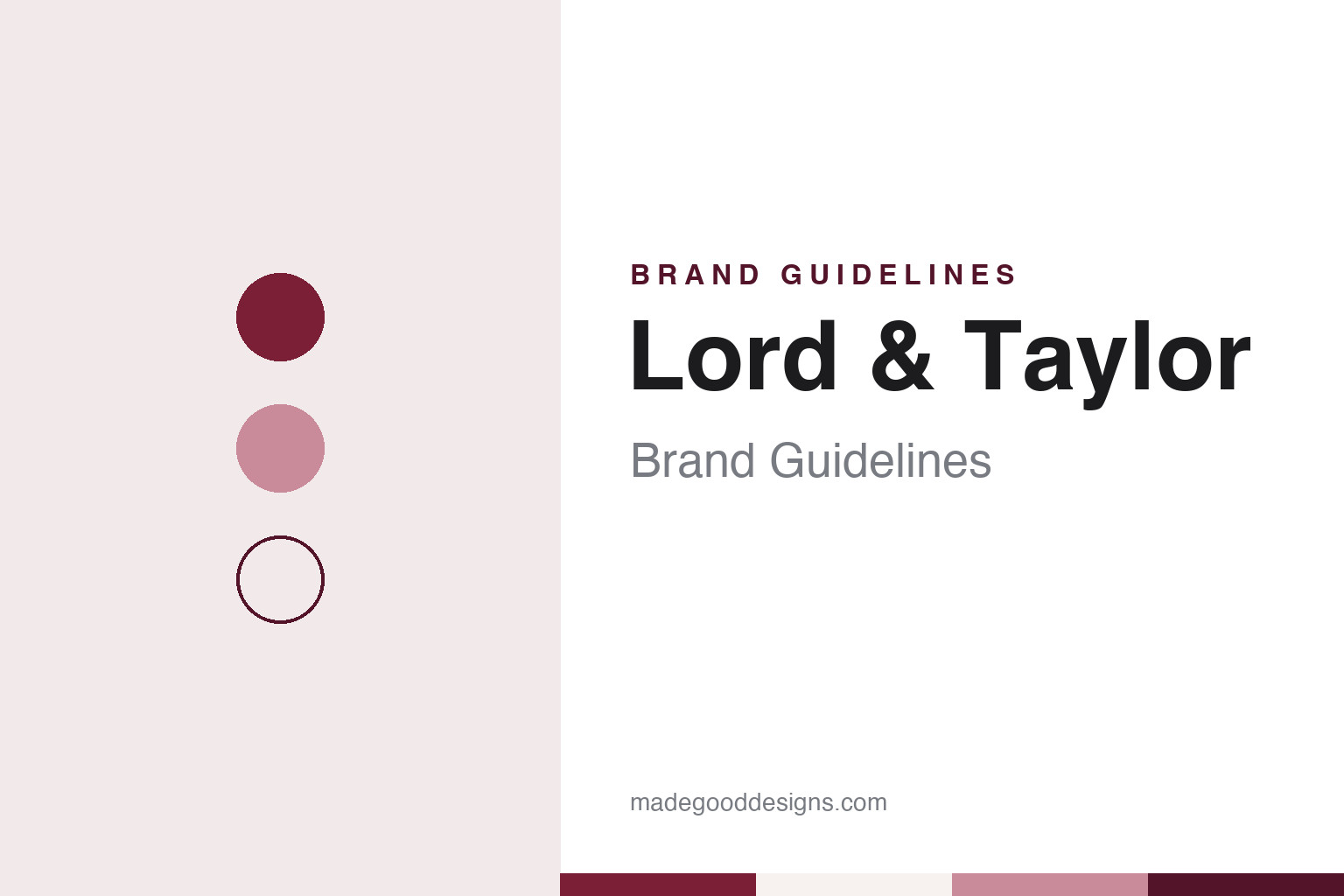
Lord & Taylor Brand Guidelines
From Catherine Street to Fifth Avenue, and from shop floors to a website.
Aa
Two constants: a rose red and limestone palette and a flowing script register. Abstract homage — not a Lord & Taylor product or mark; no logo, bag or packaging is reproduced.
Two surnames on Catherine Street
A dry-goods shop, a Broadway emporium and Ladies’ Mile.
Lord & Taylor takes its name from two men related by marriage. English Wikipedia says the English-born Samuel Lord started a dry goods business in New York in 1824 and in 1826 opened the store that became Lord & Taylor, on Catherine Street in Lower Manhattan, stocking hosiery, women’s wear and cashmere shawls. George Washington Taylor, a cousin of Lord’s wife, joined in 1834, and the business took the name Lord & Taylor. Retail Dive, reporting on the brand in March 2021, gave the same founding year, 1826.
The store moved and grew through the middle of the century. Wikipedia records a move along Catherine Street in 1838 and a new building at Grand and Chrystie Streets in 1853. On 29 August 1859 Lord & Taylor opened a second store on Broadway at Grand Street, which Wikipedia says was described at the time as a five-story marble emporium, and in the same period it took up wholesaling. Samuel Lord retired in 1862, and his son Samuel Lord Jr. and George Washington Taylor Lord took over.
In 1870 the Broadway store moved uptown to a new cast-iron building at Broadway and 20th Street, in the shopping district known as Ladies’ Mile. Wikipedia says the building was designed by James H. Giles and had a steam-powered passenger elevator. The company opened Fifth Avenue premises in 1903 and 1906, and the old downtown store was sold by Samuel Lord’s estate in 1901.
The Fifth Avenue building came next. On 24 February 1914, Wikipedia says, Lord & Taylor opened its store on Fifth Avenue between 38th and 39th Streets, designed by the architects Starrett & van Vleck, the firm that would design the Saks Fifth Avenue building a decade later. The new store included a garage for electric delivery vehicles, conveyor systems for goods and its own power and heating plant, and the Broadway store was sold soon after. The Fifth Avenue building was designated a New York City Landmark on 30 October 2007.
Colour
Associated Dry Goods, May, NRDC, Hudson’s Bay and the end of the stores.
In 1916 Lord & Taylor became a founding unit of the retail group Associated Dry Goods. Wikipedia says that under this owner Dorothy Shaver became president of the company in 1945, and that, working with the industrial design firm Raymond Loewy Associates, she opened a suburban branch in Manhasset, New York, made up of individual shops. The relationship with the Loewy firm continued until 1969 and the Stamford, Connecticut store, which Wikipedia says was designed by Loewy’s vice president Andrew Geller.
Ownership changed several times after that. The May Department Stores Company acquired Associated Dry Goods in 1986, Federated Department Stores acquired May in 2005, and in 2006 Federated sold Lord & Taylor to NRDC Equity Partners. NRDC bought the Hudson’s Bay Company in 2008, and Wikipedia says Lord & Taylor became an HBC subsidiary in 2012. In 2019 the Fifth Avenue building was sold in a joint venture with WeWork, and the flagship operated there until that year. In August 2019, Wikipedia says, the clothing rental company Le Tote took over operational control of Lord & Taylor from HBC.
The stores did not survive the following year. Lord & Taylor and Le Tote filed for Chapter 11 bankruptcy protection on 2 August 2020. On 27 August 2020 the company announced that all of its stores would close, and Wikipedia says the remaining stores shut on 27 February 2021. Lord & Taylor has had no stores since 2021.
The name continued online. Retail Dive reported on 12 March 2021 that the investment firm Saadia Group had won Lord & Taylor’s intellectual property at an October 2020 bankruptcy auction and planned to relaunch it online as “America’s Collective Store”; an update on 19 April 2021 reported that the site was back in business, online only. ABC News’ Good Morning America reported on 9 December 2024 that Regal Brands Global had acquired the Lord & Taylor intellectual property in September 2024, after Saadia Group ceased operations, and planned to relaunch the brand as an e-commerce business with licensed products in 2025. Regal Brands Global has owned the Lord & Taylor name since 2024.
Typography
Design and documentation.
A department store is one of the few retail formats where the building itself carries the brand. Many flagships occupy purpose-built premises on major city streets, and their facades, corner towers, clocks and glass domes are designed to be recognised from a distance and photographed from the pavement. Inside, atriums, galleries and grand staircases give the name a physical setting that a logo alone cannot supply, and the building often appears in advertising, on postcards and on the store’s own merchandise.
The shopping bag is the identity that leaves the building. A strong bag uses a single colour, a wordmark or a simple pattern that reads clearly at street level, and stores tend to keep the same scheme for years so that the bag becomes a familiar sight in other parts of the city. Gift boxes, tissue and ribbon usually follow the same palette.
Window displays add a seasonal layer. Many department stores dress their street windows to a theme each season, and the year-end windows are often unveiled at a public event that draws crowds. Spring fashion launches, sale periods, illuminated facades and in-store decorations follow a yearly calendar, so the identity changes on a schedule while the name and the building stay the same.
Aa
A flowing, joined script — the register of a signature on a gift box. (Specimen set in Great Vibes, a script STAND-IN; NOT the Lord & Taylor logo.)
Lord & Taylor
Two surnames, a landmark and a name that moved online.
The Lord & Taylor identity begins with its pair of surnames joined by an ampersand. The name dates from 1834, when George Washington Taylor joined Samuel Lord, and it has stayed the same through the Lord family, Associated Dry Goods, May, Federated, NRDC, Hudson’s Bay, Le Tote, Saadia Group and Regal Brands Global.
The second element is architecture. The company’s buildings track Manhattan’s shopping streets northward: Catherine Street, Grand Street, the marble Broadway store of 1859, the cast-iron Ladies’ Mile store of 1870 by James H. Giles and the Fifth Avenue building of 1914 by Starrett & van Vleck. The last is a designated New York City Landmark, so the brand’s Fifth Avenue façade is protected even though the store inside it has gone.
The third element is design partnership. Wikipedia’s account of the Dorothy Shaver years links the store to Raymond Loewy Associates, whose work for Lord & Taylor ran from the Manhasset branch to the Stamford store designed by Andrew Geller. That collaboration put an industrial design office behind the look of the suburban stores.
The fourth element is the name’s life after the stores. Retail Dive reported that Saadia Group relaunched Lord & Taylor online in April 2021 as “America’s Collective Store,” and Wikipedia says a new logo appeared in fall 2022 with a campaign called “Fall Fete.” Good Morning America reported in December 2024 that Regal Brands Global planned to sell designer goods and Lord & Taylor-branded products online and to place licensed products with other retailers. Since 2021 the brand has existed as a name, a logo and a website rather than as a set of stores.
For a design guide, Lord & Taylor shows how a retail name can outlive its buildings and continue as an online label. Compare it with Saks Fifth Avenue, whose 1924 building came from the same architects, and with Macy’s. For this guide we use rose red, dusty rose and limestone with a script, an unofficial interpretation; no product or logo is reproduced.
Explore & save
Keep Lord & Taylor’s identity on hand — save it to a board in the Made Good inspiration library.
Lord & Taylor identity set
Pin the Lord & Taylor rose red and limestone palette and the flowing script register to your own board.