Lysol Brand Guidelines
The 1889 German disinfectant that became a Reckitt brand.
Aa
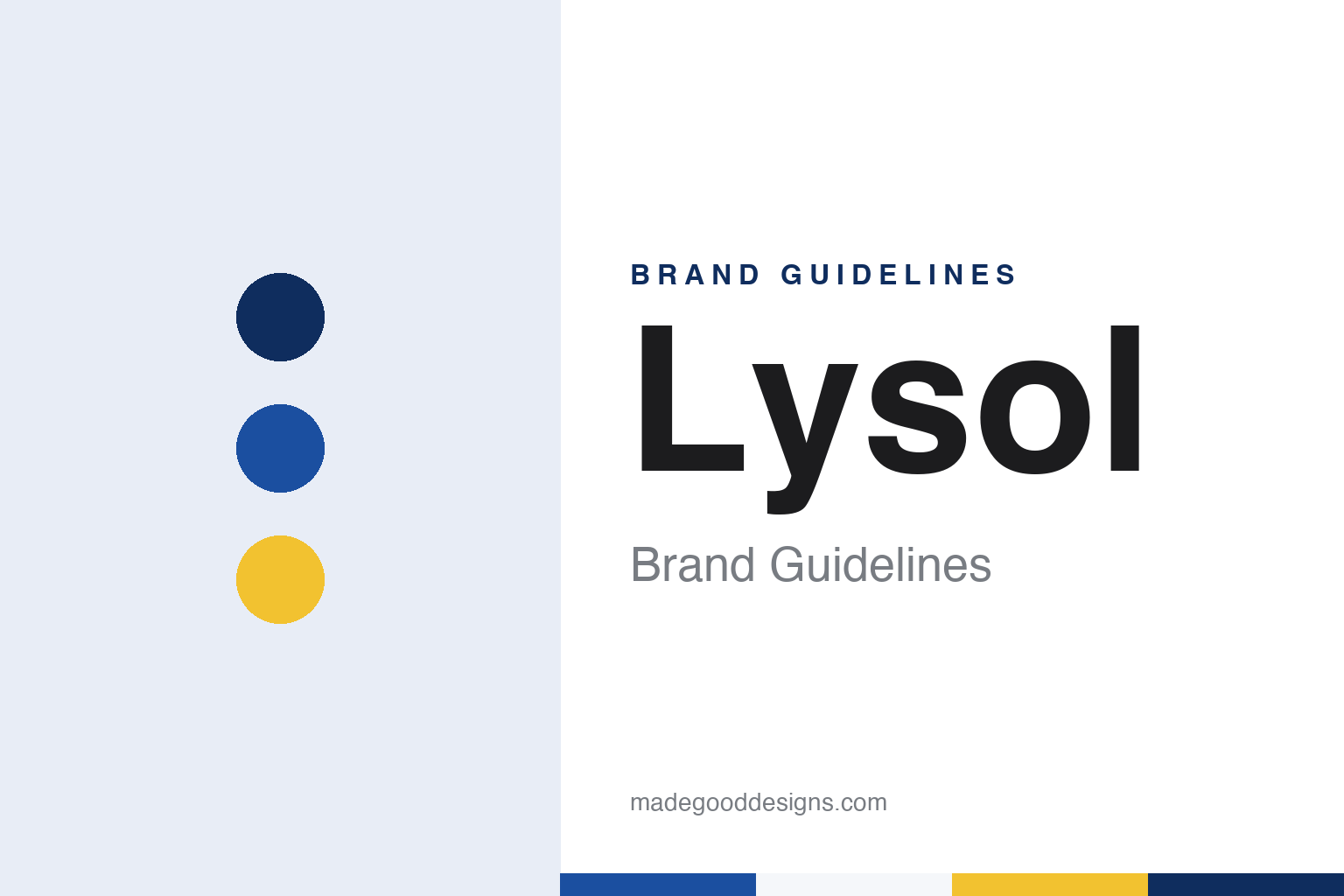
Two constants: a label blue, citrus yellow and clean white palette and a pharmacy sans register. Abstract homage — not a Lysol product or mark; no can, bottle or logo is reproduced.
Raupenstrauch’s Lysol
A Wiesbaden chemist, a Hamburg company and a patent.
Lysol is a German invention that became an American household name. German Wikipedia, citing the Neue Deutsche Biographie, says the product was developed in 1889 by Gustav Raupenstrauch, then a head of department at the chemical testing station and food-inspection office in Wiesbaden. He combined crude carbolic acid — a mixture of phenol and methylphenols obtained from coal tar and beech-wood tar — with potash soft soap to make a concentrate that would dissolve in water, and the process was patented the same year. English Wikipedia notes that the original formulation contained cresols derived from coal tar.
The name, according to the etymological dictionary Etymonline as cited by English Wikipedia, comes from lysis, the term for the breaking down of cell membranes. The word has stayed in use while the companies behind it changed.
The firm that made Lysol its business was founded in the same year. German Wikipedia says that on 15 April 1889 the ship’s captain Rudolf Schülke and the Amsterdam merchant Julius Mayr founded Schülke & Mayr in Hamburg-Winterhude, on the Goldbek canal, and that within the year they bought the patent for making Lysol, which became the foundation of the company’s expansion. Raupenstrauch himself joined the newly founded company in 1890, and German Wikipedia says the firm concentrated on producing Lysol, which was introduced as an antiseptic with early uses in surgery and obstetrics.
Schülke & Mayr became a joint-stock company in 1911, and in 1913 it launched a second disinfectant brand for consumers, Sagrotan. German Wikipedia records that a later dispute over the two marks was settled in court in Schülke & Mayr’s favour; Lysol and Sagrotan would eventually end up under the same owner.
Colour
New York, Sterling Drug, Kodak and Reckitt.
The American story runs through Lehn & Fink, a New York pharmaceutical distributor. German Wikipedia, citing Harvard Business School’s Baker Library, says Lehn & Fink acquired a production licence and from 1912 made Lysol itself for the United States market. The relationship then reversed: by 1920, German Wikipedia says, Lehn & Fink, also the licensed maker of Sagrotan, had taken over all the shares of Schülke & Mayr. German Wikipedia says that from the late 1920s Lehn & Fink also marketed a feminine-hygiene product under the Lysol name, and English Wikipedia reproduces a 1935 Canadian advertisement for it built on the slogan “The poise that knowledge gives.”
Ownership then passed through some of the large American groups of the twentieth century. English Wikipedia says Sterling Drug acquired Lehn & Fink, the maker of Lysol, Resolve and d-CON, in 1967; German Wikipedia dates Sterling’s purchase of Schülke & Mayr to 1966. In 1988 Sterling was itself bought by Eastman Kodak, as The New York Times reported in January that year, making the photography company the indirect owner of the disinfectant brand.
Kodak sold Sterling Winthrop in pieces in 1994. English Wikipedia, citing the Chicago Tribune of 30 September 1994, says the Lehn & Fink division was acquired by the British group Reckitt & Colman at the time of that sale, and German Wikipedia says Reckitt & Colman became a shareholder in Schülke & Mayr the same year. Schülke & Mayr moved on — German Wikipedia says it joined the Air Liquide group in 1996 — but the Sagrotan brand was split off and sold to Reckitt & Colman in 1997, so the German sister brand followed Lysol into the same group.
Today Lysol is a brand of the British group now called Reckitt. English Wikipedia says that as of 2015 Lysol products were distributed by Reckitt Benckiser LLC of Parsippany, New Jersey; that the name is spelled Lizol in India and Bangladesh; and that Reckitt markets the comparable Dettol or Sagrotan brands in other countries. German Wikipedia adds that the products introduced as trade marks kept their names throughout the changes of ownership.
Typography
Design and documentation.
The brands in this group all make products for cleaning the home: sprays, powders, liquids, wipes and the tools that carry them. Household-cleaning brands sit in a crowded aisle, and a single name can cover dozens of formats, from a trigger bottle by the sink to a refill pack bought in bulk, so the identity has to hold together across very different objects.
On the shelf, much of that identity is carried by shape and colour before any word is read: the profile of a bottle or tub, the colour of the liquid seen through it, a cap or trigger in a set hue, and a logo placed in the same spot on every pack. Some brands lean on a character or mascot in their advertising; others rely on a coined name or a single strong colour.
Each guide separates what independent sources record from what the company says about itself — who started the brand, who owns it now, and how its packs, logos and advertising have changed — and marks plainly what rests only on the company’s own word.
Aa
A pharmacy sans — the register of a can, a label and a product name. (Specimen set in Libre Franklin, a sans-serif STAND-IN; NOT the Lysol logo.)
Lysol
One name, many formats and several regional spellings.
The constant in Lysol’s identity is the word itself. Five letters, coined in Germany in 1889, have been carried by a Hamburg chemical company, a New York drug distributor, an American pharmaceutical group, a photography company and a British consumer-goods group, and the product name never changed hands with a new spelling except where a market asked for one — Lizol in India and Bangladesh. In other countries Reckitt sells the comparable Dettol and Sagrotan brands, so the same parent runs several distinct identities side by side.
The name has also moved across formats. English Wikipedia’s product timeline lists the disinfectant liquid introduced to drug stores and hospitals in 1930; the Lysol Disinfectant Spray of 1962, which used aerosol application; a toilet bowl cleaner in 1968, the start of a line of bathroom cleaners; the All Purpose Cleaner in 1985; pre-moistened disinfecting wipes in 2000; and hand soaps in 2009. Each format — a bottle of concentrate, an aerosol can, a trigger spray, a tub of wipes, a pump dispenser — has had to carry the same word.
Advertising carried the name across borders early. English Wikipedia cites a New York Times advertisement placed by Lehn & Fink on 30 October 1918, and reproduces the 1935 Canadian advertisement mentioned above; in Europe the name stayed with Schülke & Mayr, the Hamburg firm that had bought the patent, while in North America it belonged to Lehn & Fink and its successors.
For a design guide, Lysol shows how a short coined product name can outlast every company that has owned it, and how one word can be stretched across liquids, aerosols and wipes without changing. Compare it with Clorox, another coined American cleaning name dating from the same era, and Windex, another American household-cleaning brand. For this guide we use label blue, citrus yellow and clean white with a sans, an unofficial interpretation; no product or logo is reproduced.
Explore & save
Keep Lysol’s identity on hand — save it to a board in the Made Good inspiration library.
Lysol identity set
Pin the Lysol label blue, citrus yellow and clean white palette and the pharmacy sans register to your own board.