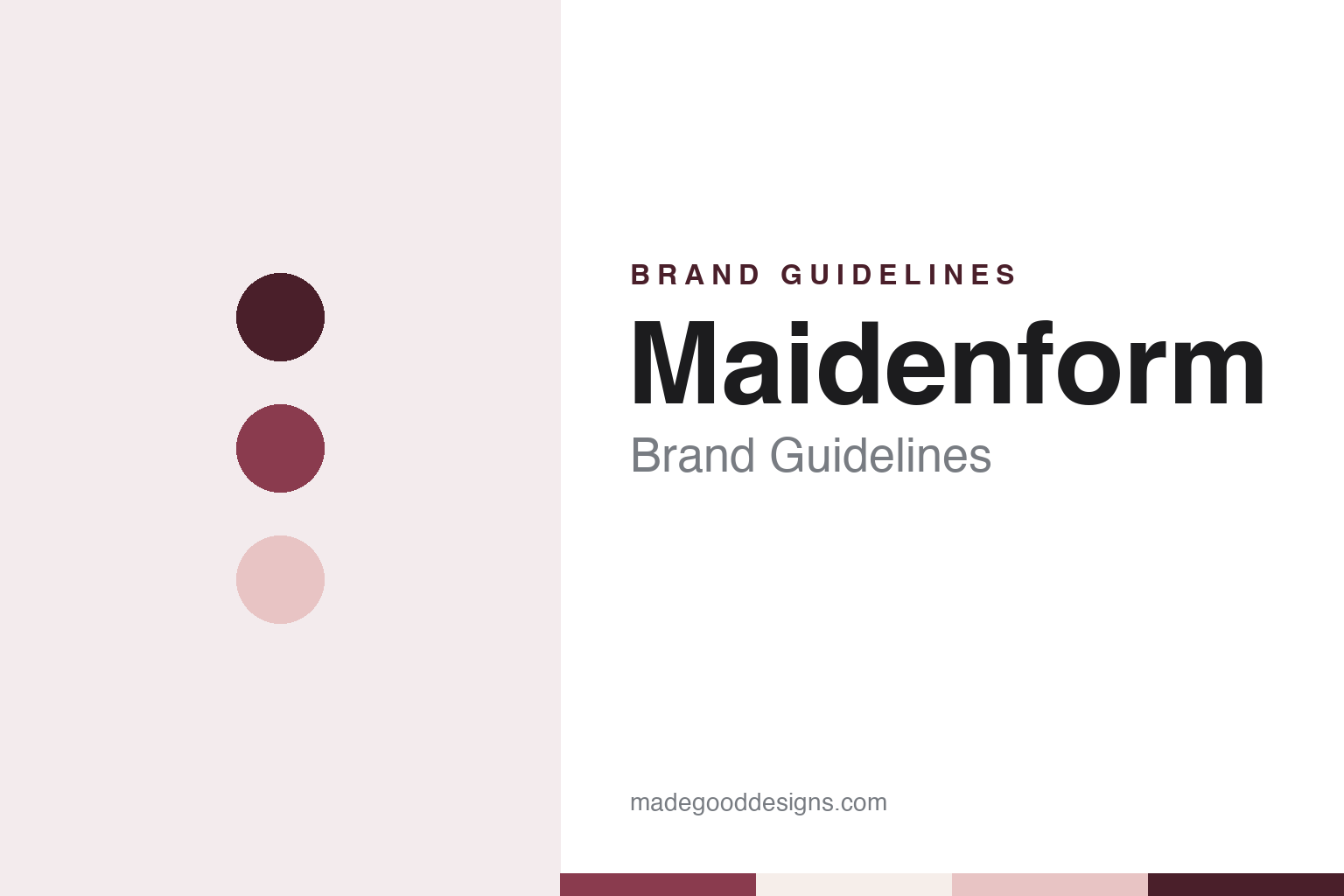
Maidenform Brand Guidelines
The dress-shop bra that named itself against the “Boyish Form”.
Aa
Two constants: a dream rose, blush and satin palette and a fashion-magazine serif register. Abstract homage — not a Maidenform product or mark; no garment, advertisement or logo is reproduced.
Enid Frocks
A dress shop, a gathered bandeau and a name chosen against a rival look.
Maidenform began inside a dress shop. The historical note to the Maidenform Collection, 1922–1997 at the Smithsonian’s National Museum of American History Archives Center — compiled by Jennifer Snyder and Mimi Minnick between 1997 and 1999 and revised up to 2005 — says the business started at Enid Frocks, a small dress shop in New York City owned and run by Enid Bissett. Ida Rosenthal, a Russian Jewish immigrant, worked there as a seamstress.
In 1922, the finding aid says, Ida Rosenthal and Enid Bissett decided that their custom-made dresses would hang better if they improved the bandeau-style bras then in fashion. They gathered the bandeau in the middle, and Ida’s husband, William Rosenthal, added straps and refined the design further. They called their bras “Maidenform”, the archive says, in counterpoint to the “Boyish Form” brand that was then in vogue. A Chicago Tribune report of October 2005 described the same founding premise, placing it in the flapper era of the 1920s.
Initially the bras were given away with each dress. As they became popular, the partners began to sell them, and in time they stopped making dresses and moved into brassiere manufacturing full time. The company’s own plant in Bayonne, New Jersey, opened in 1925, according to the Smithsonian record; English Wikipedia gives Bayonne as the place of founding in 1922. Wartime files in the collection refer to the business as the Maiden Form Brassiere Co., a two-word spelling of the name that sits alongside the single-word Maidenform in the archive.
The family stayed in charge for decades. After William Rosenthal’s death in 1958, the finding aid says, Ida became president; in 1963 their son-in-law, Dr Joseph Coleman, became head of the company, and from 1968 their daughter, Beatrice Rosenthal Coleman, held control of the business until 1990. The archive describes Maidenform as family owned and operated until 1997. During the Second World War, it adds, the company made silk parachutes and pigeon vests, harnesses that let paratroopers carry homing pigeons as they jumped behind enemy lines; the collection holds blueprints for both.
Colour
Bayonne, the export trade, two restructurings and two new owners.
Production spread well beyond New Jersey. The Smithsonian note says that after the Second World War the company marketed heavily in Europe and Latin America, and that Maidenform eventually ran plants in West Virginia, Florida, Puerto Rico and the Dominican Republic. The collection’s photographs and files name facilities in Princeton and Clarksburg, West Virginia, and a factory purchase in Huntington. It also lists trademark registrations for the name in the United States dated 1924 and 1936, and registrations in Argentina, Colombia, El Salvador, Norway, Peru, Puerto Rico, Sweden and Venezuela between 1934 and 1937.
The way the bras were sold changed too, and the archive records it. Lingerie, it says, was not always self-service: bras and girdles were originally sold behind the counter with help from sales staff. In the 1950s Maidenform moved to packaged, self-service “bra bars”, and by the 1960s bras were increasingly sold off the rack, with hang-tags carrying price and product information. The collection keeps packaging from 1950 to 1978, hang-tags from 1994 to 1996, counter cards, stylebooks and colour cards, and a retailer magazine called the Maidenform Mirror.
Later decades were less settled. Maidenform filed for Chapter 11 protection in 1997 and emerged in 1999, the Chicago Tribune reported in 2005, adding that it then began shifting manufacturing to contractors overseas. The company went public in July 2005, when the paper described its headquarters as being in Bayonne.
On 24 July 2013 Hanesbrands, the Winston-Salem, North Carolina, clothing group, agreed to buy Maidenform, English Wikipedia says, citing The New York Times and The Wall Street Journal; the same encyclopedia lists Maidenform among Hanesbrands’ brands with Hanes, Playtex and Bali. Hanesbrands then changed hands itself: the Canadian apparel maker Gildan Activewear completed its acquisition of Hanesbrands on 1 December 2025, Apparel Resources reported, which puts Maidenform inside the Gildan group today.
Typography
Design and documentation.
Underwear and basics brands in general live on a small set of surfaces. Before a garment is worn, its brand is carried by a box, a sleeve, a multipack bag or a card header on a peg; once it is unwrapped, the name moves to a woven waistband, a printed neck label or a small sewn-in tag; and in a store, a hang-tag or a fixture sign does the work that a shop assistant once did behind the counter.
Each of those surfaces has its own constraints. A waistband has to read in a narrow horizontal band, often repeated around the body, so a name set there tends to be short, wide and simple. A pack has to hold a name, a size and a style at arm’s length on a crowded shelf. A hang-tag sits close to the eye and can carry more words, a fuller logo and a line of copy.
The guides in this group look at those surfaces brand by brand: who started each name, who owns it now, how its labels, packs and advertising have changed, and where independent records and the company’s own account each stand.
Aa
A high-contrast serif — the register of a magazine page and a dream caption. (Specimen set in Playfair Display, a serif STAND-IN; NOT the Maidenform logo.)
Maidenform
A campaign line, a name and a set of dreams.
Maidenform’s identity was built above all in advertising. The Smithsonian finding aid says the “I Dreamed” campaign was launched in 1949 and ran into the late 1960s. Its pictures showed models in everyday or fantastic situations, elaborately costumed but wearing only a Maidenform bra above the waist, each one captioned as a dream. The Chicago Tribune in 2005 recalled the formula — women who dreamed they went shopping, rode fire trucks or crossed the Nile on Cleopatra’s barge “in their Maidenform bras” — and dated the run from the end of the Second World War to the mid-1960s; it also noted that Mad magazine parodied the campaign in 1962. The Smithsonian collection holds a near-complete set of the “I Dreamed” advertisements, foreign-language versions from 1951 to 1980, and an interview with Kitty D’Alessio, who worked on the campaign and with its models.
Later campaigns followed. The archive lists the “Maidenform Woman” campaign that followed, whose tagline the Tribune quoted as “The Maidenform Woman: You never know where she’ll turn up”, with the model cast as a judge or a cellist; “Dares to Dream” in 1984, which played off the original tagline; the “Celebrity” campaign from 1987, in which well-known male actors talked about women and lingerie and no women in lingerie appeared at all; and the “Women’s Advocacy” series of 1992.
In 2002 the company hired the New York agency Laspata/DeCaro, the Tribune reported, and its creative director, Charles DeCaro, answered the brief by bringing the dream back. The 2005 relaunch put a three-part billboard over the corner of 35th Street and Seventh Avenue in Manhattan from 21 September, with spare copy — “Introducing the dream bra” — and ran print lines such as “Dreams do come true” and “I dreamed every day was Sunday” in magazines including Vogue, Cosmopolitan and Elle. The paper said that set of models was more diverse than the original campaign’s had been.
For a design guide, Maidenform shows how a single sentence pattern — “I dreamed …” — can serve as a brand’s signature for two decades, outlast changes of owner and come back as a deliberate revival, while the name itself still carries its 1920s argument with the “Boyish Form”. Compare it with Hanes, its sister brand under Hanesbrands, and Vanity Fair Lingerie, another American lingerie name from the same era. For this guide we use dream rose, blush and satin with a serif, an unofficial interpretation; no product or logo is reproduced.
Explore & save
Keep Maidenform’s identity on hand — save it to a board in the Made Good inspiration library.
Maidenform identity set
Pin the Maidenform dream rose, blush and satin palette and the fashion-magazine serif register to your own board.


