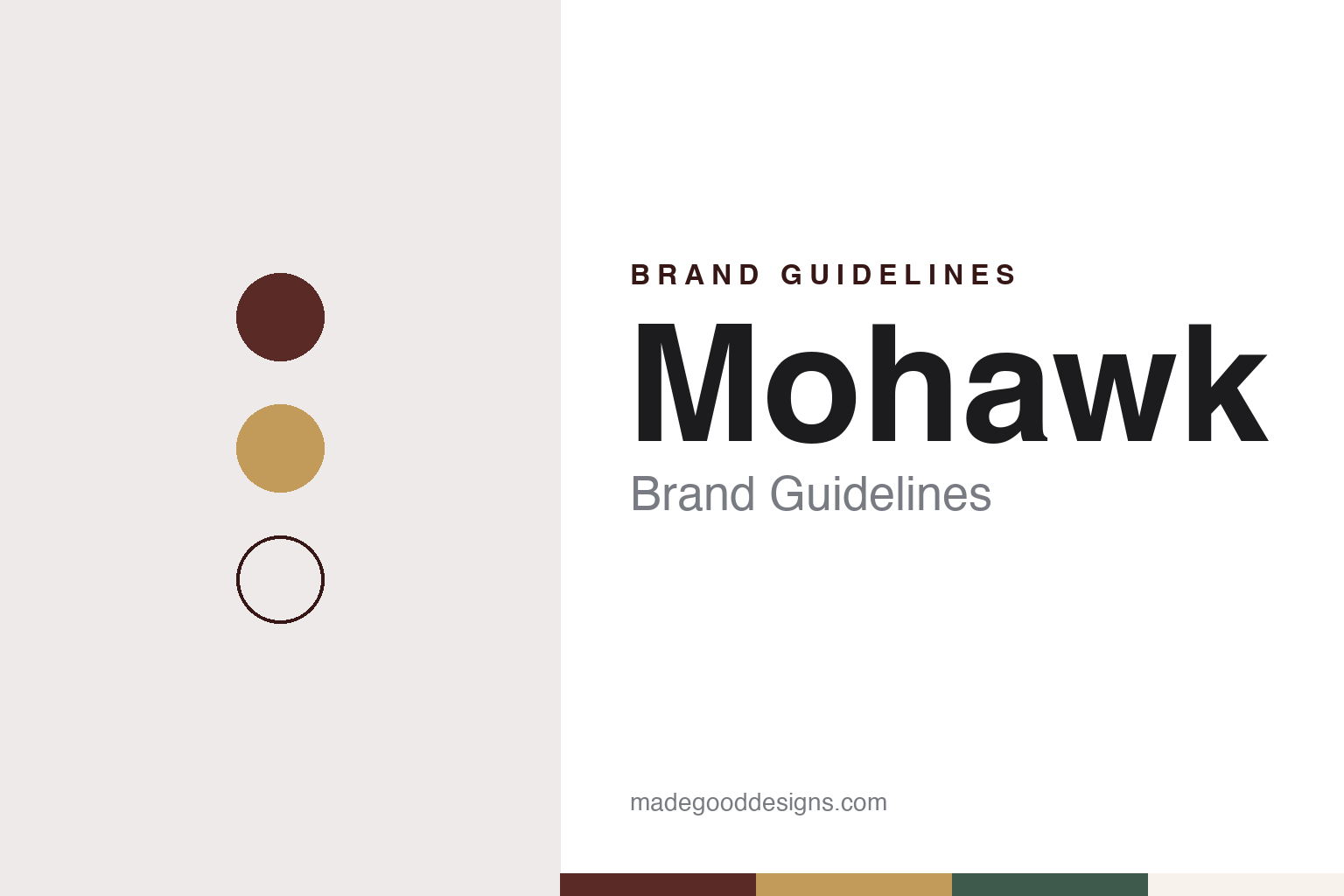
Mohawk Brand Guidelines
A family of English weavers, a mill town on the Mohawk River and a long road south to Georgia.
Aa
Two constants: a maroon, gold and green palette and a mill-town serif register. Abstract homage — not a Mohawk product or mark; no sample, label or logo is reproduced.
Weavers on the Mohawk River
An English family, an empty factory and a merger.
Mohawk is the flooring brand of Mohawk Industries, a public company with its headquarters in Calhoun, Georgia. Its roots are far to the north. English Wikipedia says that William Shuttleworth and his four sons came to the United States from England in 1875 and set up a carpet mill in the Hudson Valley. After William died, the sons moved in 1878 to Amsterdam, New York, a mill town on the Mohawk River, and took over an empty factory there. The company was incorporated as the Shuttleworth Brothers Company in 1902.
The name came from a merger. English Wikipedia, citing a history of the Amsterdam mills by Rob Yasinsac, says the company adopted the name Mohawk Carpet Mills, or Mohawk Mills for short, in 1920, when it merged with McCleary, Wallin and Crouse, another Amsterdam carpet mill. The river and the valley gave the business the name it still carries more than a century later.
Mohawk was a weaver of carpets in the years when carpets were woven, usually from wool. In 1956, according to the same source, Mohawk Carpet Mills merged with Alexander Smith, Inc. to form the Mohasco Corporation. The trade was changing around it. New tufted carpet operations in Georgia were using synthetic fibres such as nylon and polyester, and Mohasco gradually moved its manufacturing south, first into the Carolinas and eventually Georgia. In 1963 it also turned some of its attention to furniture through acquisitions.
Amsterdam’s part in the story came to an end in stages. English Wikipedia, citing the Schenectady Daily Gazette, says carpet manufacturing at the Amsterdam site had ended by 1968, and the last corporate offices left the town by 1987.
Colour
A buyout, a listing and a run of acquisitions.
Mohawk Industries in its present form dates from the late 1980s. English Wikipedia says that in 1988 Mohasco was bought in a leveraged buyout by MHS Holdings, and its carpet business was spun off to form Mohawk Industries; The New York Times reported Mohasco’s acceptance of the bid in May 1988. Mohasco’s remaining assets were sold to other investors and the company was later dissolved. In 1992 Mohawk went public, its shares trading first on NASDAQ and later on the New York Stock Exchange under the symbol MHK.
A series of carpet acquisitions followed. A company history published by FundingUniverse, citing Textile World and other trade papers, says Mohawk bought Karastan Bigelow from Fieldcrest Cannon in August 1993, bringing in two long-established carpet names. In 1994 it merged with Aladdin Mills, a privately held carpet maker owned by the Lorberbaum family, and in 1995 Jeffrey Lorberbaum, the son of Aladdin’s founder Alan Lorberbaum, was appointed president and chief operating officer. Image Carpets and Durkan Patterned Carpets were added in 1999.
Then the company moved beyond carpet. FundingUniverse says Mohawk agreed in 2001 to merge with Dal-Tile, the ceramic tile maker, and Mohawk’s own account of its growth dates the Dal-Tile acquisition to 2002. In 2005, Mohawk says, it entered the European market by buying Unilin, a Belgian maker of laminate flooring. It also bought Columbia Wood Flooring, which, the company says, added wood flooring manufacturing in the United States and Malaysia, and in 2012 its laminate entered the Brazilian market. In 2013 it acquired the Italian ceramic company Marazzi and the laminate brand Pergo.
The result is a group of many flooring names. English Wikipedia lists brands including Daltile, American Olean, Karastan, Durkan, Marazzi, Pergo, Quick-Step, Unilin, Godfrey Hirst and Feltex alongside Mohawk itself, and lists manufacturing operations in countries including the United States, Mexico, Brazil, Ireland, the United Kingdom, Belgium, France, the Netherlands, Germany, Italy, Poland, Malaysia, Australia and New Zealand. It names Paul De Cock as chief executive and Jeffrey Lorberbaum as chairman.
Typography
Design and documentation.
The brands in this group are all flooring names, covering carpet, laminate, vinyl and wood. Flooring brands in general sit at many different points in the trade, from family firms that still tell their history through a founder to names that now belong to much larger manufacturing groups, and a single brand can be sold through independent retailers, home-improvement chains and commercial specifiers at the same time.
A flooring brand’s identity is usually carried less by a single product than by a name on a sample board, a swatch label, a carton or a showroom display, because the company behind the name may have changed hands, moved its production or grown far beyond the town where it started. That makes the questions behind each name worth asking plainly: who started it, who owns it now, and where its floors are actually made.
Each guide separates what independent sources record from what the company says about itself — its founding story, its owners over time, where its flooring is made and how its labels and showrooms have changed — and marks plainly what rests only on the company’s own word.
Aa
A mill-town serif — a catalogue-and-label register. (Specimen set in Source Serif 4, a serif STAND-IN; NOT the Mohawk logo.)
Mohawk
A river name that outlived the river town.
The Mohawk name is a place name that travelled. It was adopted in 1920 by a carpet business in Amsterdam, New York, on the river of the same name, and it has outlasted the mills, the town connection and even the Mohasco corporate name of 1956. When the carpet business was spun off in 1988, it took the Mohawk name again, and the company that now lists on the New York Stock Exchange is headquartered in Calhoun, Georgia rather than in the valley that gave it its name.
That gives the brand two layers. Mohawk Industries is the parent company, the owner of a long list of flooring names in North America, Europe and beyond. Mohawk, the flooring brand, is the name a homeowner meets on sample boards, swatch labels and displays in a flooring shop. English Wikipedia lists Mohawk, Mohawk Group and Mohawk Home as separate brands within the group, alongside names such as Karastan, Daltile and Pergo that kept their own identities after they were acquired.
Keeping acquired names visible is a pattern across the company’s history. Karastan and Bigelow were bought together in 1993 and kept their own names. Aladdin, Dal-Tile, Unilin, Marazzi and Pergo each came with their own markets and customers, and Mohawk’s growth story describes each in terms of a new kind of flooring or a new region.
Read in order, the company’s dated milestones run from woven carpets in a New York mill town to a merger into Mohasco in 1956, a move of manufacturing south into the Carolinas and Georgia, and later expansion into tile, laminate and wood.
For a design guide, Mohawk shows how a nineteenth-century mill name, taken from a river in New York, can carry a flooring brand through mergers, a buyout and a move to Georgia, while the group behind it gathers other names under its roof. Compare it with Pergo, the laminate brand Mohawk acquired in 2013, and with Shaw Floors, its neighbour in Georgia’s carpet country. For this guide we use maroon, gold and green with a serif, an unofficial interpretation; no product or logo is reproduced.
Explore & save
Keep Mohawk’s identity on hand — save it to a board in the Made Good inspiration library.
Mohawk identity set
Pin the Mohawk maroon, gold and green palette and the mill-town serif register to your own board.