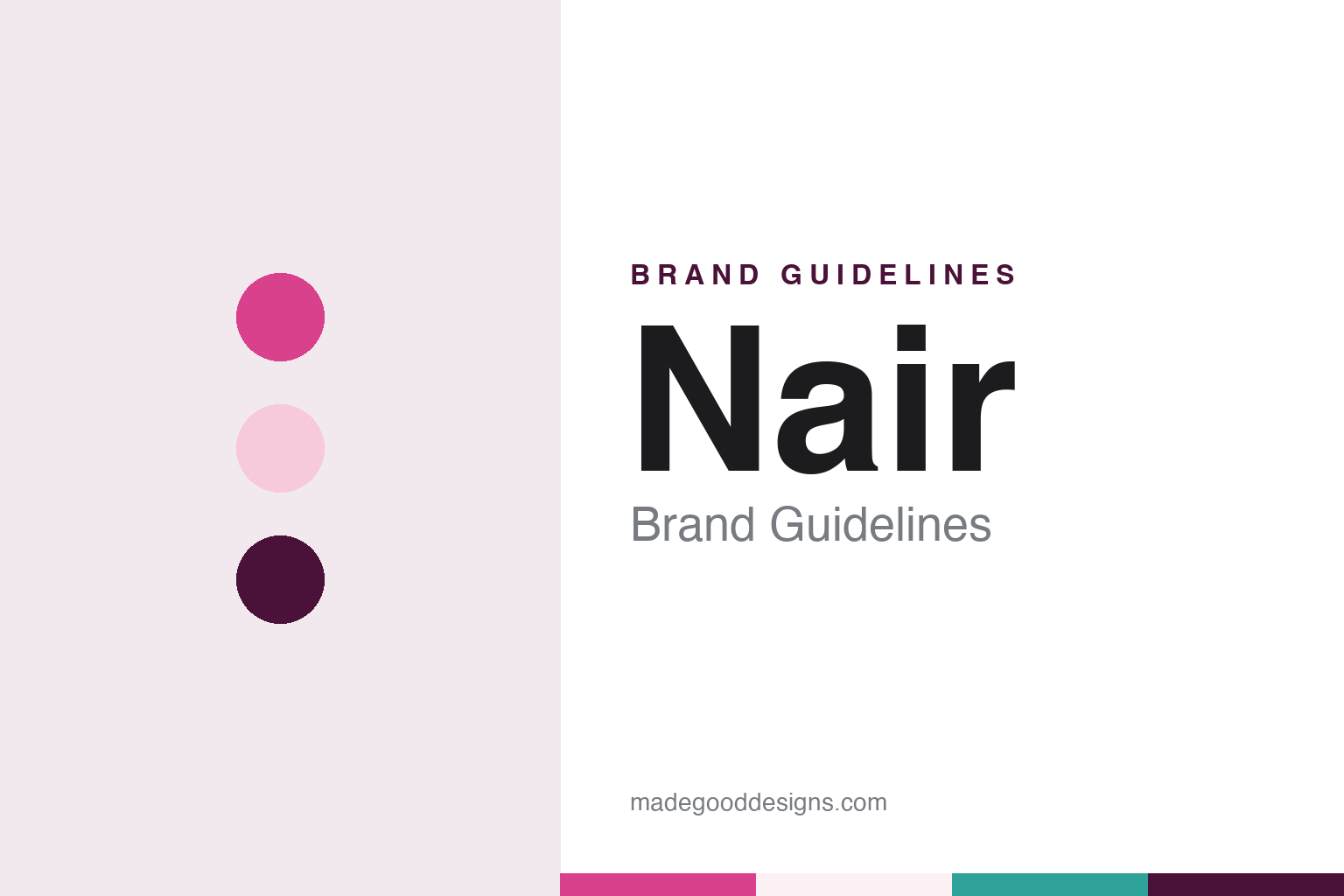
Nair Brand Guidelines
A depilatory lotion from 1940 that learned to sell itself with a pair of short-shorts.
Aa
Two constants: a rose, plum and blush palette and a friendly geometric sans register. Abstract homage — not a Nair product or mark; no pack or logo is reproduced.
Carter Products
A depilatory from the maker of Carter’s Little Liver Pills.
Nair began as a single product: a depilatory lotion introduced in 1940 by Carter Products, Inc., the company says on the heritage page of its website, which in 2015 described the original as a single-formula, single-scent lotion. The New York Times, writing about the brand in September 2007, also dated the product’s introduction to 1940. English Wikipedia says the name is a contraction of “no hair.”
Carter Products had a long history before Nair. English Wikipedia, drawing on the Encyclopedia of New Jersey and a published company history, says the business was incorporated in 1880 as the Carter Medicine Company by John Samuel Carter of Erie, Pennsylvania, the maker of Carter’s Little Liver Pills, and took the name Carter Products in 1937. By then it had added Arrid, an antiperspirant formulated by the research chemist John Higgins Wallace Jr. and introduced in 1935, according to the same article and Wallace’s 1989 obituary in The New York Times. After Nair, Carter Products launched Rise shaving cream in 1949. In 1965 the company became Carter-Wallace, with headquarters in New York City and a research facility at Cranbury, New Jersey.
The product’s origin story is told by the company’s own researchers. In the 2007 New York Times article, Tim Fowler, a research and development director at Church & Dwight, said that the scientists working on a depilatory in the 1930s had men in mind, as an alternative to shaving, but found that beard hair was too dense for a formula the face could tolerate, so the product was aimed at women’s legs instead.
Colour
“Nair for short-shorts.”
Nair’s short-shorts advertising began in 1975. The New York Times described the commercials, built around the line “If you dare wear short-shorts, Nair for short-shorts,” as showing women high-kicking their way down a stairway, and reported in 2007 that iterations of the short-shorts campaign had run for nearly 30 years. The company’s heritage page lists the same year for the debut of what it calls its “Nair for Short Shorts!” advertising.
The brand’s print advertising followed the same audience through women’s magazines. The 2007 Times article illustrated its story with a Nair advertisement from Mademoiselle in the 1970s, a print advertisement from People in 1992 and a 2007 advertisement from CosmoGirl.
The product range grew around the original lotion. The company’s heritage timeline lists a Baby Oil formula in 1977, a roll-on depilatory in 1985, Nair’s debut wax in 1990, a line called Nair for Men in 2001, a Sensitive Formula in 2007, a Brazilian Spa Clay line with mango, açaí berry and clay in 2012, a Moroccan Argan Oil collection in 2014, and the brand’s 75th anniversary in 2015, when it was advertising hair removal “Like Never Before.” The men’s line date is confirmed by The New York Times, which wrote in 2007 that the brand did not introduce products for men until 2001.
In 2007 the brand also aimed a range at younger buyers. The New York Times reported that Nair Pretty, a line marketed to girls buying their first hair remover, came in kiwi and peach scents in packages showing illustrations of teenage girls, and was advertised in CosmoGirl and Seventeen as well as in Redbook, to reach their mothers.
Typography
Cans, razors and colour.
The brands in this group sell razors, shaving creams, gels and depilatories, the everyday products of the bathroom shelf. Shaving and hair-removal brands in general are bought often and quickly, so their identity has to work at arm’s length, on a crowded shelf, through a name, a colour and a familiar shape of can, tube or handle.
Much of that identity is carried by packaging and advertising rather than by a single logo. A can of shaving cream or gel is a cylinder that can be printed all the way round; a razor is a handle and a cartridge that change shape from one generation to the next; a depilatory is a tube or bottle that sits beside skin creams. Slogans and jingles belong to that identity too, and several of these names have passed between owners over the decades, so the company on the back of the pack may not be the one that first put the name on the front.
Each guide separates what independent sources record from what the company says about itself — who founded the brand, who owns it now, and how its packs and advertising have changed — and marks plainly what rests only on the company’s own word.
Aa
A friendly geometric sans register. (Specimen set in Poppins, a sans STAND-IN; NOT the Nair logo.)
Church & Dwight
From Carter-Wallace to Armkel to Church & Dwight.
Nair changed hands when Carter-Wallace broke itself up. In May 2001, The New York Times reported, Carter-Wallace agreed to sell itself as two businesses: its consumer brands, including Trojan condoms and Arrid deodorant, to a venture of the consumer goods maker Church & Dwight and the private equity group Kelso & Company, and its drug and diagnostics business to MedPointe. The trade magazine Happi reported on 1 October 2001 that Church & Dwight had completed the purchase: it bought the antiperspirant and pet-care businesses outright, while Armkel LLC, a 50/50 joint venture with Kelso, acquired the rest of the consumer business, a list that included Nair depilatories, Trojan condoms and First Response pregnancy tests. English Wikipedia, citing Church & Dwight’s annual report, dates the completion to 28 September 2001.
By 2007 The New York Times was describing Nair as part of the women’s health and personal care division of Church & Dwight, which it said had “purchased Nair in 2001,” and quoted the division’s vice president for marketing, Stacey Feldman, on the brand’s plans. Church & Dwight also owns Arm & Hammer, whose baking soda business English Wikipedia traces to 1846; the same article gives the company’s headquarters as Ewing Township, New Jersey; it lists Nair among the company’s consumer brands alongside Trojan, First Response and Orajel.
Today the brand’s website, which carries a Church & Dwight copyright and has separate United States and Canadian editions, greets visitors with the line “No body you’d rather be.” It describes formulas “made-for-everyone” and products from lotions to sugar waxes, among them Bladeless Shave, Leg Mask and Lux Wax, and it says the brand draws on more than 80 years of experience. Men’s products are sold under a separate Men’s Nair section of the same site.
For a design guide, Nair shows how a single 1940 lotion became a family of creams, waxes and men’s products held together by a short name and a memorable piece of advertising. Compare it with Skintimate and Gillette, two other shaving and hair-removal names in this group. For this guide we use lotion rose and deep plum on blush with a geometric sans, an unofficial interpretation; no product or logo is reproduced.
Explore & save
Keep Nair’s identity on hand — save it to a board in the Made Good inspiration library.
Nair identity set
Pin the Nair rose, plum and blush palette and the friendly geometric sans register to your own board.


