Rimmel Brand Guidelines
A Victorian London perfumery whose name turned into a word for mascara.
Aa
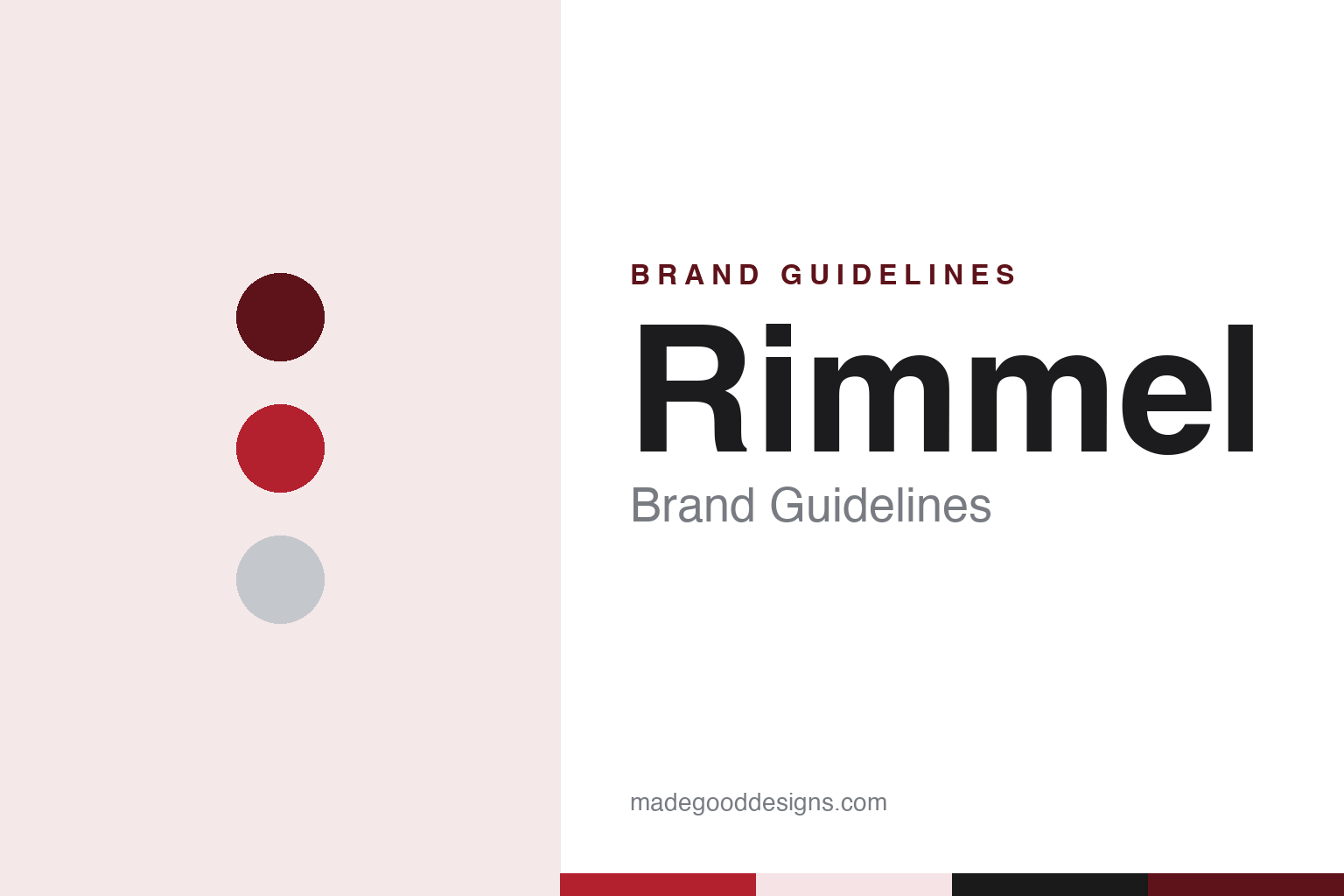
Two constants: a red, black and silver palette and a high-contrast modern serif register. Abstract homage — not a Rimmel product or mark; no pack, wand or logo is reproduced.
The House of Rimmel
A Paris-trained perfumer, a son and a shop in the West End.
Rimmel began as a perfumery, not a make-up brand. In a history of the company published on her website in January 2014, the make-up artist and writer Lisa Eldridge traces it to Hyacinthe Mars Rimmel, a French perfumer she describes as having trained under Pierre-François Lubin, the perfumer associated with the Empress Joséphine. In 1834, she writes, he left Paris and set up shop in Albemarle Street in London’s West End, bringing his wife and his son, Eugène, with him. The brand marked its 180th anniversary in 2014, the year her article appeared, and it still counts its history from that London opening. Eldridge points out that the family behind a brand now so closely tied to London came from Paris.
It was the son who built the name. Eldridge writes that Eugène opened a business of his own, The House of Rimmel, at 96 Strand in Westminster, and in 1842 took over the family business. Under him the house sold perfumes, toilet preparations and novelties: she lists mail-order catalogues, scented fans for ladies to carry to the opera and ballet, and perfumed Valentine’s cards. At the Great Exhibition of 1851 he showed a fountain that sprayed eau de cologne, so that visitors could scent their handkerchiefs, and Eldridge links that display to the patronage of Queen Victoria, whom she describes as appointing him a royal perfumer.
Eugène Rimmel was also an author. Eldridge credits him with The Book of Perfumes, a history and guide to scent, and with Rimmel’s Perfumed Almanac and Recollections of the Paris Exhibition of 1867. In those years the business looked outward, with shops in Paris and New York and, Eldridge writes, a flower garden and essential-oil distillery at Nice. After a fire destroyed the Strand premises in 1875, she says, he rebuilt on the site now occupied by the Savoy hotel. The house also sold mouthwashes and what it called toilet vinegars, fragrances she describes as a step up from eau de cologne, sold as refreshers between baths.
Colour
From a lash colour to Coty’s London brand.
The product that turned the surname into a common noun was a lash colour. Eldridge dates Rimmel’s Superfin to 1860, describing it as a blend of coal dust and petroleum jelly for darkening the lashes, and she writes that the word “rimmel”, or “rimel”, came to mean mascara and still does in several languages. The house kept working on the idea: she describes a product called Water Cosmetique, which began as a colour for moustaches and beards, used with water and a brush, and was adapted in 1917 as a block for the lashes and brows.
The business outlived its founder by decades. According to Eldridge, the Rimmel family continued to own and run it until 1949, when it was bought by a London company, and it was later sold to Coty in 1996. Coty still lists Rimmel among its brands today, alongside Max Factor and CoverGirl, and the brand presents itself under the name Rimmel London on its websites.
Its recent campaigns have used the city too. Writing in Refinery29 in June 2016, the beauty journalist Alice Casely-Hayford reported that Kate Moss had appeared in her first Rimmel campaign in 2001, photographed by Terry Richardson, and called her the original spokesperson for “the London Look”. The same article named Cara Delevingne, Rita Ora and Georgia May Jagger as later campaign faces. To mark fifteen years of the partnership, the article said, Rimmel and Moss introduced a special-edition collection of lipsticks and Super Gel nail polish in reds and nudes, in rose-gold packaging, launching that July. Shade names such as Muse Red and Boho Nude tied each colour to a moment in Moss’s wardrobe.
Typography
Design and documentation.
The brands in this group sell makeup and nail colour to a wide public, through pharmacies, supermarkets, department-store counters and salons. A mass-market cosmetics brand reaches its customer in a crowded aisle, so much of its identity is carried by small things seen at close range: a wordmark on a cap or a tube, the shape of a bottle, and the name printed on a shade.
Shade names do a great deal of that work. Some brands number their colours, some describe them plainly and some give them names that read like jokes, places or lines of dialogue, so a name can become as recognisable as the colour itself. Bottle and compact shapes are another constant, because a customer often meets the product on a rack or a counter display where many similar containers stand side by side.
Each guide separates what independent sources record from what the company says about itself — its founding story, its owners over time, its packaging and how its shades are named — and marks plainly what rests only on the company’s own word.
Aa
A high-contrast modern serif — the register of a Victorian perfumer’s label and a fashion masthead. (Specimen set in Bodoni Moda, a serif STAND-IN; NOT the Rimmel logo.)
Rimmel London
A family name with a city attached.
Two words carry the Rimmel identity. The first is the surname, which has been on the business since the 1830s and, in Eldridge’s account, travelled further than the firm itself by becoming a word for mascara in several languages. The second is London, which the brand attaches to its name today as Rimmel London and which links a mass-market make-up range back to a perfumery that stood in the West End and on the Strand.
The Victorian house already worked as a publicity machine. Eldridge’s history lists printed catalogues, perfumed almanacs, scented Valentine’s cards and an exhibition fountain, a mix of print, packaging and spectacle that put the Rimmel name in front of customers well beyond the shop.
The modern brand leans on people and places rather than on its founder. The Refinery29 account of the Kate Moss partnership describes campaigns built around the capital’s style and a model born in Croydon, and the 2016 anniversary collection named its shades after looks from her wardrobe.
For a design guide, Rimmel shows how a nineteenth-century perfumer’s surname and the name of a city can be combined into a single signature for a drugstore make-up range, renewed through campaign faces rather than a change of name. Compare it with Max Factor and CoverGirl, its stablemates at Coty. For this guide we use Strand red and kohl black with Savoy silver on powder pink and a serif, an unofficial interpretation; no product or logo is reproduced.
Explore & save
Keep Rimmel’s identity on hand — save it to a board in the Made Good inspiration library.
Rimmel identity set
Pin the Rimmel red, black and silver palette and the high-contrast modern serif register to your own board.


