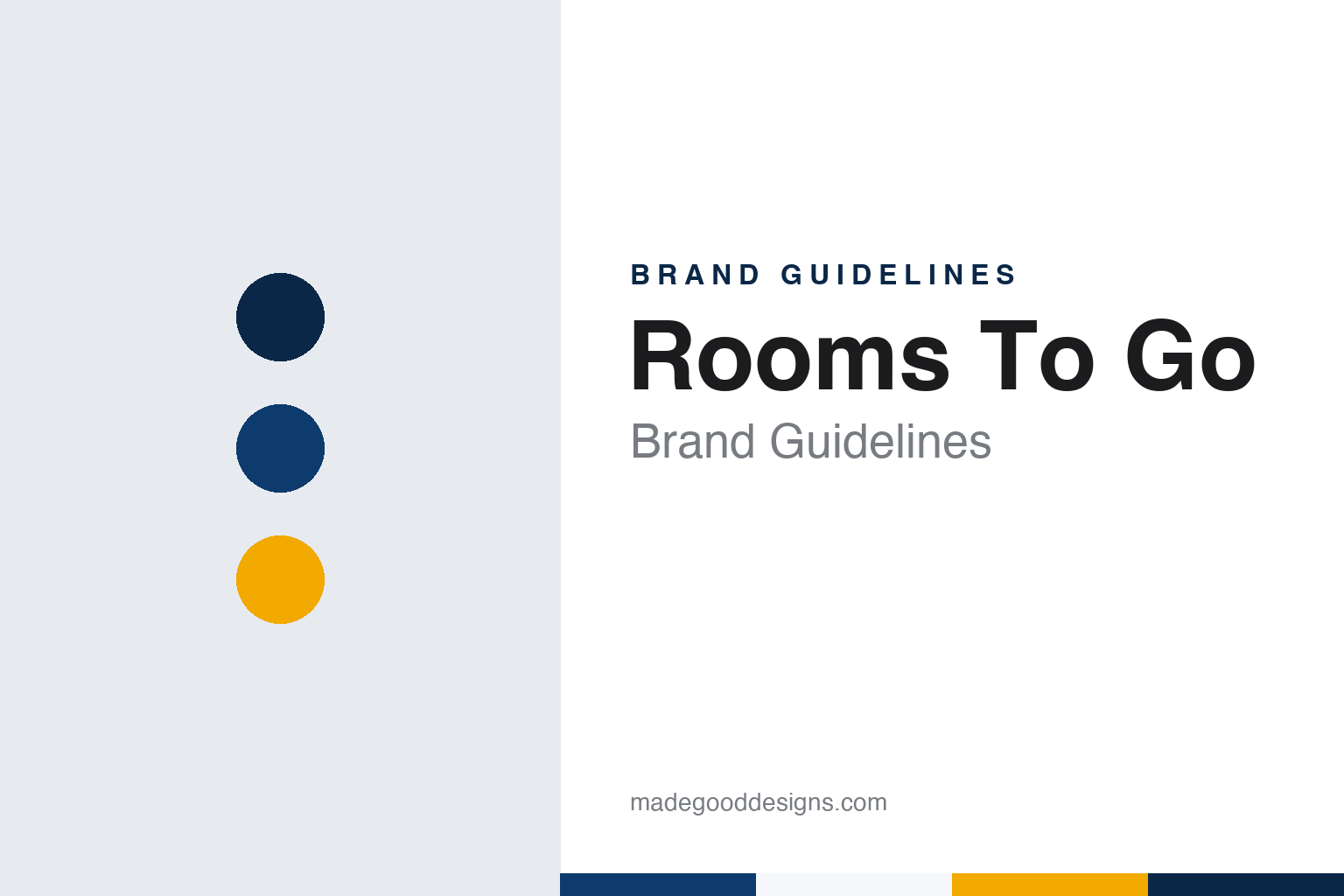
Rooms To Go Brand Guidelines
The Florida chain built on whole-room sets.
Aa
Two constants: a Gulf navy, sunshine yellow and glass white palette and a bold caps sans register. Abstract homage — not a Rooms To Go product or mark; no furniture, storefront or logo is reproduced.
After Seaman’s
A furniture family, a buyout and a new idea.
Rooms To Go was started by a family that already had a furniture name. The International Directory of Company Histories, published by St. James Press, says Jeffrey Seaman and his father, Morty Seaman, had both worked in the business of Jeffrey’s grandfather, Julius Seaman, who founded a home furnishings company in Woodbury, New York, in 1934. Jeffrey spent summers working for his grandfather while still at school, joined the family business after college and became a vice-president; Morty was president.
That business changed hands. In 1988, the directory says, Seaman’s Home Furnishings was taken over in a leveraged buyout by the investment firm Kohlberg Kravis Roberts. Quoting Deena Van Steenburgh of Furniture Retailer, it says father and son stayed on briefly as chief executive and president until February 1989, when the new owners replaced them. English Wikipedia says the two founded Rooms To Go in September 1990, after selling Seaman’s.
Jeffrey Seaman researched the new company by looking beyond his own trade. He told Van Steenburgh that he visited furniture retailers but also clothing and toy retailers and department stores, and that he was impressed by The Limited and The Gap: “I wanted my stores to look very ‘Gappish’ — uniform, colorful, interesting and open.” According to the directory, he built an executive team from other retailers, including Gerard Benatar, formerly vice-president of furniture fashion at Macy’s in New York and Barker Brothers in California; Jeff Finkel, formerly vice-president of real estate at Toys “R” Us; and Harmon Jones, formerly director of construction for Bally’s health clubs. Morty Seaman, the directory says, did not run the business day to day but advised his son on strategy, marketing, buying and planning.
Colour
Room sets, glass walls and golf shirts.
The company chose Florida for its headquarters and its opening stores, citing affordable locations, the directory says, and set up its distribution centre and head office in Seffner, near Tampa, where English Wikipedia still places the headquarters. The directory dates the opening store to Tampa in May 1991, with others following across west and central Florida within reach of a warehouse in Lakeland; English Wikipedia gives Orlando in March 1991.
The name describes the idea. The directory says company designers coordinated complete room sets — choosing the colours, fabrics, styles and groupings of furniture — so that a customer could buy a whole room at once, with lamps, rugs and accessories to finish it. Benatar and his team selected contemporary and transitional upholstery, casegoods, accessories and lamps and combined them into room settings, and the directory says Seaman and his buyers drew a share of the casegoods on paper themselves.
The shops were designed to match. According to the directory, the stores were laid out so customers could see all the merchandise from any point, with well-lit interiors, mirrors and other elements chosen for a bright, open feeling; Seaman and Benatar aimed for an atmosphere somewhere between Ikea and The Gap, with “lots of glass” and an airy environment. Display coordinators and teams were assigned to particular stores. Seaman told High Points that he wanted customers to avoid what he called “the shark attack” of salesmen pouncing at the door, and the directory says staff wore colourful, casual golf shirts instead of ties. Advertising was produced in-house.
The chain then moved beyond Florida. The directory records expansion in 1996 to Atlanta, Charlotte, Chattanooga and Nashville, and licensing agreements abroad, in countries including Turkey, Costa Rica, Honduras, Guatemala, Colombia and the Bahamas, under which Rooms To Go helped licensees find space and laid out their stores using company blueprints.
Typography
Design and documentation.
For a furniture or mattress retailer, the brand is met first at the scale of a building. Showroom signage has to read from a highway or a car park, so the name usually sits in a single bold wordmark on the façade, often lit at night and repeated on pylon signs at the entrance to a retail park. Inside, the identity steps back and the furniture takes over.
Room settings are the retailer’s main design tool. Sofas, beds and tables are grouped into staged living rooms, dining rooms and bedrooms, with rugs, lamps and accessories that suggest a way of living rather than a single product. Aisle markers, price-tag holders and department headers carry the brand colours in small doses so they do not compete with the rooms.
Catalogues, printed and digital, extend those room settings onto the page: wide photographs, generous white space, a consistent typeface for headings and a restrained palette for captions. On the road, delivery-truck graphics act as moving billboards, so the wordmark is usually large, high-contrast and readable at a glance from another lane. Together, these touchpoints let a home-furnishings name stay recognisable from the street to the doorstep.
Aa
A bold caps sans — the register of a wordmark set in capitals and a store fascia. (Specimen set in Montserrat, a sans-serif STAND-IN; NOT the Rooms To Go logo.)
Rooms To Go
Kids’ stores, a triangle and borrowed names.
The name stretched to a second format in 1997. The International Directory of Company Histories says the company tested a spin-off devoted to children’s furniture and opened a Rooms To Go Kids store in Marietta, Georgia, a suburb of Atlanta, attached to an existing Rooms To Go store but with its own entrance. The directory describes the prototype as decorated with bright wallpapers and paint schemes and complex curves and angles, with televisions placed through the store. The same year, it says, Rooms To Go signed a joint venture with the Japanese retailer Jusco, and a Rooms To Go Kids store opened in Tokyo in 1998. English Wikipedia lists a later outdoor division, Rooms To Go Patio.
The wordmark is simple. English Wikipedia describes the name as stylised in capitals, ROOMS TO GO, followed by a triangle shaped like a play symbol.
Borrowed names became part of the brand in the 2000s. In March 2006 Mark Albright, writing in the St. Petersburg Times and reprinted in The Ledger of Lakeland, reported that Rooms To Go had launched a Cindy Crawford furniture line and had landed Walt Disney Co.’s license for children’s bedroom suites featuring Disney characters. Seaman told Albright that he had planned to work with an apparel designer but spotted Crawford in an Omega watch advertisement, and that the two met in a Rooms To Go store in Grapevine, Texas, in 2004. In March 2013 HuffPost reported that the actor Sofia Vergara had signed a licensing deal for a Sofia Vergara Collection of living room, bedroom and dining room furniture and accessories. English Wikipedia adds an NFL-licensed line in 2008 and the country singer Eric Church’s “Highway to Home” collection from 2016.
English Wikipedia lists Jeffrey Seaman as chief executive.
For a design guide, Rooms To Go shows how a retail name can describe its own method: the room sold as one coordinated set, in a store designed to be seen at a glance. Compare Ashley, whose licensed HomeStores sell one maker’s goods, and Havertys, another furniture retailer. For this guide we use navy, a warm yellow and glass white with a sans, an unofficial interpretation; no product or logo is reproduced.
Explore & save
Keep Rooms To Go’s identity on hand — save it to a board in the Made Good inspiration library.
Rooms To Go identity set
Pin the Rooms To Go Gulf navy, sunshine yellow and glass white palette and the bold caps sans register to your own board.