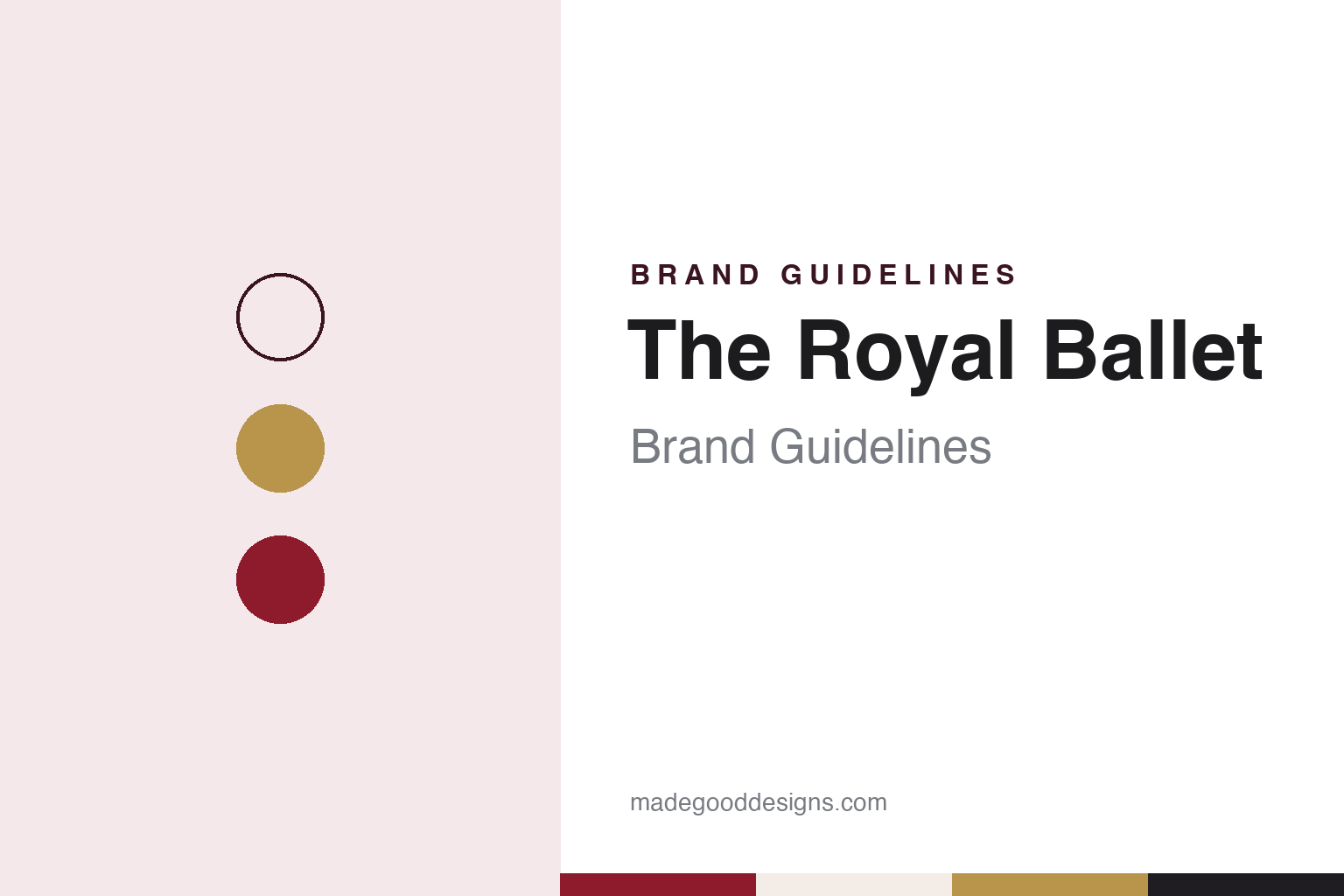
The Royal Ballet Brand Guidelines
A company named for two theatres, chartered by the Crown and now sharing its name with the house it lives in.
Aa
Two constants: a tulle ivory, charter gold, curtain crimson and stage black palette and a Covent Garden Didone serif register. Abstract homage — not a Royal Ballet or Royal Ballet and Opera asset or mark; no logo, crest, photograph or house lettering is reproduced.
Two theatres and a founder
A Ballets Russes soloist, a theatre owner and a company named after both her stages, 1926–1946.
The Royal Ballet began with one dancer’s plan. English Wikipedia says Ninette de Valois, born Edris Stannus in Ireland in 1898, joined Serge Diaghilev’s Ballets Russes in 1923 and danced with it for about three years; she later said that everything she knew about running a ballet company she had learned from Diaghilev. Back in London she opened a school, the Academy of Choreographic Art, in 1926, with the aim of building a repertory company and a school to feed it.
Her partner was the producer Lilian Baylis, who ran the Old Vic and Sadler’s Wells theatres and from 1925 engaged de Valois to stage dances at both. When Sadler’s Wells reopened in 1931, the Vic-Wells Ballet and the Vic-Wells Ballet School were set up in its premises, and the company’s name simply joined the names of its two theatres. English Wikipedia says de Valois hired former Ballets Russes stars, with Alicia Markova and Anton Dolin as principals and Tamara Karsavina as an adviser, while the conductor and composer Constant Lambert became founder musical director. Frederick Ashton, trained under Marie Rambert, joined as associate choreographer and made most of the early works.
The company also built its classical repertoire from paper. De Valois brought in Nicholas Sergeyev, a former régisseur of the Imperial Russian Ballet, who staged The Sleeping Beauty, Swan Lake, The Nutcracker, Coppélia and Giselle from choreographic notation written in St Petersburg; those notebooks are now held in the Sergeyev Collection at Harvard. After the link with the Old Vic ended, the troupe was renamed the Sadler’s Wells Ballet in 1939. In 1946 it was invited to become the resident company of the newly reopened Royal Opera House in Covent Garden, under David Webster, and opened there with The Sleeping Beauty.
Colour
A charter in 1956, a famous partnership and a house that kept growing.
The name came with royal approval. English Wikipedia says a royal charter was granted in 1956 to the main company, its touring sister and the school, which became The Royal Ballet, Sadler’s Wells Royal Ballet and the Royal Ballet School. The sister company later moved to the Birmingham Hippodrome, was renamed Birmingham Royal Ballet in 1990 and became independent of the Royal Opera House in 1997, so the two now share a heritage but not a management. From 1964 to 1979 a small unit called Ballet for All, led by Peter Brinson, toured the country with about 150 performances a year.
One chapter belongs to two dancers. Margot Fonteyn, trained at the school, spent her whole career with the company; Queen Elizabeth II named her prima ballerina assoluta as a gift for her sixtieth birthday. She first danced with Rudolf Nureyev in Giselle on 21 February 1962, and on 12 March 1963 the pair premiered Ashton’s Marguerite and Armand, set to Liszt. English Wikipedia records fifty photographers at the dress rehearsal and twenty-one curtain calls at the premiere. Ashton directed the company from 1963 to 1970 and Kenneth MacMillan from 1970 to 1977.
Today the company has about 100 dancers in six ranks, from Artist and First Artist in the corps de ballet up to Principal, with a separate rank of Principal Character Artist for roles such as Carabosse and Drosselmeyer. The Royal Ballet School trains at White Lodge in Richmond Park and in Floral Street, beside the opera house. Kevin O’Hare, a graduate of the school who danced with Birmingham Royal Ballet, took over as director in 2012, and Wayne McGregor, appointed resident choreographer in 2006, was the first to hold that post in sixteen years and the first drawn from contemporary dance. The company has won Laurence Olivier Awards since the prizes began in 1978.
Typography
A shared roof since 1946, a shared name since 2024.
A ballet or dance company rarely has a product to put on a shelf, so its visual identity is carried mostly by people in motion. Each season is announced with a set of images, usually dancer photography shot in a studio or on location months before the productions open, and those pictures travel onto brochures, banners, bus sides, programme covers and social posts. The logo tends to sit quietly in a corner while the photograph does the work. Repertory posters add a second layer: a classic full-length ballet may keep a recognisable image for years, while new commissions and mixed bills get their own typography and colour, so a company has to decide how far each title can drift from the house style before it stops looking like part of the same family.
The name on the poster is not always the name on the building. Many companies perform in theatres they do not own, and many venues present companies they do not employ, so the two identities have to share space on the same tickets, signs and web pages without one swallowing the other. Touring sharpens the problem, because a company may appear in a different city each week under a local theatre’s branding, and its mark has to read clearly at small sizes beside someone else’s. Schools, youth companies, community classes and digital channels add further sub-brands, often given their own wordmark or colour so that a parent booking a class and a regular buying a season ticket can each find their way through the same system.
Aa
Covent Garden Didone serif — after the high-contrast lettering of London theatre bills. (Specimen set in Bodoni Moda, a serif STAND-IN; NOT The Royal Ballet logo or any Royal Ballet and Opera lettering.)
The Royal Ballet
From Royal Opera House to Royal Ballet and Opera.
For most of its life the company performed under a building’s name rather than its own. That changed in 2024. Classic FM reported on 30 April 2024 that the Covent Garden theatre, known as the Royal Opera House since 1892, would now be known as Royal Ballet and Opera, announced by chief executive Alex Beard at the launch of the 2024/25 season. “The Royal Ballet and The Royal Opera have performed under the same roof since 1946,” he said. “Both companies now enjoy the prominence that they rightfully deserve.” The station said the new name came with a redesigned logo in a bold font.
The fuller identity followed a year later. Creative Review reported on 7 April 2025 that the London studio DesignStudio, working with the organisation’s in-house creative studio, built the system around the idea of a “living timeline” linking the house’s history with its present. The magazine described a serif with tapered, sweeping forms paired with a robust grotesque, a wordmark with small quirks such as an elongated leg on the R and a squat ampersand, and the house’s classic red kept prominent. Where no photography is available, a texture treatment built from production elements stands in. The typefaces were not named in the coverage we read, and no colour values are published.
For a design guide, The Royal Ballet shows a company whose identity sits inside a larger one: a name taken from two theatres, a royal charter, a Petipa repertoire rebuilt from notation and, since 2024, equal billing with the opera on the front of the house. Compare the Royal Opera House and Sadler’s Wells guides. For this guide we use tulle ivory, charter gold, curtain crimson and stage black with a serif, an unofficial interpretation; no product or logo is reproduced.
Explore & save
Keep The Royal Ballet’s identity on hand — save it to a board in the Made Good inspiration library.
The Royal Ballet identity set
Pin The Royal Ballet tulle ivory, charter gold, curtain crimson and stage black palette and the Covent Garden Didone serif register to your own board.