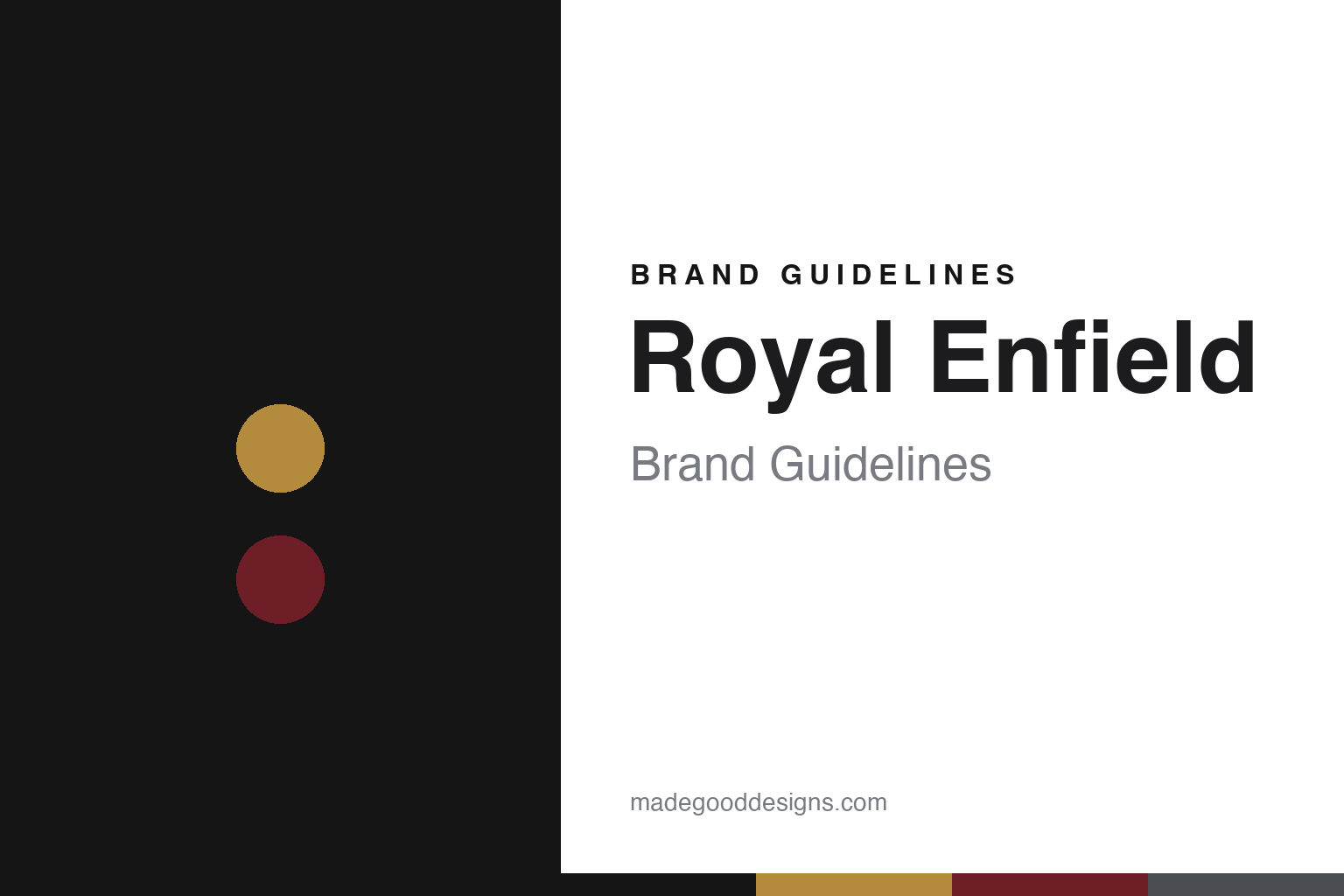
Royal Enfield Brand Guidelines
A needle maker’s bicycles, a rifle-factory name, a Bullet that moved from Redditch to Madras.
Aa
Two constants: a Bullet black, brass pinstripe and Chennai maroon palette and an Engraved capital register. Abstract homage — not a Royal Enfield product or mark; no motorcycle, badge or logo is reproduced.
Redditch, 1901
A needle town, a small-arms contract and a borrowed place name.
Royal Enfield is the motorcycle business of Eicher Motors, the Indian vehicle group headquartered in New Delhi, and English Wikipedia says its motorcycles are made at three plants around Chennai: Thiruvottiyur, Oragadam and Vallam Vadagal. The name, though, comes from the English Midlands, and the company still dates itself from 1901, the year the first Royal Enfield motorcycle was built in Redditch, Worcestershire.
Redditch was a needle-making town. English Wikipedia’s history of the original company says George Townsend founded a needle business there in 1851, that his son began making cycle components in 1882 and that the firm was selling complete bicycles by 1886. The business got into financial trouble in 1891. The company’s own history says that in 1891 Bob Walker Smith and Albert Eadie bought George Townsend & Co.
The name came from a contract. Royal Enfield says that in 1893 the firm won an order to supply precision parts to the Royal Small Arms Factory at Enfield, in north London, and launched an Enfield bicycle; the following year, it says, the bicycles became Royal Enfields and the trademark “Made Like A Gun” was introduced. Wikipedia records the New Enfield Cycle Company being incorporated in 1896 to handle the cycle side.
Motors followed quickly. The company says Smith designed a quadricycle with a De Dion engine in 1898, the year it adopted the trading name The Enfield Cycle Co. Ltd, and that the first Royal Enfield motorcycle was shown at the Stanley Cycle Show in London in 1901. Wikipedia gives that machine a 239 cc engine and notes that the company also built cars for a few years from 1902 and 1903.
Colour
From saddle tanks to the Bullet and the Flying Flea.
The shape most people now picture took form between the wars. English Wikipedia says Royal Enfield adopted bulbous saddle tanks and centre-sprung girder forks in 1928, and that the Bullet was introduced in 1932 in a special edition of The Motor Cycle, because the Olympia show had been cancelled during the Depression. The company says the first Bullets came in 250, 350 and 500 cc versions. In 1933 his son Frank Walker Smith took control.
The Second World War added a new chapter. Wikipedia says the company built military models, including a light 125 cc two-stroke designed to be dropped by parachute with airborne troops; Royal Enfield calls it the “Airborne”, also known as the Flying Flea. In 1942, Wikipedia adds, construction began on an underground factory in a disused Bath stone quarry at Westwood, near Bradford-on-Avon in Wiltshire.
After the war the line-up grew to include twins. Wikipedia lists the 500 cc twin of 1949, which led to the Meteor and Constellation, the 250 cc Crusader, the Continental GT café racer of the mid-1960s and the larger Interceptor twins. For a period in the late 1950s, Wikipedia says, Enfields were painted red and sold in the United States as Indian motorcycles through Brockhouse, an arrangement that ended in 1960.
In Britain, the story ended within a few years. Wikipedia says the company was sold to Norton Villiers in 1967, the year Redditch production stopped; Interceptor production continued at Bradford-on-Avon until that site closed in 1970, and the original Redditch company was dissolved in 1971. Royal Enfield’s own timeline places the Redditch closure in 1970.
Typography
Design and documentation.
Motorcycle makers speak through a small set of surfaces: a badge on the fuel tank, a name cast into an engine case, the colours of a racing livery and the model names that stay in a catalogue for decades. Many of these companies began as workshops that repaired bicycles, built parts for other firms or sold engines to anyone who would fit them, and the marque only came later. Some are still run close to the families or towns that started them; others have passed through several owners, closed and reopened, or moved their production to another country while keeping their design offices at home.
Because a famous name can outlive the factory that made it, the useful questions are plain ones: who founded the business and where, who owns it now, where the motorcycles are actually built, and how the badge and lettering have changed along the way.
Each guide in this group sets what independent, dated sources record beside what the company says about itself, and marks clearly where a fact rests only on the maker’s own account.
Aa
An engraved capital — wide, formal and a little military, like lettering on a cast badge. (Specimen set in Cinzel, a serif STAND-IN; NOT the Royal Enfield logo.)
Royal Enfield
From Madras Motors to Eicher and Chennai.
The Indian chapter began with an army order. English Wikipedia says the Indian government chose the Bullet for army patrols in 1952, and that in 1955 the Redditch company partnered with Madras Motors to form Enfield India, which assembled the 350 cc Bullet under licence in Madras, now Chennai. The company says Madras Motors had been founded in 1949 by K. R. Sundaram Iyer to import Royal Enfields, and that the Tiruvottiyur factory opened in 1956. By 1962, Wikipedia says, all components were made in India, and the company says Bullets were exported back to the UK and Europe from 1977.
Ownership then moved to an Indian vehicle group. Wikipedia’s article on Eicher Motors says Eicher Goodearth took a stake in Enfield India in February 1990 and a majority in 1993; Royal Enfield says Eicher acquired Enfield India in 1994 and renamed it Royal Enfield Motors Limited. Wikipedia’s history of the English company notes that Enfield of India began branding its motorcycles “Royal Enfield” in 1999.
The modern range has kept the old names while adding new ones. Wikipedia lists the Classic from 2009, a new factory at Oragadam from 2013, the Himalayan revealed in 2015, the Vallam Vadagal plant in 2017 and the 650 cc Interceptor and Continental GT twins unveiled in November 2017. The company says it acquired the British frame maker Harris Performance in 2015 and opened a UK Technology Centre in 2017. Later models include the Hunter 350, Super Meteor 650, Guerrilla 450 and Bear 650, and Wikipedia says an electric Flying Flea is planned for 2026.
For a design guide, Royal Enfield shows how a name borrowed from a London rifle factory, a gun-making slogan and one long-running model can carry a brand from a needle town in England to factories in Chennai, with revived names — Bullet, Interceptor, Flying Flea — tying old and new together. Compare Triumph, another British name revived under new ownership, and Norton, whose Norton Villiers group bought the English company in 1967. For this guide we use Bullet black, brass pinstripe and Chennai maroon with a serif, an unofficial interpretation; no product or logo is reproduced.
Explore & save
Keep Royal Enfield’s identity on hand — save it to a board in the Made Good inspiration library.
Royal Enfield identity set
Pin the Royal Enfield Bullet black, brass pinstripe and Chennai maroon palette and the Engraved capital register to your own board.


