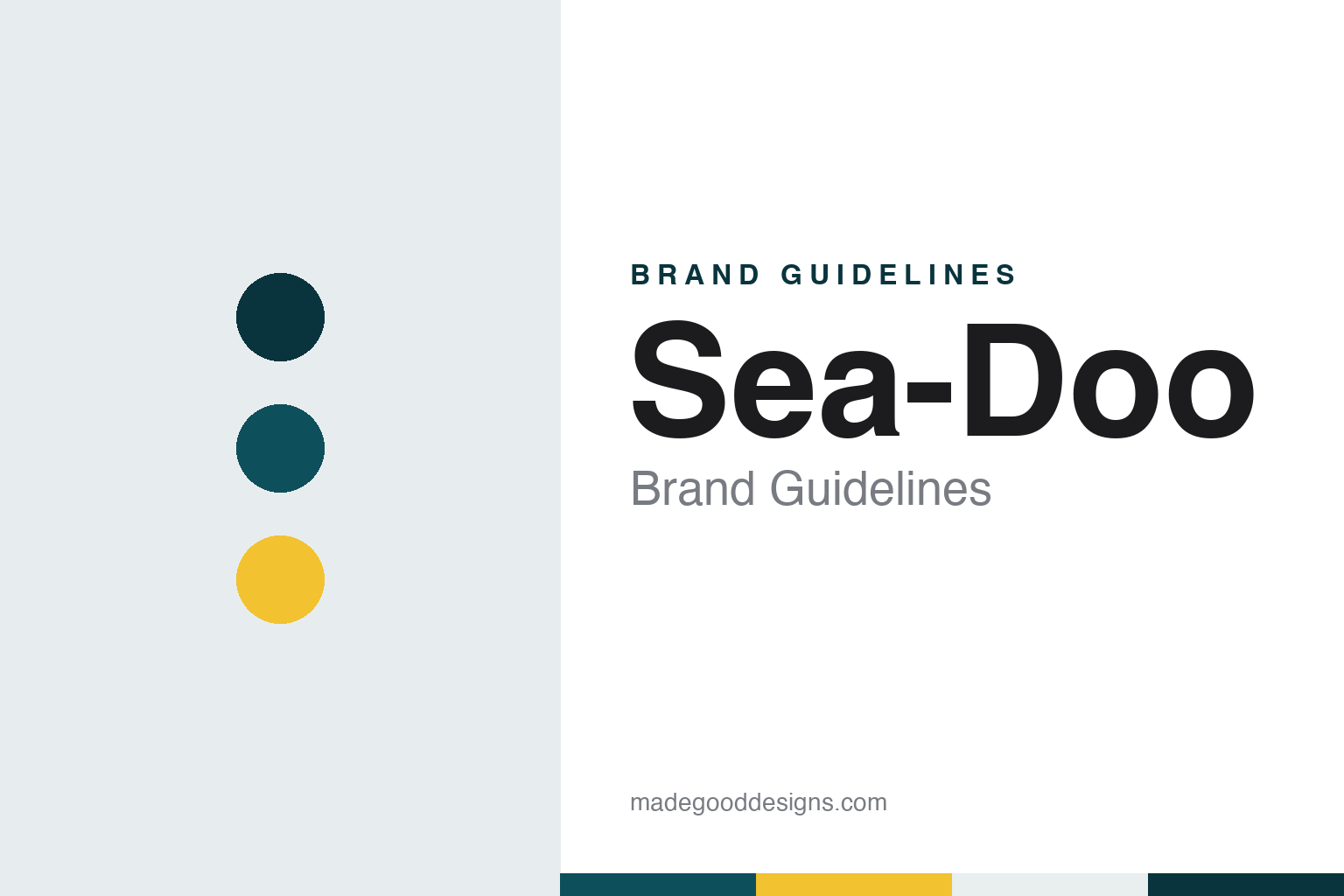
Sea-Doo Brand Guidelines
A yellow saucer on a lake in 1968, a second launch twenty years later and a name built on a snowmobile’s.
Aa
Two constants: a lagoon teal, aqua scooter yellow and spray white palette and a Condensed wake sans register. Abstract homage — not a Sea-Doo product or mark; no watercraft or logo is reproduced.
Valcourt, 1968
A snowmobile maker looks at the water.
Sea-Doo is a Canadian brand of personal watercraft and boats made by BRP Inc., the company whose name is short for Bombardier Recreational Products. English Wikipedia, citing Larry MacDonald’s 2012 book The Bombardier Story, describes it that way, and adds that every Sea-Doo model is driven by an impeller-driven waterjet rather than an exposed propeller.
The brand belongs to the same family tree as the snowmobile that made Bombardier’s name. English Wikipedia’s BRP article traces the company to L’Auto-Neige Bombardier Limitée, founded in 1942 by Joseph-Armand Bombardier at Valcourt, in Quebec’s Eastern Townships, and to the Ski-Doo snowmobile, which BRP says was created there in 1959. By the late 1960s the company was looking for a way to carry that success from snow to water.
English Wikipedia says Bombardier introduced its first personal watercraft in 1968, called the Bombardier Sea-Doo. It was designed by Clayton Jacobson II, and the BRP article adds that the company licensed Jacobson’s patents to create it. The same sources name Laurent Beaudoin, Joseph-Armand Bombardier’s son-in-law and the company’s president from 1966, as heavily involved, with an interest in extending the Ski-Doo’s success to the water.
The first machine looked nothing like the watercraft that carry the name today. English Wikipedia says it was advertised as the “Jet-powered Aqua Scooter”, that the original Sea-Doo was yellow, about five feet wide and seven and a half feet long, and that it somewhat resembled a flying saucer. Its handlebars were supplied from the Ski-Doo line. An air-cooled engine in 1968 gave way to a water-cooled one in 1969, after complaints of overheating; riders also complained about the flat seat and the lightly padded handlebars, and after about two years on the market the model was discontinued. Jacobson, the same article notes, went on to develop the Jet Ski watercraft for Kawasaki.
Colour
A second launch, a spin-off and plants in Mexico.
The name returned two decades later. English Wikipedia, again citing MacDonald, says the Sea-Doo was re-introduced in 1988 as its own brand under Bombardier, and that the relaunched watercraft helped turn round the fortunes of Bombardier’s recreational business in the 1990s. From that point Sea-Doo stood beside Ski-Doo as a separate brand rather than a single product.
The owner changed in 2003. English Wikipedia says Bombardier Inc. sold its Recreational Products division that year to a group of investors made up of Bain Capital, the Bombardier-Beaudoin family and the Caisse de dépôt et placement du Québec, and the new company took the name Bombardier Recreational Products, now shortened to BRP. BRP’s own “About BRP” page calls it “an independent company since 2003”, describes it as proudly Canadian, and lists “Sea-Doo watercraft and pontoons” among its brands, alongside Ski-Doo and Lynx snowmobiles, Can-Am vehicles and Rotax engines. English Wikipedia gives BRP’s headquarters as Valcourt, Quebec.
The watercraft themselves are not built in Valcourt. English Wikipedia, citing BRP’s list of locations, says all Sea-Doo personal watercraft are produced at BRP’s plants in Querétaro and Juárez, Nuevo León, in Mexico, and that their Rotax engines come from BRP’s plant in Gunskirchen, Austria. Rotax has been part of the group since 1970, when English Wikipedia says Bombardier acquired the Austrian engine maker.
For a time the brand also covered small jet-drive boats. English Wikipedia lists Sea-Doo sport boats under names such as Sportster, Speedster, Wake and Challenger. The Wake was made for wakeboarding, while the two Challenger models were, in the article’s words, less sporty and more luxurious. English Wikipedia says BRP ended sport-boat production in 2012, citing a decline in global marine sales; most of the affected jobs were at a plant in Benton, Illinois.
Typography
Design and documentation.
The brands in this group all make powersports machines: motorcycles, snowmobiles, all-terrain vehicles, side-by-sides and personal watercraft. Some grew out of larger industrial groups and only later attached their names to leisure machines; others were set up from the start to build engines and the vehicles around them, and a few now build machines under more than one name.
A powersports brand’s identity is usually carried less by a single badge than by a set of habits: a livery colour repeated across a range, model names and number codes on side panels, decals that change from season to season, and race teams that put the same colours in front of a crowd. Because the company behind a name may have been sold, spun off from a larger group or folded into a new owner, the questions worth asking are plain ones: who started it, who owns it now, and where its vehicles are actually built.
Each guide separates what independent sources record from what the company says about itself, and marks plainly what rests only on the company’s own word.
Aa
A condensed wake sans — narrow, upright and quick to read, like a model name on a hull side. (Specimen set in Barlow Condensed, a condensed sans STAND-IN; NOT the Sea-Doo logo.)
Sea-Doo
From the Spark to the Switch, under BRP.
Today’s range is organised by use rather than by a single model. English Wikipedia groups Sea-Doo watercraft into five categories: recreation, tow sports, touring, sport fishing and performance.
Two recent launches show how the brand has widened its reach. English Wikipedia says the Sea-Doo Spark, released in 2014, was aimed at new buyers; it was eight years in development under the code name CAFE, standing for clean, affordable, fun and easy to use, and it used a Polytec hull and deck material to cut cost and weight. In August 2021, the same article says, the brand released the Switch, a pontoon-style boat, which is why BRP now speaks of Sea-Doo “watercraft and pontoons”.
The brand has also travelled beyond the water. English Wikipedia lists Sea-Doo HydroCross, a PlayStation video game carrying the name, among its related articles.
For a design guide, Sea-Doo shows how a maker can carry a name pattern from one product to the next — Ski-Doo on snow, Sea-Doo on water — to move a brand onto a new surface, and how a first product that did not last can still give a name its starting date. Compare Ski-Doo, the snowmobile brand whose name Sea-Doo follows, and Can-Am, its stablemate at BRP. For this guide we use lagoon teal, aqua scooter yellow and spray white with a sans, an unofficial interpretation; no product or logo is reproduced.
Explore & save
Keep Sea-Doo’s identity on hand — save it to a board in the Made Good inspiration library.
Sea-Doo identity set
Pin the Sea-Doo lagoon teal, aqua scooter yellow and spray white palette and the Condensed wake sans register to your own board.


