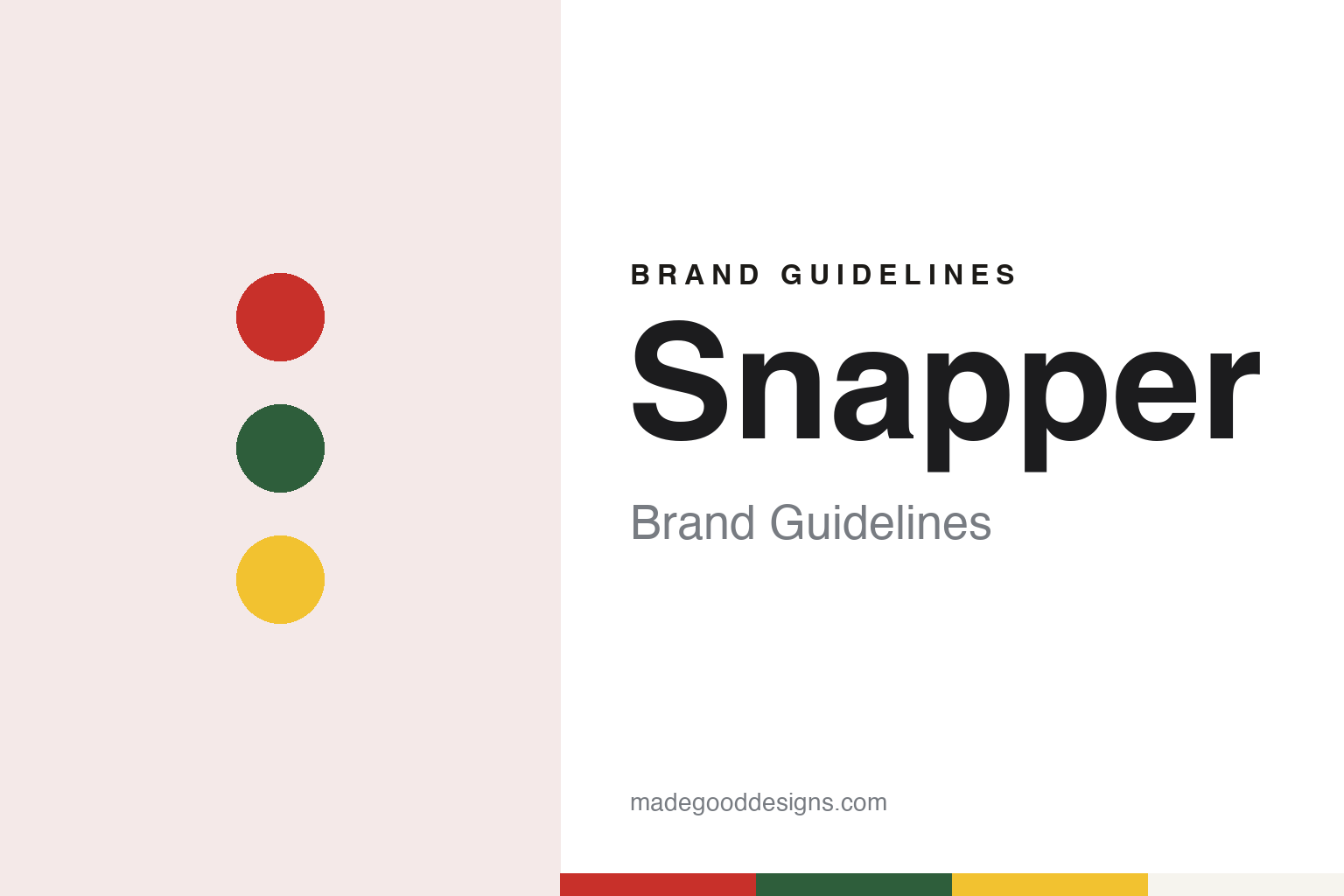
Snapper Brand Guidelines
A Georgia saw works, a patented blade and a mower named for the way it snapped the grass.
Aa
Two constants: a red, green and yellow palette and a plain-spoken sans register. Abstract homage — not a Snapper product or mark; no mower, decal or logo is reproduced.
From a saw works to the Snappin’ Turtle
A Georgia company that changed direction as the lumber trade declined.
Snapper is an American lawn-care brand owned by Briggs & Stratton, the engine and outdoor-equipment company based in Wauwatosa, Wisconsin. Its roots are in Georgia. English Wikipedia says the company began in 1894 as Southern Saw Works, and that in the 1940s, by then called the McDonough Power Company, it was acquired by William Raymond Smith, who changed its direction as the lumber industry declined. The company was based in McDonough, Georgia.
The brand itself dates from the early 1950s. Citing a 2003 obituary of Smith in The New York Times, English Wikipedia says he bought the patent for a mowing-blade design in 1950. The mower built on it arrived in 1951 as the “Snappin’ Turtle,” named, according to Wikipedia, for the way it snapped the grass and for the turtle figurine mounted on the top front of the first model. Snapper’s European website tells the same story in its own words: under the heading “Since 1951,” it says the brand “was born out of the suburban growth in the early 1950s when homeowners needed efficient and reliable tools to maintain their lawns,” and it names William R. Smith as the founder of Snapper.
The company grew under a conglomerate. English Wikipedia says Snapper was acquired by Fuqua Industries in 1967 and that, under Fuqua, it broadened its range and its manufacturing base, with plants in McDonough, in Beatrice, Nebraska, and in Fort Worth, Texas. It also made tillers and snow blowers alongside its mowers. In January 1991, UPI reported that Fuqua would close the Texas and Nebraska plants; according to Wikipedia, the Georgia factory was expanded to take on their production. By then the parent company had changed its name: when Snapper was sold in 2002, its parent was Metromedia International Group.
Colour
Simplicity, Briggs & Stratton and KPS Capital Partners.
The modern ownership chain starts in Wisconsin. In a press release dated 23 October 2002 from Port Washington, Wisconsin, Simplicity Manufacturing announced an agreement to buy substantially all of the assets of Snapper, Inc., which it described as a Georgia-based maker of lawn and garden equipment for residential and commercial customers, from Metromedia International Group. Simplicity’s president and chief executive, Jim Wier, said the deal fitted the company’s strategy of selling through independent dealers, and the release noted that Simplicity’s strongest distribution was in the Midwest and Northeast while Snapper’s was in the South and Southeast.
The combined business did not stay independent for long. English Wikipedia says Simplicity was itself acquired by Briggs & Stratton in 2004, and Snapper’s European website dates the brand’s “acquisition by Briggs & Stratton” to the same year. Briggs & Stratton has owned Snapper since then. English Wikipedia says that on 17 January 2013 Briggs & Stratton announced that it would sell Snapper-labelled mowers through Walmart, and, citing Fast Company, that this reversed a stance taken when Snapper was independent.
Manufacturing then moved north. According to English Wikipedia, citing the Milwaukee Journal Sentinel, Briggs & Stratton announced in 2014 that it would close the Snapper plant in McDonough and move production to its factory in Wauwatosa, near the company’s headquarters and engineering staff. The parent company changed hands in 2020: in a release dated 22 September 2020, Briggs & Stratton announced that KPS Capital Partners, through a newly formed affiliate, had acquired substantially all of its assets, and that the acquired business had exited its Chapter 11 proceeding. The release listed Snapper among the brands that came with it, alongside Simplicity, Ferris, Murray and Victa. English Wikipedia adds that in 2023 Briggs & Stratton decided to end production of Snapper zero-turn mowers and tractors for North America, while the brand kept a full range for Europe, the Middle East and Africa.
Typography
Design and documentation.
The brands in this group all make lawn mowers and outdoor power equipment: walk-behind and riding mowers, zero-turn machines, tillers, trimmers, chainsaws and the engines that drive them. Lawn-mower and outdoor-power brands sit at many different points in the trade, from family companies that began in a barn or a small workshop to names that now belong to much larger industrial groups, and a single brand can be sold through independent dealers, hardware chains or both.
An outdoor-power brand’s identity is usually carried less by one machine than by a name, a livery colour and the decals and dealer signs that go with it, because the company behind the name may have changed hands, been licensed to another maker or moved its factories over the decades. That makes the questions behind each name worth asking plainly: who started it, who owns it now, and where its machines are actually made.
Each guide separates what independent sources record from what the company says about itself — its founding story, its owners over time, where its machines are made and how its marks have changed — and marks plainly what rests only on the company’s own word.
Aa
A plain-spoken sans — a straightforward, dealer-catalogue register. (Specimen set in Barlow, a sans-serif STAND-IN; NOT the Snapper logo.)
Snapper
A turtle, a rear-engine rider and a film role.
Snapper’s earliest piece of identity was literal. The first Snappin’ Turtle mower carried a turtle figurine on its top front, and the name joined that mascot to the sound of the blade, according to English Wikipedia.
The Rear Engine Rider has its own place in the brand’s story, and Snapper’s European website gives it a section of its own, headed “Forrest Gump’s lawn mower”: it says the Rear Engine Rider appears in the 1994 film Forrest Gump, where Forrest mows the public lawns of Greenbow and then his own lawn at home. English Wikipedia also notes the film appearance. In the United States, according to Wikipedia, the name is now mainly associated with walk-behind mowers such as the Hi-Vac and Ninja lines and with entry-level equipment sold through large retailers.
In Europe the brand has a fuller programme and a separate website, snapper.eu, with local-language sites and a dealer locator. Its range there includes lawn tractors, zero-turn mowers, electric ride-on mowers, cordless mowers and a cordless garden-tool system sold as XD 82V Max. English Wikipedia says the European range added RPX and RTX ride-on lawn tractors with rear grass collection in 2024. An archived 2008 capture of the US website, snapper.com, carried the tagline “It Just Makes Sense.”
For a design guide, Snapper shows how a regional Georgia company turned a patented blade and a turtle mascot into a national mower name, then kept that name through a conglomerate, a Wisconsin rival and an engine maker, with a film cameo doing some of its advertising. Compare it with Simplicity, the Wisconsin company that bought Snapper in 2002, and with Briggs & Stratton, which has owned it since 2004. For this guide we use red, lawn green and yellow with a sans, an unofficial interpretation; no product or logo is reproduced.
Explore & save
Keep Snapper’s identity on hand — save it to a board in the Made Good inspiration library.
Snapper identity set
Pin the Snapper red, green and yellow palette and the plain-spoken sans register to your own board.


