Tencent Brand Guidelines
Fast information, a penguin in a red scarf and a message app called WeChat.
Aa
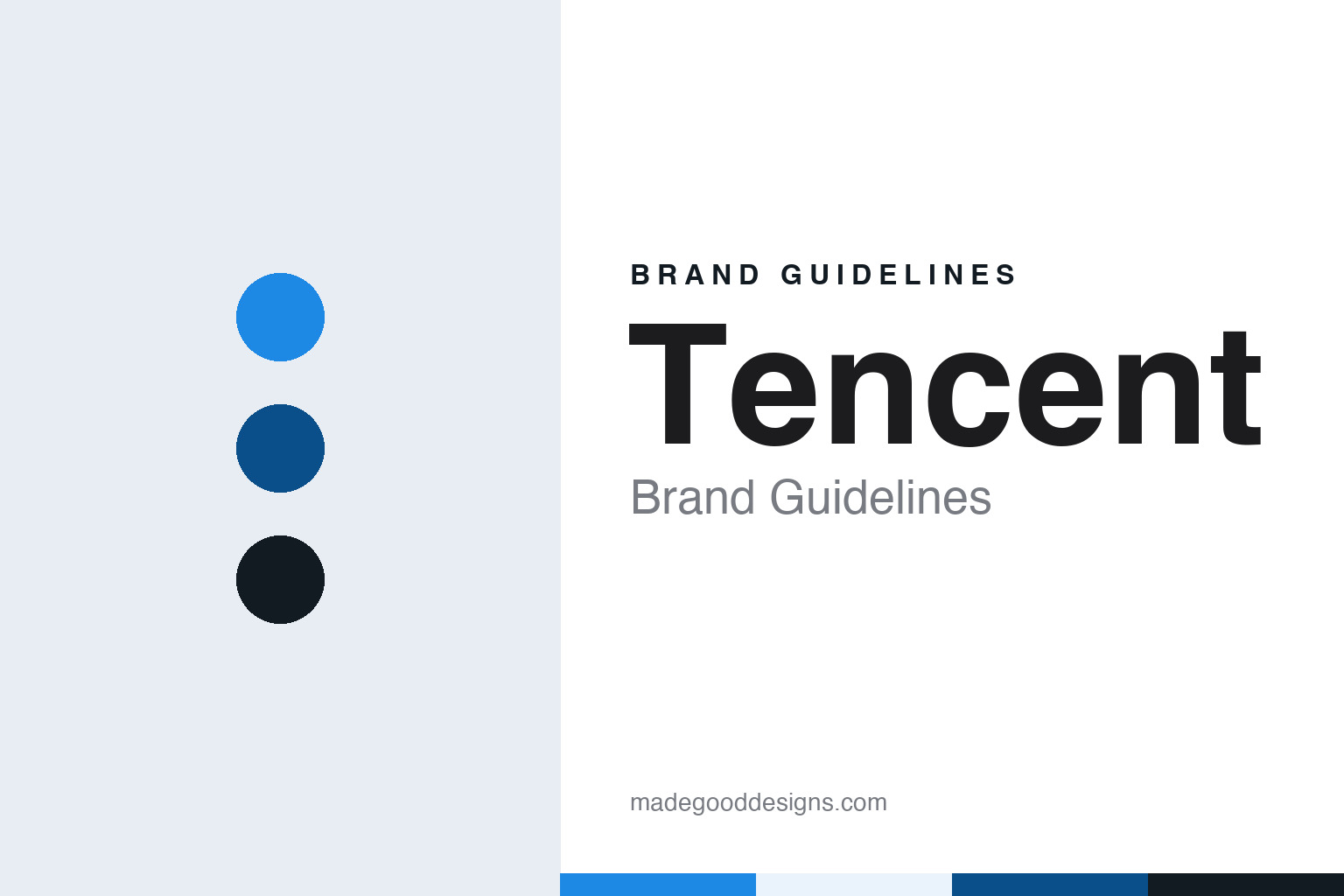
Two constants: a sky blue, deep blue and ink palette and a Rounded sans register. Abstract homage — not a Tencent asset or mark; no logo, mascot, icon or wordmark is reproduced.
Galloping fast information
Shenzhen, 1998.
Tencent was founded in November 1998 by five people, Wikipedia says: Pony Ma, Zhang Zhidong, Xu Chenye, Charles Chen and Zeng Liqing. The company is headquartered in Shenzhen, the southern Chinese city across the border from Hong Kong, where its twin-tower headquarters, Tencent Seafront Towers, stand in the Nanshan District.
The name is built from its founder’s name. The English “Tencent” is based on the Chinese name Tengxun (腾讯), Wikipedia says, which incorporates part of Pony Ma’s Chinese name, Ma Huateng, and literally means “galloping fast information”. The result describes the business, a company built on messages moving quickly, while carrying part of the founder’s name inside it. The company was registered as Tencent Inc when it was set up in 1998, Wikipedia says, and the English name keeps the sound of the Chinese one rather than translating it. Ma Huateng became known in English as “Pony Ma”, a nickname that ClickZ also used in an October 2017 profile.
The product the company started with set the tone for everything that followed. Tencent released its messenger OICQ in February 1999, Wikipedia says. ClickZ, in a report by Carrie Law published on 9 October 2017, said the service launched in 1999 as OICQ, short for “Open ICQ”, and that at launch it was a simple instant messenger closely modelled on ICQ, the Israeli chat app of the period. Improvements quickly followed, the report said, and the service, renamed QQ, grew to include online games, customisable avatars, email and file sharing, and the social network Qzone.
The short name proved durable. Two repeated letters are easy to say in Chinese and in English and easy to type. The company’s news portal later took the same name as QQ.com, Wikipedia says, so the product name and the web address became one and the same.
Colour
A penguin in a red scarf.
The visual heart of the QQ brand is a penguin. ClickZ reproduced the original 1999 logo for QQ, from the days when it was still called OICQ, and noted that eighteen years later the redesigned logo still featured the familiar penguin, now wearing a red scarf and winking. The name of the service changed, but the bird stayed.
The penguin also became a product in its own right. By 2005, Wikipedia says, Tencent was earning income from licensing its penguin character, which could be found on snack food and clothing. A messaging mascot became merchandise, carrying the brand into places where no screen was involved.
The 2017 version described by ClickZ adds very little to the bird: a red scarf and a wink. The scarf gives the black-and-white figure a spot of colour, and the wink gives it an expression. Both are small enough details to survive when the penguin is reduced to an app icon.
Tencent also operates the instant messenger and news site under the same QQ name, Wikipedia says, alongside WeChat, so the penguin sits beside a family of products rather than above the corporate name. The company name Tencent is the one that appears on its Shenzhen headquarters.
Typography
Names, mascots and icons.
Corporate names in East Asia often carry a meaning of their own. A company may take its name from a word for a mood or a hope, from a line of classical poetry, or from a folk tale known well beyond the region, and that meaning is then repeated in speeches, annual events and advertising. The name works as a small story that customers can retell.
Mascots are another recurring device. A drawn animal or character can stand in for a service that has no physical product, appearing on screens, plush toys, packaging and office signage, and it can stay in use long after the logo beside it has been redrawn.
For businesses that live inside phones, the app icon is frequently the version of the identity that people see every day. Icons are reduced to a single closed shape and one or two colours so they remain legible at fingertip size, while the full wordmark is kept for larger formats.
Campaign naming built on calendar dates is a further pattern: a day and month written as numbers become the name of an annual event, which can be printed, counted down and repeated every year.
Aa
A rounded sans — after a round, friendly mascot and short product names. (Specimen set in Nunito, a sans STAND-IN; NOT the Tencent logo, the QQ penguin or any Tencent typeface.)
Tencent
From QQ to WeChat.
The company’s second messaging brand arrived in 2011. On 21 January 2011, Wikipedia says, Tencent launched Weixin (微信), a social media app now branded internationally as WeChat. The English name keeps the idea of chat in a short, easy compound.
The reason for a second brand was the move to phones. ClickZ reported in 2017 that, as the mobile era got under way, Tencent worried that QQ, a product born on the desktop, would not make the transition well, and its answer was the messaging app now known as WeChat. The report described WeChat as in many ways the upgrade to QQ: on the older platform, sharing a history of posts comes naturally, while WeChat’s Moments feature puts the emphasis on the here and now. WeChat’s QR-code payments, the report added, let customers pay for products from the app.
QQ did not disappear. ClickZ said the older service was reinventing itself as an online destination for teenagers and pre-teens, and that it remained in use in offices. The two services now sit side by side, one with a penguin and one without, under the same corporate name.
Wikipedia describes WeChat as one of the “super apps”, because of the range of functions and services it brings together, from messaging to payments and small programs that run inside it. Tencent introduced its mini-programs feature in 2017, Wikipedia says, letting users open apps inside WeChat without downloading them separately.
Architecture is the company’s other visible signature. Tencent’s headquarters, the Seafront Towers in Shenzhen, are a pair of linked skyscrapers, also known as Tencent Binhai Mansion, according to Wikipedia, which places them in the Nanshan District. In December 2023, Wikipedia says, the architecture firm Büro Ole Scheeren unveiled a helix-inspired design for a new global headquarters in the same city.
For a design guide, Tencent shows how a company can let a mascot and short product names carry its public identity, while the corporate name stays in the background. Compare Alibaba, another Chinese internet group with a family of separately named products, and Baidu, whose name comes from a classical poem. For this guide we use sky blue, a deep blue and ink with a sans, an unofficial interpretation; no product or logo is reproduced.
Explore & save
Keep Tencent’s identity on hand — save it to a board in the Made Good inspiration library.
Tencent identity set
Pin the Tencent sky blue, deep blue and ink palette and the Rounded sans register to your own board.