Wienerschnitzel Brand Guidelines
A Wilmington hot-dog stand, an A-frame roof and a rounded W.
Aa
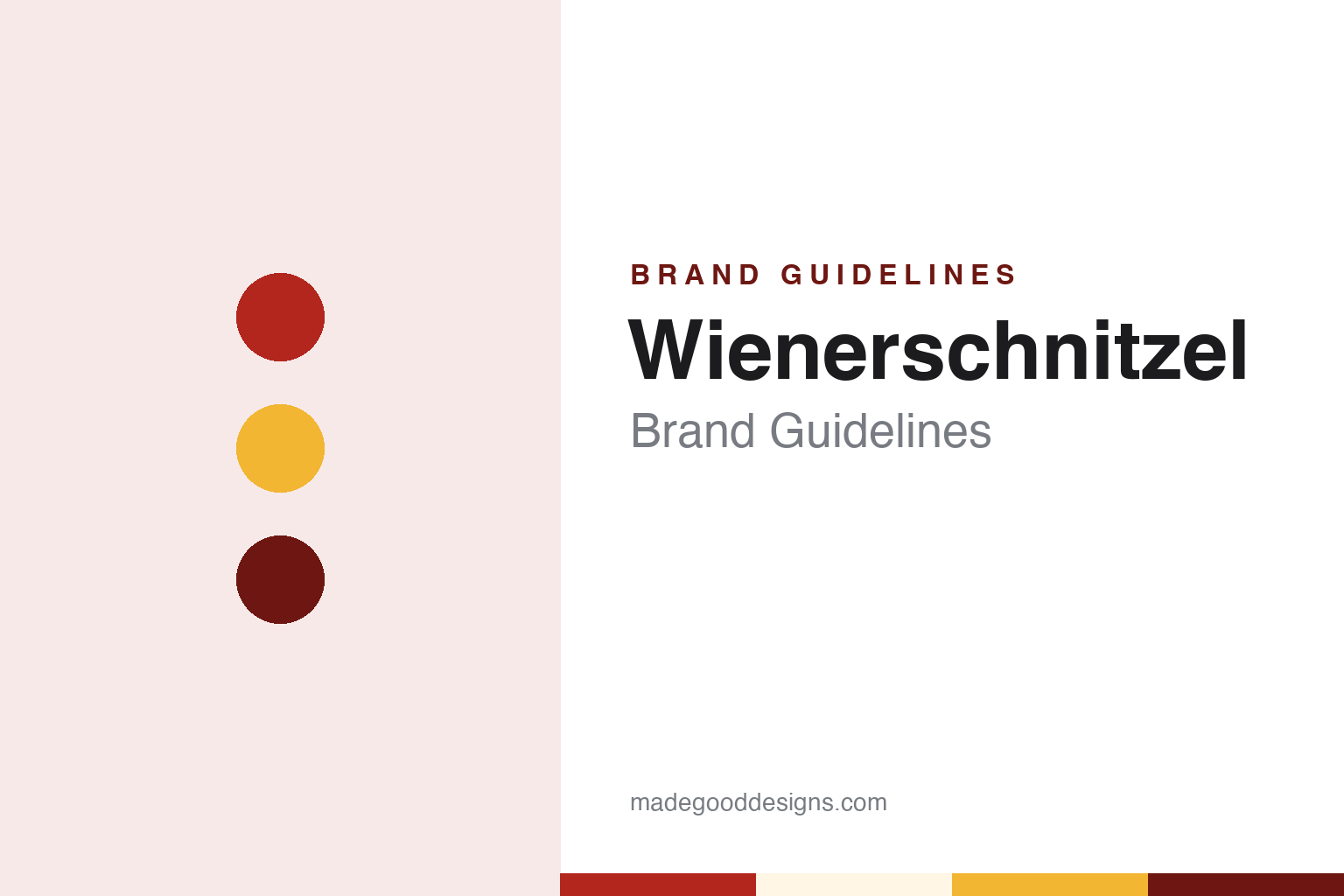
Two constants: a roof red, mustard and bun cream palette and a rounded geometric sans register. Abstract homage — not a Wienerschnitzel product or mark; no sign, roof, mascot or logo is reproduced.
Der Wienerschnitzel
A Taco Tia apprentice, a cookbook name and a stand in Wilmington.
Wienerschnitzel began as Der Wienerschnitzel, a hot-dog stand that John Galardi opened in 1961 in the Wilmington section of Los Angeles. An Associated Press report published in April 2013, drawing on the company’s biography of its founder, says Galardi came from Kansas City and started out working for Glen Bell, the later founder of Taco Bell, at Bell’s Taco Tia restaurant in Pasadena in 1961. The same report says Galardi’s stand specialised in hot dogs and chili, a deliberate niche in a market already full of burger, chicken and taco counters.
English Wikipedia fills in how the stand came about. It says a property owner wanted Galardi to run a restaurant on a site on Pacific Coast Highway in Wilmington, next to one of Bell’s taco stores, and that Bell encouraged him to take the offer as long as he sold a different kind of food. Galardi chose hot dogs. The name, Wikipedia says, came from his wife, who found it while looking through a cookbook; Galardi is quoted there as saying he doubted anyone would call a company Wienerschnitzel, then decided three days later that it beat “John’s Hot Dogs”. Wikipedia dates the opening to June 1961.
The name is a German compound of Wiener, “Viennese”, and Schnitzel, “cutlet” — the breaded veal dish, not a sausage. Wikipedia notes that in American English “wiener” is also a colloquial word for a hot dog, and that the chain has only once served an actual Wiener schnitzel, as a limited menu item in 2017.
Buildings became part of the brand. Wikipedia associates the chain with the A-frame roofs of its older restaurants, a steeply pitched shape it compares with early buildings used by IHOP, Tastee-Freez, Nickerson Farms and Whataburger. Galardi formed the Galardi Group as a parent company in 1970, Wikipedia says, and the AP report records that he later added the Original Hamburger Stand and the soft-serve chain Tastee Freez to the business.
Colour
A family company from Galardi to his son.
Galardi remained chairman of the Galardi Group but, the AP reported in 2013, handed day-to-day operations to chief operating officer Dennis Tase in 1993. The Galardi Group, then based in Irvine, California, announced his death in April 2013, the AP said. Wikipedia records that the company created The Original Hamburger Stand and a second burger brand in 1983 after an attempt to add hamburgers to the Wienerschnitzel menu, and that it became a Tastee-Freez franchisee before buying the ice-cream brand.
The business stayed in the family. Nation’s Restaurant News reported in August 2014 that Galardi’s former wife, Cindy Galardi Culpepper, had become chief executive after his death, working with the existing management team, and that many Wienerschnitzel restaurants were co-branded with Tastee Freez. In that interview she described the Galardis’ son, J.R. Galardi, as the likely future head of the company and said he had started a “visionary department” aimed at younger customers.
That succession happened in 2022. A company announcement published by Franchising.com on 7 February 2022 says J.R. Galardi became chief executive on 1 February 2022, adding the title to the presidency he had held since 2017, with oversight of Wienerschnitzel, Tastee Freez and Hamburger Stand, while Culpepper stayed on as executive chairman. The announcement says his first job at Wienerschnitzel was as a janitor, and that under his leadership the company set up an international division to take its trademarks outside the United States. The Galardi Group, a family company in Irvine, has owned Wienerschnitzel since Galardi formed it in 1970.
The A-frame remained central to new building. Nation’s Restaurant News reported in 2014 that the company was testing a prototype called the Heritage, which Culpepper said incorporated the traditional A-frame architecture in a smaller, drive-thru and walk-up building, with the first one planned for El Paso, Texas, that September, alongside a version with inside seating.
Typography
Design and documentation.
A restaurant brand is read from the road before it is read on a plate. Its identity lives in a building’s outline, a sign raised high enough to be seen from a moving car, a colour picked to stand out against sky and asphalt, and a name lettered on a menu, a placemat, a cup and a uniform. For chains that grew along highways or around a theme, the roofline, the dining room and the mascot can carry as much of the brand as the logo itself.
That identity can also outlast the business that made it. Restaurants change owners, franchisees rebrand or close individual sites, and a name can pass from one company to another or be split between different trades. A sign, a roof shape or a character may stay familiar long after the company behind it has changed.
Each guide below sets out who started the brand, where and when, who has owned it since, and how its name, signs, buildings and mascots have changed. It separates what independent, dated sources record from what the company says about itself, and marks plainly what rests on the company’s own word.
Aa
A rounded geometric sans — the register of a roadside sign and a paper boat tray. (Specimen set in Questrial, a sans-serif STAND-IN; NOT the Wienerschnitzel logo.)
Wienerschnitzel
Dropping the “Der”, a rounded W and a running hot dog.
The current identity dates from the end of the 1970s, when the chain dropped the German article from its name. English Wikipedia says the name had been Der Wienerschnitzel until 1979 and that a new logo designed by Bass/Yager & Associates debuted at the beginning of that year, with the version now in use a slight redesign from 2007. The type archive Fonts In Use, in an entry by Stephen Coles dated March 2018, credits the logo to Saul Bass and dates the artwork to 1978, saying it has largely survived on franchise signage since.
Fonts In Use describes the parts of that mark. The rounded W is most likely custom lettering, it says, while the word “Wienerschnitzel” was set in ITC Avant Garde Gothic with alternate e and c characters and a custom swash z, and without the typeface’s diamond-shaped i dots. Around 2009, the entry says, the type in the official logo changed to a modified ITC Kabel with a custom W and t, while the older Avant Garde version remained on many physical signs.
Advertising gave the brand a character of its own. Wikipedia says the mascot The Delicious One, an anthropomorphised hot dog, was conceived in 1997 by creative directors Courtney Betley and Julia Cadar. It debuted as a claymation figure animated and voiced by Luke Thomas, with visual development by the London production company Loose Moose, and its running joke is a hot dog fleeing the people who want to eat it. After a television hiatus following 2008, Wikipedia says, the character returned in January 2014 in a 2D-animated style voiced by Justin Roiland. The Orange County Business Journal reported in October 2014 that the chain’s new Visionary Department had sponsored the Joe Gibbs Racing supercross and motocross team, with the brand’s logo appearing on racers’ bikes at the Monster Energy Cup in Las Vegas that month. Wikipedia adds that Wienerschnitzel sponsors the Wiener Nationals dachshund races.
For a design guide, Wienerschnitzel shows how a pun of a name, a steep roof and a single rounded letter can carry a family-run chain across six decades and two typefaces. Compare it with Nathan’s Famous, the Coney Island hot-dog brand, and Taco Bell, founded by Galardi’s early employer Glen Bell. For this guide we use roof red, mustard and bun cream with a sans, an unofficial interpretation; no product or logo is reproduced.
Explore & save
Keep Wienerschnitzel’s identity on hand — save it to a board in the Made Good inspiration library.
Wienerschnitzel identity set
Pin the Wienerschnitzel roof red, mustard and bun cream palette and the rounded geometric sans register to your own board.