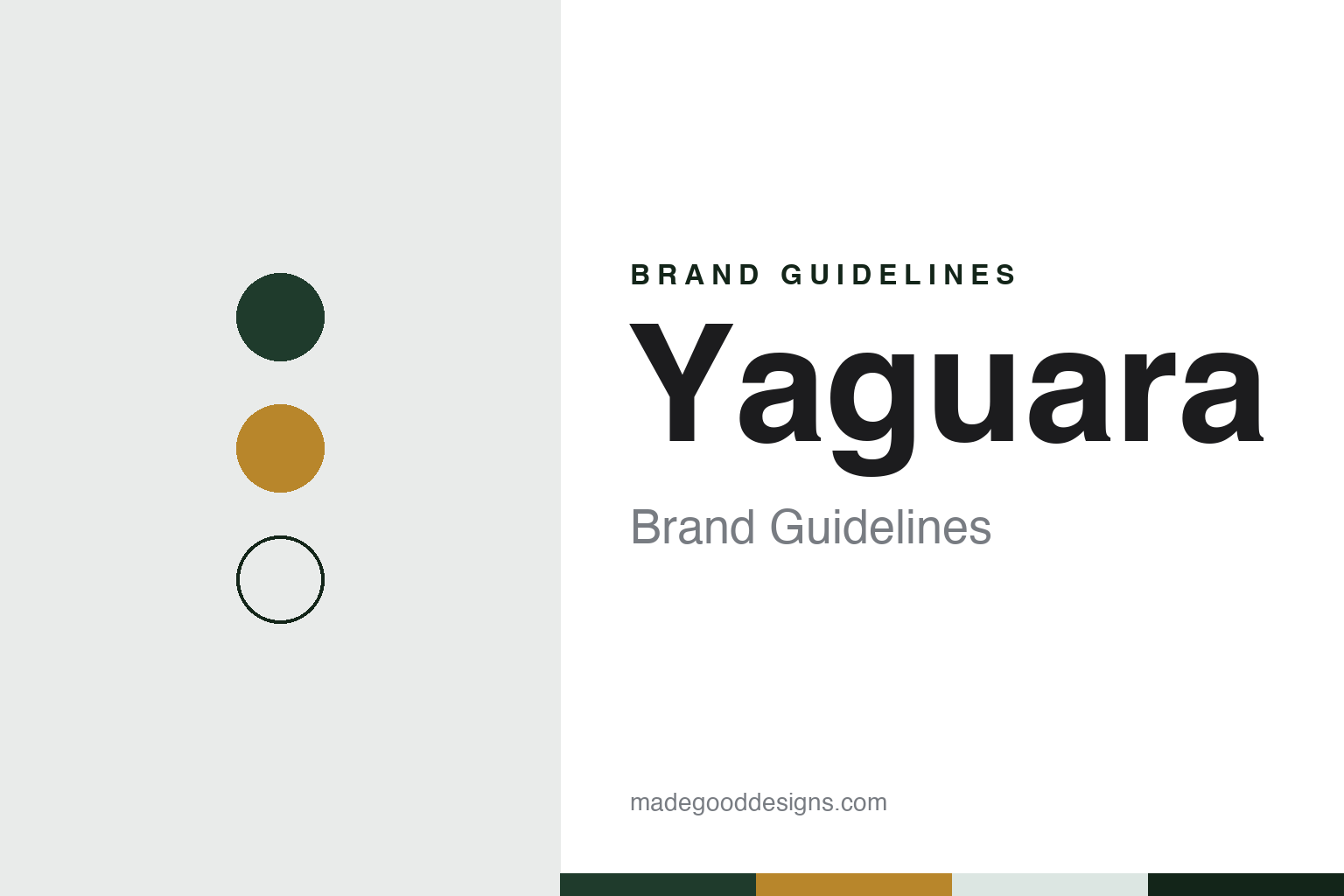
Yaguara Brand Guidelines
The 2013 cachaça in a bottle by glass artist Brian Clarke.
Aa
Two constants: a forest green, oak gold and glass mist palette and a geometric sans register. Abstract homage — not a Yaguara product or mark; no bottle, label or logo is reproduced.
Two brothers and a friend
A family tradition from Paraná, relaunched as a modern brand.
Yaguara is a young brand built on an older family story. The Brazilian business magazine IstoÉ Dinheiro reported on 8 November 2013 that three young entrepreneurs — the brothers Thyrso and Thiago Camargo, from São Paulo, and the Briton Hamilton Lowe — had joined private investors to launch the cachaça, which had been on sale in Brazil since the end of October 2013. The magazine said the founders planned to take it abroad early the following year.
The family story is the brothers’. IstoÉ Dinheiro said that with Yaguara they had turned into a business a family tradition begun by their grandfather, Serafim Meneghel, who made an artisanal cachaça in Cambará, in the state of Paraná, and it pictured him with the three founders. The brand’s own website has long described the drink as the product of “five generations of family passion,” and its English pages from 2022 refer to “the traditional Menaghel family recipe,” spelling the name differently from the magazine.
The cachaça itself is made far to the south. According to IstoÉ Dinheiro, Yaguara was produced in Ivoti, in Rio Grande do Sul, and aged in oak barrels. The magazine said the founders had recruited the Brazilian master blender Erwin Weimann to oversee the drink, and that Hamilton Lowe’s father, the British advertising executive Sir Frank Lowe, had joined Yaguara’s board.
From the start the founders aimed at bars rather than supermarket shelves. The same report named partner bars including PDT and the Dead Rabbit in New York, the Experimental Cocktail Club in London, Candela in Paris and Bar Tram in Tokyo, along with São Paulo restaurants such as D.O.M. and Dalva e Dito and the Copacabana Palace and Fasano hotels in Rio de Janeiro.
Colour
A bottle by a stained-glass artist.
Yaguara’s identity rests above all on its bottle. In December 2013 the glass-packaging maker Owens-Illinois (O-I) announced that it had developed the bottle in a design partnership between the British artist Brian Clarke, its Covet luxury-packaging team and Yaguara, as reported by Glass Online on 9 December and Packaging Insights on 17 December. The reports described the bottle as Clarke’s first commercial collaboration.
The reports quoted Clarke saying that “the bottle’s form is familiar, but its radical exterior hints at the elixir within,” and that the project had given him the chance to celebrate the artistry of glass with a global audience. The bottle was made at O-I’s plant in Soacha, Colombia, and had debuted in Brazil, where it appeared in holiday gift baskets at the São Paulo food store Empório Santa Maria. Thyrso Camargo, named as co-founder, said O-I had been “an integral partner in getting Cachaça Yaguara to market.”
The brand kept Clarke at the centre of its story. Its English-language website, as archived in 2016, gave a section to the bottle under the headings inspiration, development and craft, and quoted Clarke, as bottle designer, describing a product that combined the latest drinks technology with artisan perfectionism. The same site carried the line “A Brasilian Story” and quotes from bartenders, among them Jim Meehan of PDT.
The blender was the other face of the brand. The 2016 website quoted Erwin Weimann describing a product that “combines the latest in spirits technology, with the knowledge of 100 years of artisanal craftsmanship,” and said he had spent over 40 years refining the art of blending.
Typography
Cachaça and its makers.
The seven brands in this group are all cachaça names: Sagatiba, Avuá, Germana, Yaguara, Pitú, Velho Barreiro and Weber Haus. Cachaça, Brazil’s sugar-cane spirit, is made by producers of very different kinds, from family stills that still carry a founder’s or a family’s name to brands that have been launched, bought or sold by much larger drinks companies, and a single label can be sold everywhere from a corner bar to an export market.
A cachaça brand’s identity is usually carried less by the spirit in the glass than by a label, a name and the place it promises, because the company behind the name may have changed hands, changed its name or grown far beyond the town where it started. That makes the questions behind each name worth asking plainly: who started it, who owns it now, and where its cachaça is actually distilled, aged and bottled.
Each guide separates what independent sources record from what the company says about itself — its founding story, its owners over time, where its cachaça is made and how its labels have changed — and marks plainly what rests only on the company’s own word.
Aa
A clean geometric sans for a modern cachaça. (Specimen set in Jost, a sans STAND-IN; NOT the Yaguara logo.)
Yaguara
A blend of rested and oak-aged cachaça.
Yaguara presented itself as a blend. Its website, as archived in May 2022, said the cachaça was made from certified organic sugarcane of the Java variety, cut by hand, fermented with local yeast and distilled once in a 750-litre still, keeping only the heart of the run. The spirit was then rested for ten months in stainless steel and blended with cachaça aged five to six years in European oak, and filtered three times. The site described the result as “a ‘marriage’ of the finest white cachaça and the traditional Menaghel family recipe,” developed by Erwin Weimann.
The same pages set out what the company said about sustainability: that the distillery’s electricity was solar, that surplus bagasse fuelled the furnaces, that gravity rather than pumps moved the liquid, and that leftover heads and tails were redistilled as biofuel. The Portuguese pages added that the bottles contained 30% recycled glass. These are the company’s own claims. The 2022 site credited its build to Agência Mango and named the cocktails it recommended, from the Caipirinha and Rabo de Galo to a Batida.
The brand name is easily confused online. The Brazilian domain yaguara.com.br belongs to Yaguara Ecológico, an unrelated farm-food business in Pernambuco, and the cachaça has used cachacayaguara.com and cachacayaguara.com.br instead.
For a design guide, Yaguara shows a brand launched with its packaging as the headline: a bottle commissioned from a fine artist and announced by its glassmaker before most drinkers had tasted the spirit. Compare Weber Haus, a cachaça from Rio Grande do Sul, and Novo Fogo, an organic cachaça from Paraná. For this guide we use forest green, oak gold and a pale glass tone with a sans, an unofficial interpretation; no product or logo is reproduced.
Explore & save
Keep Yaguara’s identity on hand — save it to a board in the Made Good inspiration library.
Yaguara identity set
Pin the Yaguara forest green, oak gold and glass mist palette and the geometric sans register to your own board.


