3 Fonteinen Brand Guidelines
The Beersel geuze blendery the Debelder family turned into a lambic brewery.
Aa
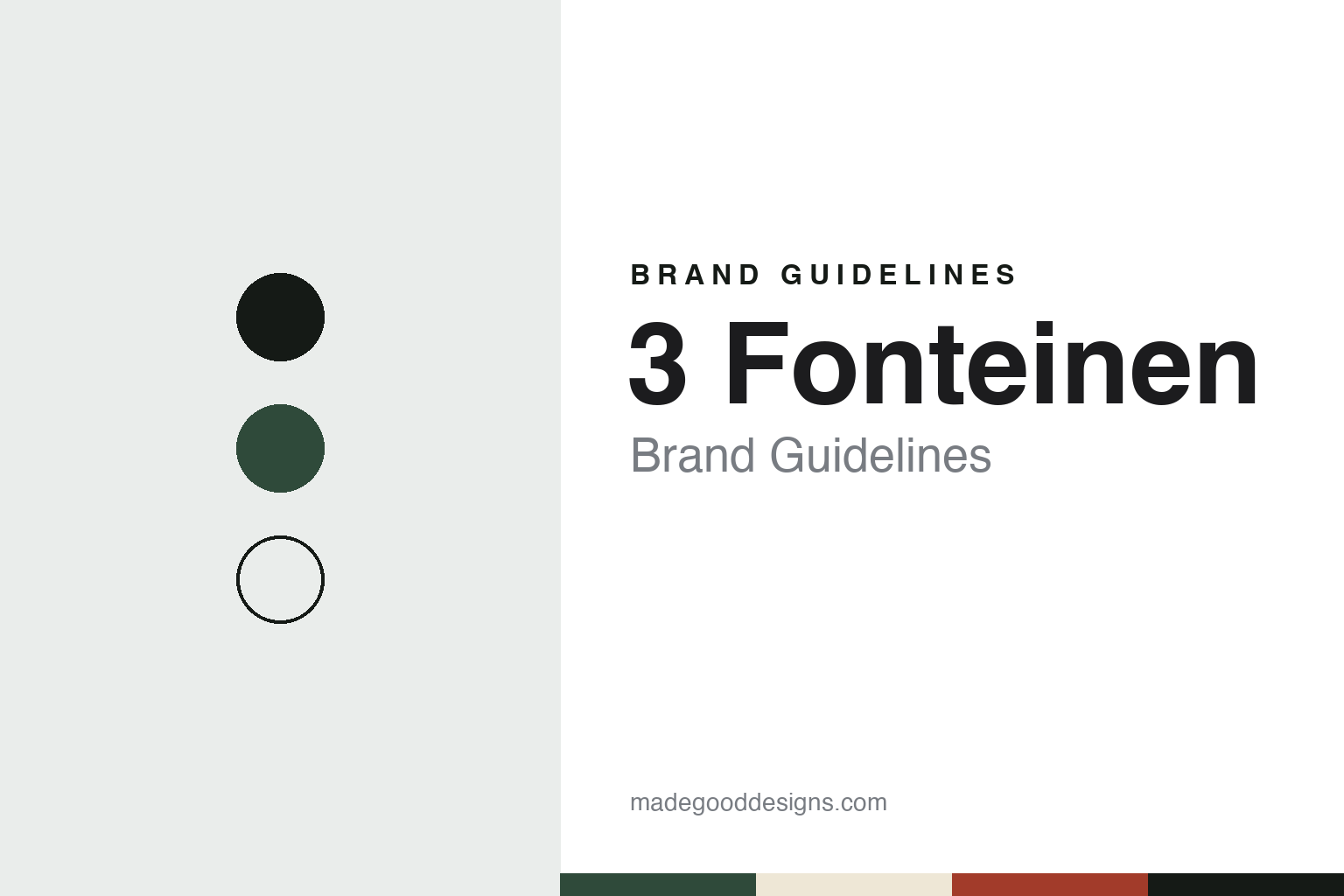
Two constants: a Beersel green, cherry and straw palette and an old-style serif register. Abstract homage — not a 3 Fonteinen product or mark; no bottle, label or logo is reproduced.
In de 3 Fonteinen
An inn, a blendery and a family from Elbeek.
3 Fonteinen grew out of an inn. The brewery says its foundation goes back to at least 1864, when Jacobus Vanderlinden and Joanna Brillens opened an inn in Beersel, the village south of Brussels in the Pajottenland lambic country, and that it has more than 135 years of history behind it. The brand writes its name with a numeral, 3 Fonteinen, the Dutch for “three fountains.”
The Debelder family arrived in 1953. According to the company, Gaston Debelder and Raymonde Dedoncker left their farm in Elbeek that year and took over the inn and its geuze blending house in Beersel, keeping the existing name, “In de 3 Fonteinen.” Good Beer Hunting, writing in March 2022, gave the same date for the family’s move to Beersel and its start in lambic blending. The company calls what they took on a geuze blending house; the family did not brew its own lambic there until 1998.
The next generation came through the kitchen. The company says Armand Debelder, Gaston and Raymonde’s first-born son, became the inn’s chef in 1974, at the age of 24, and added regional dishes made with lambic, faro and geuze to the menu. In 1982 Gaston and Raymonde handed the business to their two sons, with Armand taking charge of the kitchen and the geuze blendery. Good Beer Hunting says he took over much of the blending work through the 1980s and early 1990s.
Colour
From blender to brewer, and a bad night in 2009.
Armand Debelder also helped organise the trade. Good Beer Hunting reported that when the Hoge Raad voor Ambachtelijke Lambiekbieren, or HORAL, was founded in 1997 as a body for traditional lambic producers, he became its first chairperson. A year later, in 1998, the company says, Armand began brewing lambic himself despite his father’s doubts, turning a blendery into a brewery. Good Beer Hunting reported that he bought another brewing kit in 2012, adding to the brewing capacity he had started with in 1998.
A setback came on 16 May 2009. The company says a malfunctioning thermostat raised the temperature in its storage room from the usual 18°C to about 60°C, and that roughly 13,000 bottles exploded under the pressure. Good Beer Hunting gave the same figure and said a further 67,000 bottles were spoiled; the remaining beer, it reported, was distilled into a spirit sold as Armand’Spirit. The company’s own account says that more than once in its history the future of the brewery was at stake.
The brewery then changed hands and sites. Good Beer Hunting reported that a transitional succession began in 2014, with Michaël Blancquaert and Werner Van Obberghen taking over the running of 3 Fonteinen, that operations moved to a new facility in Lot, within the municipality of Beersel, in 2015, and that the site opened to the public in 2016 as the Lambik-O-Droom, a name built on the Dutch word droom, “dream.” The company describes the building as a warehouse of about 6,000 square metres that gave it room to work more slowly. In 2018, Good Beer Hunting reported, Armand Debelder and 3 Fonteinen parted ways with HORAL over disagreements about how the heritage should be protected; the publication added that HORAL had eleven members in 2022.
Typography
Design and documentation.
The seven brands in this group are all Trappist, lambic and craft brewers: Rochefort, Westvleteren, La Trappe, Cantillon, Boon, 3 Fonteinen and Russian River Brewing Company. Beer brands in general sit at many different points in the trade, from breweries run inside monastic communities to family businesses that still carry a founder’s name and companies that now belong to much larger drinks groups, and a single beer can be poured everywhere from a village café to a city bar.
A beer brand’s identity is usually carried less by a single bottle than by a label, a name and the place it promises, because the company behind the name may have changed hands, moved its brewing or grown far beyond the place where it started. That makes the questions behind each name worth asking plainly: who started it, who owns it now, and where its beer is actually brewed and bottled.
Each guide separates what independent sources record from what the brewery says about itself — its founding story, its owners over time, where its beer is made and how its labels have changed — and marks plainly what rests only on the brewery’s own word.
Aa
An old-style serif — a stand-in for an inn-and-blendery register. (Specimen set in Fraunces, a serif STAND-IN; NOT the 3 Fonteinen logo.)
3 Fonteinen
The sons he never had.
The succession is part of the brand’s story. Good Beer Hunting reported that Armand Debelder often described Michaël Blancquaert and Werner Van Obberghen as “the sons I never had,” and that he died in March 2022. The company’s own history names Armand, Mich and Werner as the people running the brewery after the move, and in 2026 its calendar lists a “Tribute to Armand” event at the Lambik-O-Droom.
The products stay inside the lambic family. The company describes lambic as its base beer, which it also uses for its geuze and its fruit beers. It describes its geuze as a blend of lambics at least one, two and three years old, sold only in bottles and never in keykegs or stainless-steel kegs, and its kriek as made with sour cherries, with their stones but without stalks, macerated in lambic for months. It also makes other fruit lambics, which it says use pure fruit, sourced locally where possible. Farming has become part of the identity too: the company says it has joined some ten farmers to revive old Brabant cereal varieties that were largely lost after the Second World War. The company gives its home as Lot, in the municipality of Beersel.
For a design guide, 3 Fonteinen shows how a brand can be carried by a place name, a family and a history told openly, rather than by a mascot or a slogan. Compare Boon, the Lembeek blender that also became a brewery, and Cantillon, the Brussels lambic brewery. For this guide we use Beersel green, cherry red and straw with a serif, an unofficial interpretation; no product or logo is reproduced.
Explore & save
Keep 3 Fonteinen’s identity on hand — save it to a board in the Made Good inspiration library.
3 Fonteinen identity set
Pin the 3 Fonteinen Beersel green, cherry and straw palette and the old-style serif register to your own board.