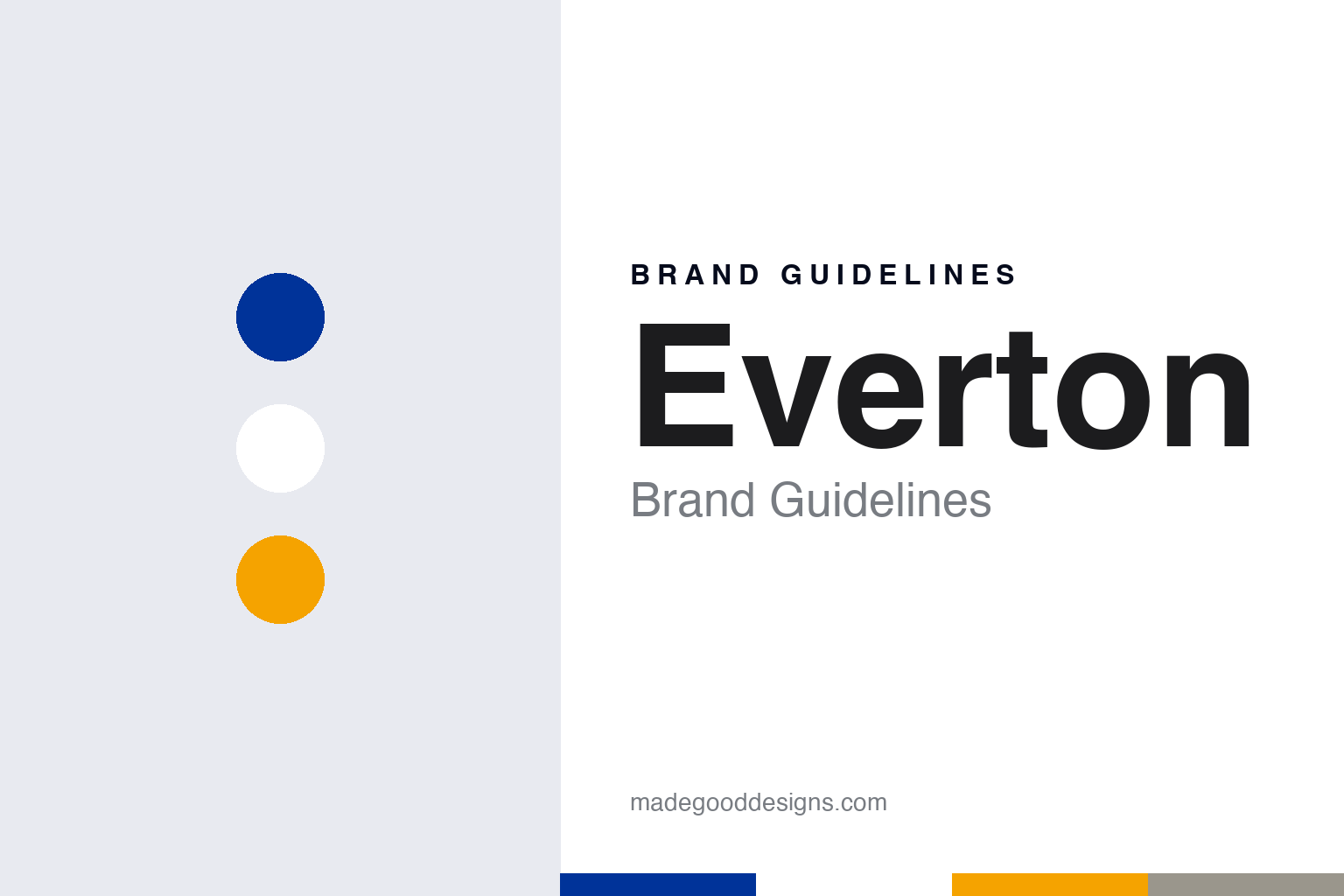
Everton Brand Guidelines
A chapel team that named itself after its district and put a village lock-up on its tie.
Aa
Two constants: a royal blue, white and amber palette and a condensed sans register. Abstract homage — not an Everton crest, kit or mark; no logo is reproduced.
St. Domingo’s
A Methodist chapel, a district name, and a long search for a colour.
Everton started as a way to keep a congregation playing sport through the winter. English Wikipedia says the club was founded as St. Domingo’s FC in 1878 so that members of the St Domingo Methodist New Connexion Chapel in Breckfield Road North, Everton, could play all year round, with cricket in the summer. The side’s first game was against Everton Church Club.
The name widened the club’s reach. Wikipedia says the club was renamed Everton in November 1879, after the local area, because people outside the congregation wanted to take part. Early meetings were held at the Queen’s Head hotel in the village.
The colours took decades to settle. Wikipedia says the team first played in white, then in blue and white stripes, but new players kept turning up in their old clubs’ shirts, so the shirts were dyed black to save money and look more professional. The result looked morbid, and a scarlet sash was added; the black kit earned the nickname “the Black Watch.” When the club moved to Goodison Park in 1892 it wore salmon pink and dark blue stripes, and later ruby shirts with blue trim.
Royal blue shirts with white shorts were first used in 1901–02, Wikipedia says. A switch to sky blue in 1906 drew protests from supporters and was reversed, and the club has occasionally worn lighter shades since. The home kit today is royal blue shirts with white shorts and socks. The traditional away colours were white shirts and black shorts, but from 1968 amber shirts with royal blue shorts became common, with black, white, grey and yellow alternatives in later years.
The nickname came from a sweet shop. Wikipedia says the commonly cited explanation for “the Toffees” is Mother Noblett’s, a toffee shop in Everton village that sold Everton Mints and stood opposite the lock-up later used on the crest. Another story points to Ma Bushell’s toffee house near the Queen’s Head. The Toffee Lady tradition, in which a girl walks the edge of the pitch before kick-off throwing Everton Mints into the crowd, keeps the link alive. David Moyes called Everton “the People’s Club” on arriving as manager in 2002, and the phrase has become a semi-official nickname.
The music is part of the brand as well. Since 1962, Wikipedia says, players have walked out to “Johnny Todd” in the arrangement used as the theme of the television series Z-Cars, a traditional Liverpool children’s song about a sailor betrayed while away at sea.
Colour
A tie for the secretary, a village lock-up, and a fans’ vote.
The crest began as a piece of neckwear. English Wikipedia says that at the end of the 1937–38 season the club secretary Theo Kelly, who later became the club’s manager, wanted to design a club necktie in blue, and was asked to design a crest to go on it. He worked on it for four months before settling on a reproduction of the Everton Lock-Up, a small round building that has stood on Everton Brow since 1787 and was originally used to hold drunks and minor offenders overnight.
Kelly framed the tower with two laurel wreaths, which, according to the College of Arms as cited by Wikipedia, he chose as a sign of winners. Beneath it ran the club motto, “Nil satis nisi optimum.” Kelly and the chairman, E. Green, first wore the ties on the opening day of the 1938–39 season.
The shirt took much longer to carry it. Wikipedia says an interwoven “EFC” appeared on the shirts between 1922 and 1930, after which they were plain royal blue until bold “EFC” lettering was added in 1972. Kelly’s crest went onto the shirts in 1978 and has stayed there, gradually redrawn over the years.
A 2013 redesign was reversed within a season. Wikipedia says the club launched a new crest in May 2013 to make the badge easier to reproduce at small sizes in print and on screen, with fewer colours and the radial effect removed. Supporters objected, a petition gathered more than 22,000 signatures, and the club apologised and promised a new crest with fan consultation. The Independent reported on 4 October 2013 that Everton had revealed the winner of a supporter vote between three designs, and that the motto, removed in the 2013 redesign, would return. The manager, Roberto Martínez, told reporters that fans had made it clear they wanted to see the tower and the motto.
The fans’ choice went into use the following summer. The Guardian reported on 4 July 2014 that Everton had begun using the new crest around Goodison Park, quoting a club statement that it brought together the key icons of the club’s tradition, the tower, the motto and the shield, in royal blue and white.
Typography
Clubs, crests and colours.
English club crests draw on a small set of visual sources. Some borrow directly from heraldry, with rampant lions, shields, mottoes and stars arranged in the manner of a coat of arms. Others take an animal associated with a club’s nickname, such as a fox, a bird or a hammer-bearing figure, and render it as a simple silhouette. Many lean on the arms of the town or city the club represents, adapting towers, ships, rivers or civic symbols into a badge that can sit on a shirt, a programme cover or a stadium wall.
Crests change over time. Clubs redraw them to work at small sizes, on screens and on merchandise, to simplify fine detail, or to register a mark as a trademark. A redesign can be contentious, because supporters often treat the badge as part of their own identity, and several clubs now run fan consultations, surveys or supporter panels before a new crest is adopted. Some redesigns have been revised or withdrawn after supporters objected.
Shirt sponsorship sits alongside the crest on the kit. Sponsor names, kit-maker logos and sleeve partners appear on the front of the shirt, and they change far more often than the badge itself, which is one reason the crest and club colours carry so much of a club’s visual continuity.
Aa
A condensed sport sans — the register of a shirt number and a stand sign. (Specimen set in Oswald, a sans-serif STAND-IN; NOT the Everton logo.)
Everton
Anfield, Goodison, Bramley-Moore Dock, and owners from Texas.
Everton’s grounds tell a story of their own. English Wikipedia says the club first played in Stanley Park, then at Priory Road, and became tenants at Anfield in 1884. After a dispute over rent with John Houlding, who had bought the land, Everton left in 1892 for a new ground, Goodison Park. Houlding tried to keep the Everton name and colours but was refused by the Football Association, and formed a new club instead: Liverpool.
Goodison was the men’s team’s home until the end of the 2024–25 season, Wikipedia says, and is now the home of Everton Women. The new ground was built at Bramley-Moore Dock on the Liverpool waterfront. Wikipedia says planning permission was granted in July 2021, construction began that August with Laing O’Rourke as the contractor, and the dock was filled with sea-dredged sand. On 16 May 2025 the law firm Hill Dickinson was announced as the stadium’s title sponsor, and it became the Hill Dickinson Stadium.
The first Premier League match there was played on 24 August 2025. fcbusiness reported on 27 August 2025 that Everton beat Brighton & Hove Albion, that the stadium architect Dan Meis appeared on the giant screens before kick-off, that the teams came out to the Z-Cars theme, and that the stadium had been built on land reclaimed from the River Mersey.
Ownership changed twice in a decade. Wikipedia says the investor Farhad Moshiri agreed to buy a stake in February 2016 and later became majority owner. The Independent reported on 19 December 2024 that The Friedkin Group, which also owns AS Roma, had completed its takeover by buying Moshiri’s shareholding through Roundhouse Capital Holdings, after approval from the Premier League, the Football Association, the Women’s Professional Football Leagues and the Financial Conduct Authority. Dan Friedkin was set to become chairman, with Marc Watts as executive chairman.
The shirt has had many makers and names. Wikipedia lists Umbro across four spells, Le Coq Sportif, Puma from 2000 to 2004, Nike from 2012 to 2014, Hummel from 2020 to 2024 and Castore from 2024. Chang beer sponsored the shirt from 2004 to 2017, and CMC Markets became the main sponsor from 2026–27. The club plays in the Premier League.
For a design guide, Everton shows how a badge drawn for a secretary’s tie can become a club’s mark, and how supporters can bring a tower and a motto back after a simplified redesign. Compare Liverpool FC, the club formed at Everton’s old ground, and Chelsea FC, which also returned to an older crest. For this guide we use royal blue, white and away amber with a condensed sans, an unofficial interpretation; no product or logo is reproduced.
Explore & save
Keep Everton’s identity on hand — save it to a board in the Made Good inspiration library.
Everton identity set
Pin the Everton royal blue, white and amber palette and the condensed sans register to your own board.